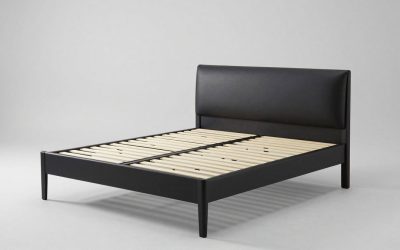
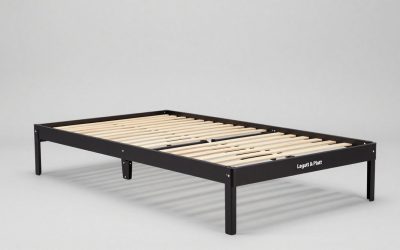
Queen bed side rails with hooks attach without bolts by dropping two flat metal hooks on each end of the rail into slotted plates on the headboard and footboard, with gravity and the mattress weight locking the joint in place.
If your rails are bent, cracked, or missing, you can buy replacements as long as you match the rail length, hook size, and hook spacing to your existing headboard and footboard brackets. Most queen hook rails fail because one of those three measurements is off by even 1/4 inch.
Our top picks


As an Amazon Associate we earn from qualifying purchases at no extra cost to you.
How Hook-On Side Rails Actually Work
A queen bed using a hook-on system has four components: the headboard, the footboard, and two side rails. Each end of a side rail has a bracket with two downward-facing hooks, one above the other. The headboard and footboard each have a matching bracket plate with two rectangular slots.
To assemble, you hold the rail at a slight angle, insert the top and bottom hooks into the slots, then push down firmly until the hooks seat. The lower hook bears most of the vertical load, while the upper hook prevents the rail from pulling outward. There are no bolts, wing nuts, or tools required for the connection itself, though many rails include a center support leg or cross-slats that do require screws.
This system is common on traditional wooden queen beds, poster beds, and many upholstered queen beds with a separate wood frame underneath. It is not the same as bolt-on rails, which use threaded bolts through the leg, or bracket rails that use a flat plate with a pin and notch. Hook rails rely on a friction and gravity fit, which is why correct hook thickness and slot width matter so much.
When properly seated, a quality pair of queen bed side rails with hooks will support 500 to 700 pounds of total distributed weight including mattress, occupants, and bedding. The weak points are rarely the steel hooks themselves, but the wood screws holding the plates to the headboard legs and the center support beam.
Standard Sizes for Queen Bed Side Rails With Hooks
Queen beds are nominally 60 inches wide x 80 inches long for the mattress, but side rails are always longer than the mattress to span the distance between the inside faces of the headboard and footboard legs.
Most replacement rails are sold by overall length including the hooks, and by hook dimensions. Use this reference before you order:
| Measurement | Standard for Queen Hook Rails | Tolerance / What to Check |
|---|---|---|
| Overall Rail Length (hook tip to hook tip) | 80 inches (most common), 79.5 to 82 inches | Measure old rail tip-to-tip. A rail even 1 inch too short will not seat both ends. |
| Wood / Steel Rail Body Length (without hooks) | 76 to 77.5 inches | This is the body only. Mattress sits inside this length with 1-2 inches of play at head/foot. |
| Height of Rail Body | 5 to 7.5 inches for wood, 3.5 to 5 inches for steel angle rails | Taller wood rails support box spring ledges better. |
| Hook Plate Height | 4 to 5 inches tall | Distance from top of upper hook to bottom of lower hook. |
| Hook Spacing (center-to-center) | 3.0 to 3.5 inches | Must match your headboard plate exactly. 3-1/4 inches is the most common. |
| Hook Thickness | 0.12 to 0.18 inches (approx 11 to 7 gauge steel) | If hooks are too thick, they will not enter the slot. Too thin causes wobble and squeaking. |
| Hook Depth (how far hook protrudes from rail) | 0.75 to 1.0 inch | Determines how deep the hook seats. Short hooks can pop out under lateral pressure. |
| Bracket Plate Slot Size | Approx 1.0 inch wide x 0.20 inch deep | Check your existing plates for bent or widened slots from years of weight. |
For a queen bed, the critical number is tip-to-tip length. Many sellers list rails as 60×80 queen, but that refers to the mattress size they fit, not the rail length. Always confirm the actual rail length is 80 inches unless you have measured a shorter or longer distance between your headboard and footboard plates.
If your bed uses a hook-on headboard only and a low footboard or no footboard, you need a hook-to-hook board conversion or a freestanding hook rail set with a separate foot bracket, which is less common.
How to Measure for Replacement Rails Correctly
You need a tape measure, a straight edge, and your old rail if you still have it. Measure with the mattress and bedding removed.
Step 1: Measure the Span Between Plates
Measure from the inside face of the headboard plate to the inside face of the footboard plate at the height where the hooks will sit. Take this measurement on both sides of the bed at the top slot and bottom slot. They should be identical. If your bed is slightly racked, use the longer of the two measurements. This span is the minimum tip-to-tip length your new rails must cover.
Step 2: Measure Your Old Rail (If Available)
Lay the rail flat and measure tip-to-tip from the outer edge of the hook on one end to the outer edge of the hook on the other end. Then measure the body alone. Compare these numbers to the span from Step 1. A correctly sized rail will be 0 to 1/4 inch longer than the plate-to-plate span so the hooks drop in without forcing the headboard and footboard apart.
Step 3: Measure Hook Spacing and Thickness
On the old rail, measure from the center of the upper hook to the center of the lower hook. Write down the exact number to the nearest 1/16 inch. Measure hook thickness with calipers if possible, or compare against the slot width on the headboard. Also measure the width of the hook plate where it attaches to the rail, typically 1-1/4 to 1-1/2 inches wide.
On the headboard and footboard, measure the distance between the centers of the two slots on one plate, and the slot width. The slot spacing must equal your rail hook spacing. If the slots are wallowed out or bent outward, the plate should be replaced as well. Replacement plates usually cost $8 to $15 for a set of four and are sold as hook-on bed rail plates or bed hook plates.
Step 4: Confirm Height and Support Needs
Measure from the floor to the center of the lower slot on the headboard. Standard hook height is 9 to 12 inches from the floor for a bed that uses a box spring, and 7 to 9 inches for a platform-style hook rail that supports slats directly. If your new rails sit too high or too low, your box spring or slats will not sit level.
Check whether your old rails had: a) a ledger or lip for a box spring to sit on, b) a series of slat support brackets, or c) a plain angle with a center support leg. For a queen, you need center support to prevent sagging. Any queen rail over 75 inches without a center support leg or center support beam system will sag in the middle within months, especially with a heavy hybrid or memory foam mattress over 90 pounds.
Common Compatibility Problems and How to Avoid Them
Most returns happen for three reasons. First, the buyer orders bolt-on rails for a hook-on bed. Bolt-on rails have flat plates with holes and need bolts through the leg, they will not hook in. Second, the hook spacing is off. A 3-inch hook will not properly seat in a plate drilled for 3-1/2 inch spacing, even if the rail length is correct. The rail will perch on one hook and creak or collapse.
Third, the rail length is listed for mattress size and not actual length. A rail listed as 82 inches tip-to-tip will push a bed that needs 80 inches out of square, leaving a gap at the headboard and stressing the plate screws. Always ask for tip-to-tip and body-only dimensions if the listing does not show them.
Also check clearance and fit in the room. A queen bed with hook rails typically occupies about 65 to 67 inches wide x 86 to 90 inches long including headboard and footboard thickness. In a 10×12 ft bedroom, that leaves roughly 30 to 36 inches of clearance on the sides for nightstands and 20 to 24 inches at the foot for a dresser or foot traffic. If your room is tight, steel angle hook rails save 1 to 2 inches of width versus thick solid wood rails.
Inspect the existing plates before reusing them. If the screws are loose, fill the holes with hardwood dowels and wood glue, then re-drill. If the plate itself is bent, replace it. A new rail in a damaged plate will still fail.
Material and Construction Trade-Offs
Replacement queen bed side rails with hooks are sold in three main types. The right choice depends on weight, noise, and whether you use a box spring or platform slats.
| Type | Typical Cost Range | Weight per Pair | Durability and Wear Points | Best For |
|---|---|---|---|---|
| Solid Wood (poplar, pine, rubberwood) | usually $70–$150 | 22–32 lbs | Quiet, strong ledger for box spring. Can crack at hook mortise if screws are over-tightened. Sensitive to humidity changes. | Traditional beds reusing a box spring; wants original look. |
| Engineered Wood / MDF with Veneer | usually $50–$110 | 25–35 lbs | Heavier than solid wood, edges chip. Hook plates can pull out of particle core under heavy load. Lowest long-term strength. | Budget replacement for light use, guest room, lower weight loads under 400 lbs total. |
| Steel Angle or Tubular Steel with Welded Hooks | usually $40–$100 | 14–20 lbs | Strongest and most dimensionally stable. Noisier without felt pads. Excellent for heavy mattresses 100+ lbs. May require separate slat system. | Heavy occupants, heavy memory foam/hybrid mattresses, rentals where durability matters. |
Solid wood rails usually arrive in two pieces per side at 40 inches each with a center joint only if they are knock-down, but one-piece 80-inch rails are common. One-piece steel rails are shipped in a long carton, typically 82 x 6 x 4 inches, weighing 15 to 20 pounds. Check that your doorway and hallway can handle an 82-inch carton, especially in apartments with 28 to 30 inch doorways and tight turns. Wood rails are bulkier and harder to maneuver up stairs than steel.
For support, queen hook rails should be paired with either: 1 to 2 center support legs that touch the floor with adjustable levelers, or 12 to 14 wood slats spaced 2.5 to 3 inches apart, plus a center support beam running head-to-foot. Slat systems without a center beam will flex and squeak on a queen.
Choosing the Right Replacement for Your Situation
Use your actual setup to narrow the choice:
- You have the original plates and an 80-inch span, need a direct swap: Match tip-to-tip length, 3-1/4 inch hook spacing, and ledger type exactly. Solid wood with ledger if you use a box spring, steel angle with slat brackets if you have a platform setup.
- Heavy mattress or combined weight over 550 pounds: Choose steel angle hook rails with at least one center leg per side or a center beam system. Avoid MDF/engineered wood rails, which tend to strip at the hook plate screws under sustained load.
- Rental or frequent moving: Steel hook rails pack flatter, weigh less, and tolerate being assembled and disassembled repeatedly. Keep felt pads on the hooks to reduce wear on plates.
- Old antique bed with non-standard plates: Order a rail and plate set together and replace both. Antique plates often have 3-inch or 3-1/2 inch spacing that no longer matches modern replacement rails. Replacing the plates solves the mismatch and gives you fresh screw bite in the legs.
- Noise or squeaking is the main issue: Squeaks come from thin hooks in oversized slots. Choose rails with thicker 0.15 inch or greater hooks, add adhesive felt inside the slot, and ensure the center support leg has a leveler firmly on the floor so the rail is not flexing.
Assembly and Long-Term Durability
Assembly of hook rails takes one person about 10 to 15 minutes if the plates are sound. Seat both rails before adding slats or the box spring. Tap the top of the rail gently with a rubber mallet to fully seat the hooks, then check that the rail is vertical and not leaning outward. The box spring or slats then lock the rails from bowing inward.
What wears first is predictable: the screws holding the plate to the headboard leg loosen, the slot edges peen over from metal-on-metal movement, and the center support leg leveler punches through carpet pad and loses height. Check plate screws every 6 to 12 months and tighten. If a leg has no leveler, add an adjustable foot. Felt or UHMW tape on the contact points between hook and slot noticeably reduces metal squeal.
Avoid lifting the bed by the side rails when moving. Hook joints are designed for vertical load, not for carrying the bed sideways. Always lift from the headboard and footboard legs to prevent the hooks from bending outward, which is the most common cause of a rail that suddenly will not stay seated.
FAQ
Can I replace just one queen side rail?
Yes, but replace in pairs if the rails are more than 3 to 5 years old. A new rail paired with an old fatigued rail often sits at a slightly different height and causes the box spring to rock. If you must replace one, measure the good rail carefully and match hook spacing and body height exactly.
Are queen hook rails interchangeable between brands?
Sometimes. There is no universal queen hook standard, but most modern queen beds from the last 20 years use 80-inch tip-to-tip rails with 3-1/4 inch hook spacing and plates that accept 0.12 to 0.15 inch thick hooks. Older or custom beds vary, so measure rather than assuming interchangeability.
Do I need tools to install hook rails?
No tools are needed to hook the rails themselves. You need a drill or screwdriver only if you are replacing the headboard plates or adding slats and center support hardware. Keep a rubber mallet and a level handy to confirm the rails are fully seated and even.
Why do my new hook rails pop out?
Usually the hooks are too short or too thin for the plate slots, the rail is too short for the span, or the headboard and footboard are splayed outward by an uneven floor. Verify tip-to-tip length and hook spacing first, then check that plates are not bent and that the floor is level under the center support legs.