Key takeaways
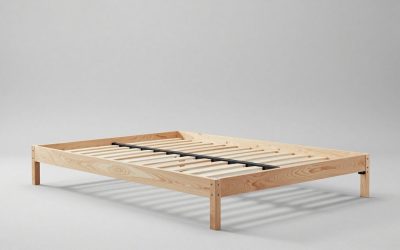
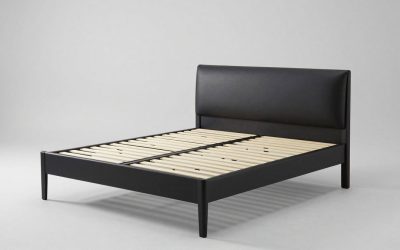
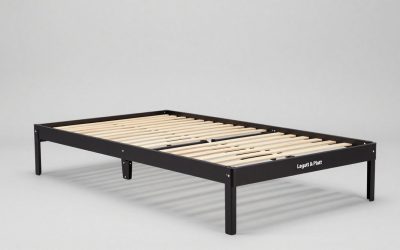
- Slatted platforms – wood or metal slats spanning the frame rails, sometimes with a center support beam and legs underneath the midpoint of the 60×80 span.
- Solid platform panels – plywood or particleboard sheets, sometimes with cutouts, giving continuous support with no gaps at all.
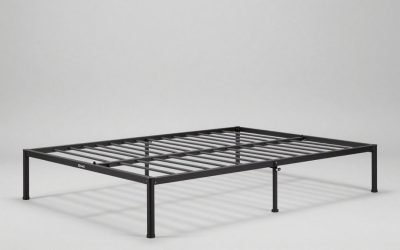
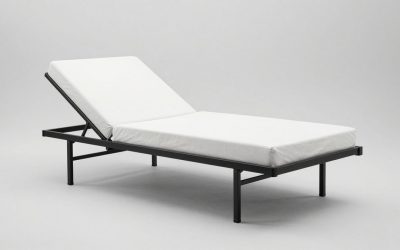
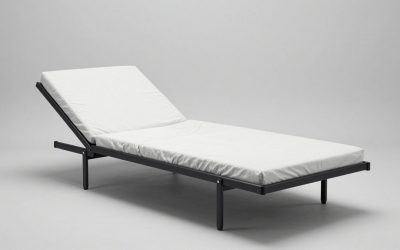
- Metal grid or wire-frame decks – crosshatched steel bases, common on adjustable and storage bed frames, that mimic a slat pattern but with narrower, evenly spaced bars.
A queen bed frame without a box spring works when it replaces the box spring’s job with something else: slats spaced close enough to support the mattress, a solid platform panel, or a metal grid rated for the mattress type you own. The box spring itself was never structural for the room, it was a spacer that raised the mattress and gave old-style innerspring mattresses a springy base to absorb impact. Modern platform frames do that job with wood or metal instead, and for most queen mattresses sold in 2026, that swap works fine.
Our top picks


As an Amazon Associate we earn from qualifying purchases at no extra cost to you.
What Actually Replaces the Box Spring
Three systems cover almost every queen bed frame without box spring on the market:
- Slatted platforms – wood or metal slats spanning the frame rails, sometimes with a center support beam and legs underneath the midpoint of the 60×80 span.
- Solid platform panels – plywood or particleboard sheets, sometimes with cutouts, giving continuous support with no gaps at all.
- Metal grid or wire-frame decks – crosshatched steel bases, common on adjustable and storage bed frames, that mimic a slat pattern but with narrower, evenly spaced bars.
Any of these eliminates the box spring, but they are not interchangeable in terms of what mattress they support well. That’s where slat spacing and mattress construction start to matter.
Slat Spacing: The Number That Actually Matters
Manufacturers rarely explain why spacing thresholds exist, but the physics is simple: foam and latex mattresses have no internal support structure, so if the gap between slats is too wide, the foam sags into the gap over months and creates permanent body-shaped depressions. Innerspring and hybrid mattresses have steel coils that bridge gaps better, so they tolerate wider spacing.
| Mattress Type | Max Slat Gap | Minimum Slat Width | Notes |
|---|---|---|---|
| All-foam or memory foam | 2.75 in (about 7 cm) | 2.5 in | Tighter spacing prevents sagging; check warranty fine print |
| Latex | 3 in | 2.5 in | Latex resists sag better than memory foam but still needs support |
| Hybrid (foam + coils) | 3 in | 2 in | Coil layer distributes weight across gaps |
| Innerspring | 3.5-4 in | 2 in | Most tolerant of wider spacing due to coil rigidity |
If you don’t know your slat gap, measure it. Most flat-pack queen frames ship with slats 2.5 to 3 inches apart, which covers hybrids and innersprings comfortably but sits at the edge of what’s safe for a soft all-foam mattress. When in doubt, add a thin bunkie board or plywood sheet on top of the slats. It costs far less than a mattress replacement and solves the gap problem outright.
Center Support: Non-Negotiable at Queen Size
A queen frame spans 60 by 80 inches, wide enough that side rails alone will bow under body weight concentrated near the middle. Almost every reputable queen bed frame without box spring required includes a center support beam running head-to-foot, usually with one or two legs touching the floor at the midpoint. Frames that skip this and rely only on the perimeter rails are a warranty red flag, not a minor omission.
Twin bed frame without box spring designs get away without center legs because the shorter 38-inch width doesn’t create the same sag risk. King frames (76×80) need center support even more than queens, often with two center legs instead of one, since the extra 16 inches of width adds real flex across the span.
If you’re shopping and the listing doesn’t mention a center rail, check the assembly diagram or ask before buying. A missing center support under a queen platform is the single most common cause of a frame failing early, not the wood quality.
Weight Limits and Warranty Language to Actually Check
Weight limits are usually listed two ways: static (total weight, mattress plus sleepers plus bedding) and dynamic (sudden or shifting weight, like jumping or two people getting in at once). A frame rated for 700 lbs static might only handle half that dynamically. For a queen shared by two average adults plus a mattress (roughly 120-150 lbs for a queen mattress), look for at least 600 lbs static capacity as a comfortable margin, more if pets or kids regularly jump on the bed.
On warranties, three phrases are worth hunting for in the fine print:
- “Box spring required” or “foundation required” – this voids sagging or breakage claims if you used a platform or slats instead. Some queen bed frame box spring required mattress warranties, especially on traditional innerspring models, still carry this clause even though the mattress ships fine on slats.
- “Slatted foundation acceptable, gaps not to exceed X inches” – this is the language you want; it explicitly permits your setup.
- “Center support required for queen and larger” – if a mattress brand states this and your frame lacks it, sagging is your responsibility, not theirs.
Read the mattress warranty separately from the frame warranty. Mattress brands care about foundation type because it affects sag claims; frame brands care about weight limits and structural failure. The two documents rarely overlap, so check both if you’re combining a mattress and frame from different companies.
How Bed Height Changes Without a Box Spring
This is the change people notice most and plan for least. A standard box spring adds 9 inches of height on its own. Remove it and put the mattress straight onto a platform, and total bed height drops substantially, which affects everything from nightstand proportions to how the bed looks under a headboard.
| Setup | Approx. Total Height (floor to mattress top) |
|---|---|
| Frame + box spring + mattress | 25-30 in |
| Low platform frame + mattress only | 14-18 in |
| Platform frame with storage drawers + mattress | 18-22 in |
| Frame with adjustable-height legs + mattress | 16-24 in (varies by setting) |
A queen platform bed frame without headboard sits lower and simpler, often preferred in small rooms since it reads visually lighter against the wall. If you’re buying a queen bed frame for box spring and mattress with headboard, double-check the headboard’s mounting height. Headboards designed for the taller box-spring-plus-mattress stack sometimes sit awkwardly low, or the headboard bracket clears the mattress top by too little, once you drop to a platform-only height.
Material Trade-offs Worth Knowing
| Frame Material | Typical Price Range | Strength / Sag Resistance | Trade-off |
|---|---|---|---|
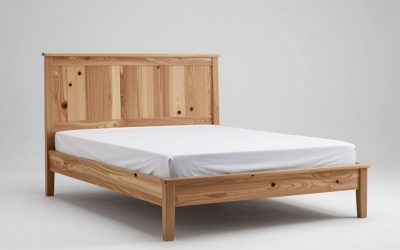
| Solid wood (queen wood bed frame without headboard or with) | usually $300-$800 | High, especially with a center beam | Heavier to move, can creak over years at joints |
| Engineered wood / particleboard | usually $120-$300 | Moderate, depends on slat count | Lighter and cheaper but more prone to sagging under heavy dynamic use |
| Metal (tube steel with slat or grid deck) | usually $100-$350 | High for static weight, can flex under dynamic load if legs are thin | Lightest to move, sometimes noisier (metal-on-metal creak) |
Matching Frame to Situation
- Renters or frequent movers: metal frame with a slat or grid deck. Lightest to disassemble, fits through most doorways in pieces, no box spring to haul separately.
- Back pain or firmer support preference: solid platform panel or tightly spaced slats (2.5 in or less) under a medium-firm hybrid or innerspring mattress, with center support mandatory.
- Small apartment, want visual lightness: low platform frame, no headboard, 14-18 inch total height, pairs well with slimmer nightstands.
- Kids or pets that jump on the bed: prioritize dynamic weight rating and a solid center beam over slats; solid wood or reinforced metal outperforms particleboard here long-term.
- Want the taller, traditional look without a box spring: frames with adjustable-height legs or storage platforms recover some of the height a box spring used to add.
Assembly and Moving Realities
Flat-pack queen platform frames typically ship in one long box weighing 60-90 lbs, awkward for one person but manageable. Solid wood frames with a separate headboard panel often split into two boxes, one of which may exceed 90 lbs and need two people to carry through a standard 30-32 inch doorway. Metal frames pack lighter and flatter, usually 40-60 lbs total, and are the easiest single-person assembly.
On durability, the center support legs are usually the first failure point, not the rails, especially on budget metal frames with thin-gauge center legs. If you’re buying based on price alone, ask specifically about center leg gauge or count rather than judging by overall frame weight capacity, since that number often reflects the perimeter rails’ rating rather than the center support’s real-world durability under years of daily use.