Key takeaways
- Edge and end grain: on solid oak, grain wraps continuously from the face around the edge. On veneer, the edge shows a thin line or a banding strip with a different pattern.
- Leg ends and rail ends: solid oak shows growth rings and pores in the end grain. Particleboard or MDF shows uniform fibers or chips.
- Repeating grain: identical grain patterns on matching panels can indicate printed laminate.
- Weight: a king headboard in solid oak is noticeably heavy. If a whole “solid oak” king ships under about 100 lb, the parts are thin or not solid oak.
- Species substitution: rubberwood, ash or acacia are sometimes stained to look like oak. Ash looks closest; rubberwood has finer, less distinct grain.
A solid oak king size bed is one of the longest-lasting bed frames you can buy, typically weighing 150-350 lb and usually costing $1,500-$5,000 or more, but only if it really is solid oak throughout and has a properly supported center rail. Many beds sold as “oak” are oak veneer over engineered board, or another hardwood stained to look like oak. This guide covers white vs red oak, how to tell real solid oak from look-alikes, the weights and dimensions to plan for, and what to check in construction.
As an Amazon Associate we earn from qualifying purchases at no extra cost to you.
White oak vs red oak: which you are buying matters
“Oak” on a label usually means one of two North American species groups, and they behave differently in a bed.
| Property | White oak | Red oak |
|---|---|---|
| Janka hardness | About 1,360 lbf | About 1,290 lbf |
| Approx. density (dry) | About 47 lb/ft³ | About 44 lb/ft³ |
| Color | Light tan to olive-brown | Pinkish to reddish-tan |
| Grain | Tighter, often straight; quarter-sawn shows ray fleck | Bolder, more open cathedral grain |
| Pores | Closed (more moisture resistant) | Open |
| Stains well? | Yes, takes modern light and fumed finishes | Yes, but red undertone shows through light stains |
| Typical cost | Higher | Lower |
| Best for | Modern, Japandi, Scandinavian, light natural finishes | Traditional, Mission, darker stains |
For a bed, both are more than hard enough. White oak is the trend-driven choice for natural and light finishes; red oak is the better value if you plan on a medium or dark stain.
How oak compares to other king bed materials
| Material | Janka (approx.) | Dent resistance | Typical king price range |
|---|---|---|---|
| Hard maple | 1,450 | Excellent | $2,000-$5,000+ |
| White oak | 1,360 | Excellent | $2,000-$6,000+ |
| Red oak | 1,290 | Very good | $1,500-$4,000 |
| Black walnut | 1,010 | Good | $2,500-$7,000+ |
| Rubberwood | About 950-1,000 | Good | $700-$1,800 |
| Pine | About 380-870 | Fair to poor | $400-$1,200 |
| Engineered wood with oak veneer | Surface only | Veneer chips at edges | $400-$1,500 |
How to tell solid oak from veneer and look-alikes
Product descriptions are the first clue. “Solid oak” should mean every visible structural part is oak. Phrases like “oak finish,” “oak veneer,” “oak solids and veneers” or “solid wood and engineered wood” signal a mix. In person or from detailed photos, check:
- Edge and end grain: on solid oak, grain wraps continuously from the face around the edge. On veneer, the edge shows a thin line or a banding strip with a different pattern.
- Leg ends and rail ends: solid oak shows growth rings and pores in the end grain. Particleboard or MDF shows uniform fibers or chips.
- Repeating grain: identical grain patterns on matching panels can indicate printed laminate.
- Weight: a king headboard in solid oak is noticeably heavy. If a whole “solid oak” king ships under about 100 lb, the parts are thin or not solid oak.
- Species substitution: rubberwood, ash or acacia are sometimes stained to look like oak. Ash looks closest; rubberwood has finer, less distinct grain.
Veneer is not automatically bad. Large headboard panels in quality oak veneer over plywood are stable and resist cracking. The issue is paying solid-oak prices for it.
King dimensions, weights and moving realities
| Item | Typical figure | Why it matters |
|---|---|---|
| King mattress | 76″ x 80″ | Frame interior must match within about 1″ |
| Frame outside footprint | About 80″-86″ W x 84″-92″ L | Thick posts and overhanging headboards add inches |
| Headboard height | About 40″-60″ | Tall headboards look best with ceilings 8 ft+ |
| Total bed weight | About 150-350 lb | Platform styles are lighter; sleigh and post beds heaviest |
| Heaviest single piece | Headboard, often 60-120 lb | Two-person carry; needs to tilt through doorways |
| Side rails | About 80″-84″ long | Fit through hallways but need room to pivot on stairs |
| Room size for comfort | 12 x 12 ft or larger | Allows 30″ each side and 36″ at foot |
A standard 30- to 32-inch doorway will pass an 80-inch-wide headboard only if it can be tilted on edge and the headboard is less than about 30 inches deep, including legs. Measure stair turns, not just doors, before ordering a one-piece headboard and post assembly.
Construction details to check
Rail-to-post connections
- Bed bolts into threaded inserts or barrel nuts: strong, re-tightenable, the best long-term choice.
- Hook-in metal brackets: convenient and common; quality varies by bracket thickness.
- Traditional joinery (mortise and tenon, wedged tenons): excellent but usually only on higher-end or handmade beds.
Center support
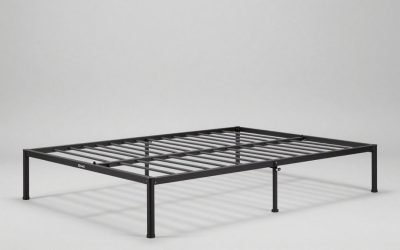
Every king needs a center rail running head to foot with at least one or two floor legs. Without one, even solid oak rails will sag over 76 inches of span. Check that the center legs are adjustable or that they reach the floor solidly.
Slats
Slats of about 3/4″ to 1″ thick, spaced 2-3 inches apart, suit most foam and hybrid mattresses. Some oak beds use pine or poplar slats, which is normal; slats do not need to be oak.
Finish
- Hardwax oil: natural look, easy spot repair, needs occasional refresh.
- Lacquer or catalyzed varnish: tougher film, harder to spot-repair.
- Fumed or dark stains: hide dents well.
Living with oak: durability and care
- Seasonal movement: oak expands and contracts with humidity. Wide panels should float in frames; hairline gaps in winter are normal. Keeping indoor humidity around 35-55% limits movement.
- Iron staining: oak’s tannins react with iron and moisture, leaving black marks. Avoid steel wool and wet metal objects on raw or oil-finished oak.
- Squeaks: nearly always come from loose bolts or slats rubbing, not the oak itself. Tighten bolts after the first month and then twice a year.
- Lifespan: a well-built solid oak frame commonly outlasts several mattresses and can be refinished.
Who should choose a solid oak king
| Situation | Recommendation |
|---|---|
| Forever bed, staying in one home | Solid white or red oak with bolted joinery |
| Frequent movers, upstairs apartments | Oak platform style or a lighter wood; avoid heavy sleigh beds |
| Light, natural modern look | White oak with oil or matte finish |
| Traditional bedroom, darker stain | Red oak for better value |
| Kids and pets | Oak with a durable film finish; dents stay minimal |
| Tight budget | Oak veneer over plywood, or rubberwood, instead of solid oak |
The bottom line: confirm the species, confirm that “solid” means solid, check for a supported center rail and bolted joints, and measure your route into the bedroom. Get those four right and a solid oak king bed can serve for decades.