Key takeaways
- 2 legs: Acceptable for two average-weight sleepers (under 200 lbs each) with a hybrid or innerspring. Place them at 1/3 and 2/3 of the rail length.
- 3 legs: Recommended for memory foam, latex, or combined sleeper weight over 400 lbs. This prevents the slight valley that forms between two legs. Most warranty-compliant king platforms in 2026 use 3 legs.
- Leg type matters: Look for steel legs with adjustable levelers and broad floor glides (at least 2″ diameter). Threaded adjustable height from 11″ to 15″ lets you compensate for uneven floors and prevents wobble. Plastic T-legs and narrow dowels crack first.
- Attachment: The rail should bolt or bracket-lock to the headboard and footboard, not just rest in a slot. Slats should be screwed down or held with Velcro/caps to the rail and side rails to stop shifting.
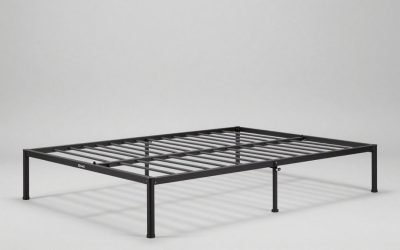
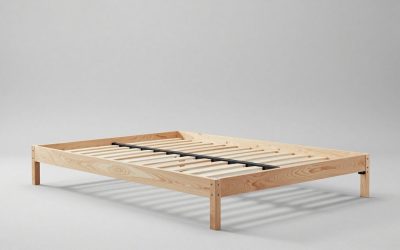
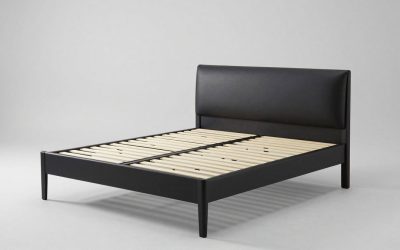
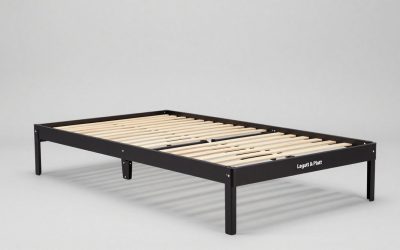
King size bed slats with center support prevent sagging when slats are 2.5 to 3.5 inches wide, 0.75 inches thick, spaced 2 to 3 inches apart, and reinforced by a center support rail with at least 2 to 3 legs reaching the floor.
For foam, hybrid, and latex mattresses on a king frame (76″ x 80″), that configuration distributes 600 to 1,000+ lbs evenly, keeps warranty-compliant support, and stops the dip in the middle that causes hip and lower-back pain. If you buy a replacement slat system or a platform bed without a box spring, use these specs as your checklist.
Our top picks


As an Amazon Associate we earn from qualifying purchases at no extra cost to you.
What Ideal King Size Bed Slats With Center Support Look Like
A king is essentially two twin XLs side by side. Without a solid center rail and legs, the 76-inch span flexes under weight. The center support acts as a spine – it turns one wide, bouncy surface into two stable 38-inch sections. Every major mattress warranty requires this.
| Spec | Ideal Range for King | Why It Matters | Red Flag |
|---|---|---|---|
| Slat-to-slat spacing (gap) | 2″ – 3″ (max 3″ for foam/latex) | Prevents foam sinking between slats, keeps airflow | Gaps over 3.5″ void many foam warranties |
| Slat width | 2.5″ – 3.75″ | Wider slats = more surface contact | Narrow 1.5″ slats bend faster |
| Slat thickness | 0.75″ – 1″ solid wood | Resists bowing under 250+ lbs per side | 0.5″ slats without reinforcement |
| Number of slats (king) | 14 – 20 slats | 14 at 3″ gaps, 18-20 at 2-2.5″ gaps | Fewer than 12 slats |
| Center rail | 1 steel or hardwood rail, full length | Transfers center load to legs, not side rails | Center rail that floats without legs |
| Center support legs | 2 legs minimum, 3 for heavy/foam use | Each leg adds 200-300 lbs capacity | 1 leg or plastic glides only |
| Total weight capacity | 700 – 1,200 lbs (frame + slats + rail) | Covers two adults + mattress (120-180 lbs) | Rated under 500 lbs for a king |
Slat Spacing, Width and Thickness Explained
1. Spacing: The 3-Inch Rule
Mattress makers including Tempur-Pedic, Casper, Purple and Saatva require slats no more than 3 inches apart for foam, hybrid and latex. Latex is heaviest and most flexible, so aim for 2 to 2.5 inches. Innerspring can tolerate up to 4 inches, but 3 inches is still better for edge support.
To check quickly: if you can fit a soda can (2.6″ diameter) vertically between slats with room to spare, the gaps are too wide for foam.
2. Width and Thickness
Standard pine or poplar slats are 2.8″ wide x 0.75″ thick. That thickness is the minimum for a king without plywood-style flex. Hardwood slats like birch or beech at the same thickness are 30-40% stiffer than spruce/pine. If slats are only 0.5″ thick, they need a center strap or interlocking system to avoid cracking.
Curved bowed slats (slightly arched upward) add spring but should still meet the 2-3 inch gap rule and be paired with a center rail. Flat slats give firmer, more stable support for heavier memory foam.
3. How Many Slats Does a King Need?
For an 80-inch long king: 14 slats at 3″ gaps = bare minimum. 16-18 slats at 2.5″ gaps = ideal for most foam and hybrid king mattresses. 20 slats at 2″ gaps = best for latex or sleepers over 250 lbs per side. More slats also improve ventilation, reducing heat and moisture buildup under foam.
Center Support: Rail and Leg Count
The center rail runs head to foot down the middle of the bed, perpendicular to the slats. On a king, it must be supported to the floor. Without legs, the rail just hangs and the slats still sag in the middle.
- 2 legs: Acceptable for two average-weight sleepers (under 200 lbs each) with a hybrid or innerspring. Place them at 1/3 and 2/3 of the rail length.
- 3 legs: Recommended for memory foam, latex, or combined sleeper weight over 400 lbs. This prevents the slight valley that forms between two legs. Most warranty-compliant king platforms in 2026 use 3 legs.
- Leg type matters: Look for steel legs with adjustable levelers and broad floor glides (at least 2″ diameter). Threaded adjustable height from 11″ to 15″ lets you compensate for uneven floors and prevents wobble. Plastic T-legs and narrow dowels crack first.
- Attachment: The rail should bolt or bracket-lock to the headboard and footboard, not just rest in a slot. Slats should be screwed down or held with Velcro/caps to the rail and side rails to stop shifting.
If your current king has only a center bar with one leg, add a third-party king center support system: a steel rail with 3 folding legs that bolts under existing slats, usually $50-$120. It is cheaper than replacing the frame and instantly fixes center sag.
Material and Construction Trade-Offs
| Material | Support and Sag Resistance | Durability | Noise | Best For |
|---|---|---|---|---|
| Solid hardwood (birch, beech, poplar) | Excellent – resists bowing, 0.75″ holds 250+ lbs per slat | 10+ years, can be sanded if warped | Quiet if secured, may creak if loose | Foam, latex, heavy use |
| Solid softwood (pine, spruce) | Good if thick (0.75″+), flexes more over time | 5-8 years, prone to cracking at knots | Quiet initially | Budget platform beds, guest rooms |
| Engineered wood / LVL plywood slats | Very good – layered grain resists warping | 8-12 years, stable in humidity | Low noise, consistent flex | Curved slat systems |
| Metal slats or steel grid + wood top | Excellent – no sag, highest weight capacity | 15+ years, will not crack | Can squeak if bolts loosen | Maximum weight capacity, rentals |
For king size bed slats with center support, solid birch or LVL plywood plus a steel center rail is the most reliable combination. All-wood slat packs are quieter; steel center rails with wood slats give you the stiffness where it counts without a hard, noisy sleep surface.
Decision Matrix: Pick the Right Setup for Your Situation
| Your Situation | Recommended Slat System | Why |
|---|---|---|
| Memory foam or boxed hybrid (Casper, Purple, Nectar type) | 16-20 flat slats, 2-2.5″ gaps, 0.75″ thick + 3-leg steel rail | Foam needs tight gaps and rigid center to avoid body impressions |
| Latex mattress (heavy, flexible) | 18-20 slats, 2″ gaps + 3 legs, hardwood or LVL | Latex will sag through wide gaps faster than any other material |
| Two sleepers, combined over 450 lbs | 18+ slats, 2.5″ gaps + 3 adjustable steel legs, 800+ lbs rating | Extra legs prevent center dip and side-rail spread |
| Small apartment / rental, need to move often | Metal platform with roll-up slats and folding center legs | Roll-up slats pack tight, metal frame breaks down without tools |
| Kids and pets jumping on bed | Hardwood or metal slats, screwed down, 3 legs with wide feet | Dynamic load is higher than static sleeping weight |
| Back pain, need firm support | Flat (not bowed) solid slats, 2-2.5″ gaps, no flex | Bowed slats add bounce that reduces spinal alignment for some |
Room Fit, Clearance and Weight Realities
A king frame is 76″ wide x 80″ long, but the footprint is larger. With side rails, allow 80″ x 84″ floor space. In a 10×12 ft room, a king leaves only 22″ to 32″ on each side – tight for nightstands (standard 20-24″ wide). Measure doorways and hallways before delivery: king slat bundles ship in boxes 75-80″ long and will not turn through a 28″ interior doorway if boxed rigid. Roll-up slat packs ship at 40-42″ and fit any doorway.
Clearance height: Platform slats sit 14-18″ off the floor. That leaves 6-8″ under-bed storage with standard 14″ legs. If you use an 11-12″ low-profile platform, center legs may be too short to reach the floor on thick carpet – choose adjustable legs.
Weight and moving: A solid wood king slat set weighs 35-55 lbs; with a steel center rail add 15-20 lbs. The full platform frame is 80-130 lbs. What wears first is not the slats but the center leg glides and the slat end caps or screws, which loosen in 2-3 years if not tightened. Check bolts every 6 months.
Assembly and Long-Term Durability Tips
- Unpack slats and lay them out before tightening the center rail. The rail must be level – use the adjustable feet to make all 3 legs touch without rocking.
- Secure each slat to the center rail with the provided Velcro strips or screws. Floating slats shift, widen gaps, and squeak.
- If gaps are too wide, add a bunkie board (1-2″ solid foundation) or a 3/4″ plywood sheet with drilled ventilation holes every 6 inches. Do not lay foam directly on solid plywood without holes – it traps moisture.
- For squeaks, wrap slat ends with felt tape where they meet the side rail and tighten the center rail bolts with a washer.
- Frames without a center rail cannot be fixed by adding more slats alone. You must add the rail and legs.
Replacement king slat systems usually cost $90-$220 for wood slats with a steel center support, and $180-$400 for a complete steel grid platform. If a king platform costs under that range and lists fewer than 14 slats or only one center leg, expect sag within a year under foam.
FAQ
Can I use king size bed slats with center support without a box spring?
Yes. That is their purpose. Modern foam, hybrid and latex kings are designed for slats or a solid platform, not a box spring. Just keep gaps at or under 3 inches and keep the center rail legged.
Do I need a bunkie board if I have good slats?
No, if slats meet the specs above. A bunkie board is only needed to fix gaps over 3 inches, to quiet an old frame, or if your mattress warranty specifically requires a solid surface.
How do I know if my center support is failing?
Look for a ridge or valley down the middle of the mattress, slats that bow downward in the center, or a center leg that no longer touches the floor. A level placed across the slats will show a dip greater than 0.5 inches.