Key takeaways
- Basic tubular-steel slat sets: 500–700 lb distributed (mattress + sleepers)
- Flat-bar or “heavy-duty” slat sets: 800–1,200 lb
- Frames with a reinforced center beam and 2+ floor legs: often advertised at 1,000 lb and up
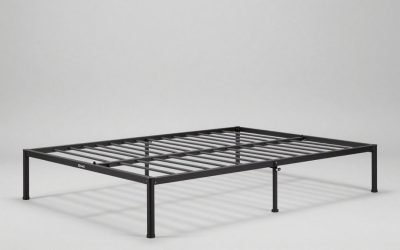
For a queen bed, metal slats should be spaced no more than 3 inches apart for a foam mattress (and 2.5 inches for dense latex or warranty-sensitive brands) and up to about 4 inches for an innerspring sitting on a foundation — which works out to roughly 12–16 slats across a standard 60 × 80-inch frame, plus a center support rail with legs to the floor. Everything else in this guide is about dialing in those numbers for your mattress, your weight load, and your frame.
Our top picks


As an Amazon Associate we earn from qualifying purchases at no extra cost to you.
How Far Apart Should Metal Slats Be on a Queen Bed?
The spacing rule exists because mattresses fail downward into gaps. A slab of memory foam has no internal rigidity — push past a 3-inch gap and the foam creeps into it, creating permanent dips and, in many cases, voiding the mattress warranty. Hybrids have a coil unit that bridges small gaps better, but the comfort foam on top still sags over wide spacing. A traditional innerspring on a box spring barely cares about slats at all, because the foundation does the bridging.
| Mattress type | Max slat gap | Min. slats on an 80-in length | Center support rail? |
|---|---|---|---|
| Memory foam / all-foam | 3 in (2.5 in safer) | 14 | Yes, required |
| Latex foam | 2.5 in | 16 | Yes — latex is the heaviest mattress type |
| Hybrid (coils + foam) | 3 in | 13 | Yes |
| Innerspring + box spring | 4–6 in (slats only carry the foundation) | 8–10 | Yes, to stop rail flex |
Measure gaps at the middle of the bed, not the ends — slats bow outward under load and a 3-inch gap at the edge can open to 3.5 inches mid-frame.
The Slat Math for a Queen Frame
A queen mattress is 60 × 80 inches, but the usable slat run is usually 78–80 inches once you subtract the head and foot rail flanges. The formula: number of slats = usable length ÷ (slat width + gap). Worked example with common 2.5-inch steel flat bars and a 2.75-inch target gap: 80 ÷ 5.25 ≈ 15 slats. With narrower 1.25-inch tubular slats at the same gap, you need about 19–20. If your frame came with 5 or 6 slats — common on decorative metal beds — you have a box-spring frame, not a platform frame, and a foam mattress on it will fail within a year.
Weight Limits and When to Add Center Support Legs
Published weight ratings assume the load is distributed and a center rail exists. Typical numbers for a queen:
- Basic tubular-steel slat sets: 500–700 lb distributed (mattress + sleepers)
- Flat-bar or “heavy-duty” slat sets: 800–1,200 lb
- Frames with a reinforced center beam and 2+ floor legs: often advertised at 1,000 lb and up
On a queen or king, a center support rail running head-to-foot with at least one adjustable leg touching the floor is not optional — every foam mattress warranty assumes it, and physics does too. Without it, the 80-inch unsupported span lets side rails bow outward and slats pop out of their ledges. Add a second leg for couples, latex mattresses, or combined sleeper weight over about 350 lb. Signs you’re under-supported right now: a visible dip down the middle of the mattress, slats that rattle or shift sideways, a squeak at the same spot every night, or screw-in legs that have started to lean.
How to Measure for Replacement Metal Slats
- Inside width: Measure between the inner faces of the side rails at head, middle, and foot — older frames flex and the three numbers can differ by a quarter inch. Slat length should equal the smallest measurement minus roughly 1/8 inch so slats drop in without forcing the rails apart. On most queen frames this lands around 59.5–61 inches.
- Ledge depth: Measure the lip each slat rests on. Slats need at least 3/4 inch of bearing on each side; tubular slats hanging on a 1/2-inch lip will roll off under load.
- Slat height: Measure from the top of the ledge to the top of the rail so replacements sit flush — common thicknesses are 0.75 in (wood), 1 in, and 1.5 in (steel tube).
- Mounting style: Slats attach four ways — bolted ends, hooked ends that drop into rail slots, rubber caps that sit on the ledge, or a roll connected by webbing straps. Match the existing type, or buy a universal retrofit set with adjustable caps.
Steel vs. Wood Slats vs. a Bunkie Board
You don’t have to replace metal with metal. A metal bed frame with wood slats is a legitimate and popular setup — pine or poplar slats add a slight flex that quiets the frame and cushions the mattress, and cracked slats can be swapped one at a time for a few dollars. The same spacing rules apply. Conversely, a wood and metal queen bed — timber rails with a steel slat grid — is common on platform beds and holds up extremely well.
| Slat type | Typical spec (queen) | Distributed capacity | Noise | Set price range | Watch out for |
|---|---|---|---|---|---|
| Tubular steel | 1–1.5 in tube, powder-coated | 500–700 lb | Squeaks at rail contact points — add felt tape or rubber caps | Check on Amazon | Ships in wide spacings on decorative frames; won’t sag itself but drops foam through gaps |
| Flat-bar steel | 2–3 in bar, bolted | 700–1,200 lb | Quiet if bolted tight | Check on Amazon | Heavy; overkill for light sleepers on box springs |
| Wood slats in a metal frame | 2.5–3.5 × 0.75 in pine/poplar | 600–900 lb with center rail | Quietest option; flex absorbs movement | Check on Amazon | Knots crack first; avoid spacing past 3 in or slats split |
| Bunkie board over existing slats | 1.5–2 in engineered wood deck, 60 × 80 in | Spreads any load across the whole frame | Silent | Check on Amazon | The fastest fix for 4–6 in factory gaps; reduces under-bed clearance slightly |
A bunkie board is the cheat code when your gaps are too wide: lay one over the existing slats and the spacing problem disappears entirely.
Decorative Metal Frames: Headboards Don’t Support Anything
One scenario trips people up constantly: a white metal queen bed headboard and frame set in the Victorian iron-look style. These frames typically ship with only 4–6 thin tubular slats, because they were designed decades ago for a box spring. The ornate headboard is purely cosmetic — all structural work happens in the side rails and slats. Keep the look, retrofit the support: add a wood slat roll or steel retrofit kit to reach 13+ slats, plus a center beam with a leg, or drop in a bunkie board. The same applies to any antique or brass-style frame where slat hooks are spaced 12+ inches apart.
Quick Decision Matrix
| Your situation | Best fix |
|---|---|
| Foam mattress, frame squeaks and dips | Add slats to ≤3-in gaps + center rail with leg + felt tape at contact points |
| Couple, heavy hybrid, combined 350+ lb | Flat-bar steel set or bunkie board, center beam with 2 legs |
| White metal / antique frame with 5 slats | Keep the headboard, add slat roll or bunkie board + center support |
| Renter who moves every year or two | Bolt-on steel slats — wood slats crack at screw holes after 2–3 disassemblies |
| Kids’ room (jumping happens) | Flat steel slats or plywood deck, no exceptions |
FAQ
Can I just put plywood over metal slats?
Yes — a 3/4-inch plywood sheet cut to 60 × 80 in works as a solid deck. The trade-off is ventilation: foam mattresses can trap moisture against solid wood, so either drill a grid of 1-inch holes, use a slatted bunkie board instead, or lift and air the mattress monthly.
Do metal slats ruin a mattress?
Not if spacing is correct. The only real risk is abrasion where the mattress bottom rubs bare steel — a thin rug pad or the fabric cover most slat sets ship with prevents it.
How many legs should a queen center rail have?
One at minimum, two for couples or latex mattresses, three if the floor is uneven or the frame is over 10 years old and the rails have any flex left in them.