Key takeaways
- Listed interior dimensions, not exterior — upholstered surrounds can lose 1–2 inches per side to padding.
- No center beam across the floor cavity unless it’s positioned to miss the base legs and the motor housing, which usually sits mid-bed.
- An open or very low foot end — the foot section of the deck rises well past horizontal, and a tall footboard can block articulation.
- Rail tops at or below deck height (decks typically sit 13–16 inches high) so rails don’t rub the mattress retainer as the head lifts.
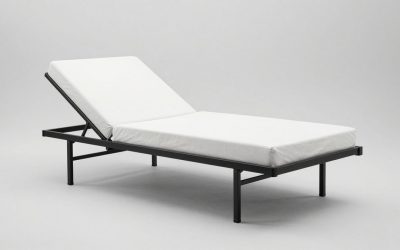
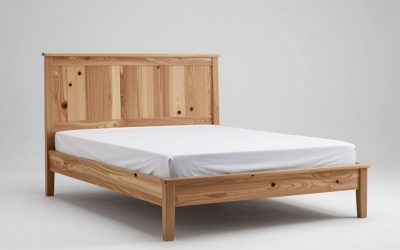
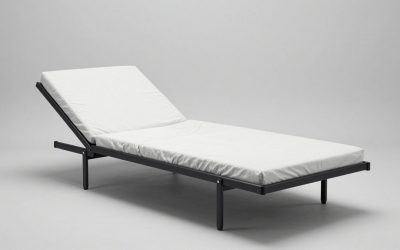
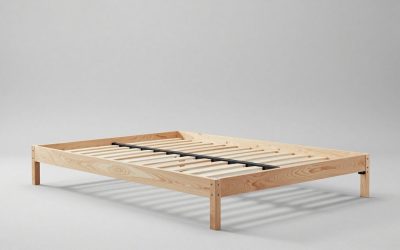
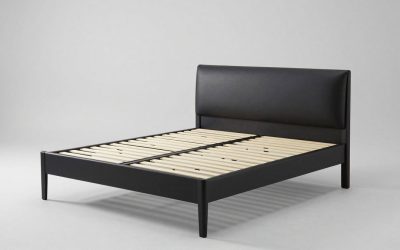
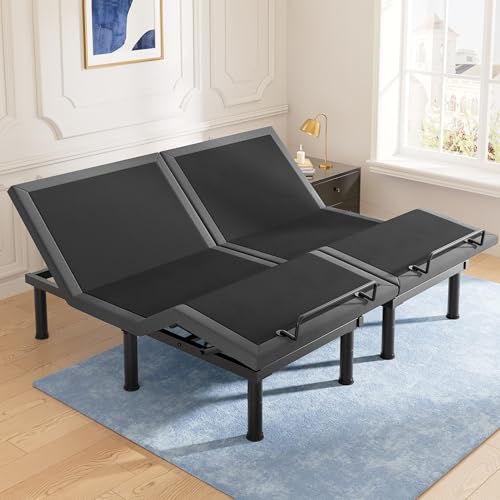
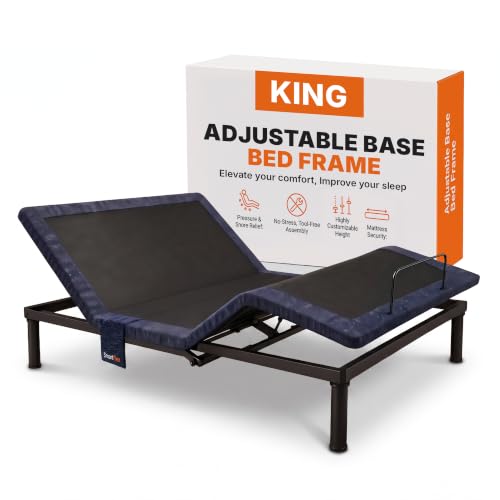
Most king adjustable bases measure about 76 x 80 inches — a split king is simply two 38 x 80-inch Twin XL units side by side — so a frame works if its open interior clears roughly 77 x 81 inches and it either ships slat-free or lets you remove the slats. That narrows king bed frames compatible with adjustable base setups to three designs: open “surround” frames the base drops inside, platform frames with removable slats paired with a legged base, and solid-deck platforms matched with a zero-clearance base.
Our top picks


As an Amazon Associate we earn from qualifying purchases at no extra cost to you.
The three frame designs that actually fit
1. Surround frames — a bed frame to go around an adjustable base
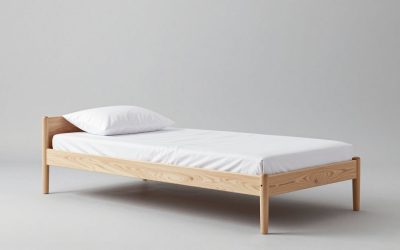
A surround frame is a decorative perimeter — headboard, side rails, sometimes a low foot rail — with a completely open interior. The adjustable base stands on its own legs on the floor inside it; the frame carries no load and never touches the moving deck. This is the cleanest option visually, since the base disappears behind the rails. When shopping, check:
- Listed interior dimensions, not exterior — upholstered surrounds can lose 1–2 inches per side to padding.
- No center beam across the floor cavity unless it’s positioned to miss the base legs and the motor housing, which usually sits mid-bed.
- An open or very low foot end — the foot section of the deck rises well past horizontal, and a tall footboard can block articulation.
- Rail tops at or below deck height (decks typically sit 13–16 inches high) so rails don’t rub the mattress retainer as the head lifts.
Expect to pay about $400–$1,500 for metal or engineered-wood surrounds, and $800–$2,500 for solid oak or walnut.
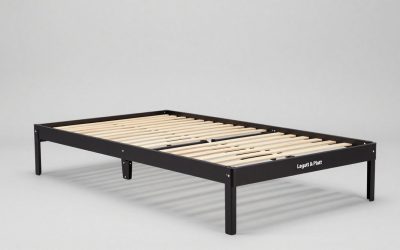
2. Platform frames with removable slats
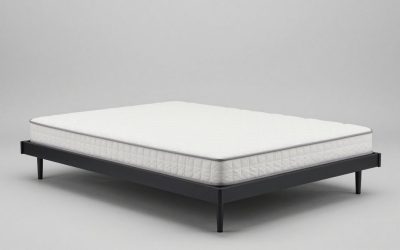
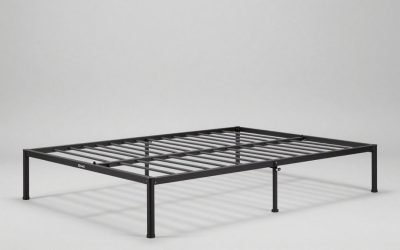
If you already own a platform king, pull the slats and set a legged base inside the cavity. Two catches: on cheaper frames the slats act as spreaders that keep the side rails from bowing outward, so recheck that the rails stay square a week after removal and add a center support if they drift. Second, the base legs must reach solid floor — never rest base legs on remaining slats or a thin rail.
3. Zero-clearance base on a solid deck
Zero-clearance bases — offered across most 2026 lines from makers like Leggett & Platt, Tempur-Pedic, and Saatva — sit flat on a platform deck with no legs at all. The deck must be solid plywood or slats spaced under 3 inches apart and rated for the full stack: the base itself (150–200 lb), a king mattress (90–150 lb), and sleepers. Look for a combined rating of 800 lb or more.
Measurements that decide fit
Bases vary an inch or two between brands, so measure your specific model — but these are typical numbers:
| Base type | Footprint (W x L) | Min. interior width | Min. interior length | Typical deck height |
|---|---|---|---|---|
| Standard king (one piece) | 75.5–76 x 79.5–80 in | 77 in | 81 in | 13–16 in |
| Split king (2 Twin XL) | 76 x 80 in total (38 x 80 each) | 77 in | 81 in | 13–16 in |
| California king | ~72 x 84 in | 73 in | 85 in | 13–16 in |
| Zero-clearance (no legs) | Same footprints | Sits on deck instead | Deck must fully support unit | Adds 4–7 in to deck |
Beyond the footprint, four clearances trip people up:
- Head/wall gap: non-wall-hugging bases pivot toward the wall as the head rises — leave 3–6 inches behind the headboard. Wall-hugger designs slide the deck back toward you instead and need only about 2 inches.
- The mattress retainer bar adds roughly 1 inch past the foot of the base; keep 2 inches between it and any foot rail.
- Motors and massage units mount under the deck mid-section — don’t let a frame crossmember sit beneath them.
- Walkways: plan 24 inches minimum on each side, 30–36 for comfort. In a 10 x 12 ft room, a 76-inch king leaves about 22 inches per side when centered — workable but tight, and a surround frame adds another 2–4 inches to the footprint.
Split king vs. standard king inside the same frame
Both fill the same 76 x 80 envelope, so any compatible surround accepts either. The differences are practical, not dimensional. A one-piece king base weighs 200–250 lb boxed and is brutal on stair turns. A split king ships as two cartons around 80 x 39 inches at 130–180 lb each — much easier upstairs and through 32-inch doorways. The trade-offs: two power cords to route, and the two units can drift a fraction apart over months — a non-slip pad or linking straps inside the frame keeps them married. If your surround has a center floor beam, confirm the inner legs of each Twin XL base land on clear floor rather than on the beam.
Weight, moving, and assembly realities
- Lift capacity on most king bases runs 650–850 lb including the mattress; if the base sits on a frame deck, the frame must carry that entire load.
- Frame weight: solid-wood surrounds run 90–140 lb boxed, upholstered 70–110 lb, steel 50–80 lb. All fit standard doorways flat-packed — it’s the base carton that needs delivery planning and two people.
- What wears first: essentially nothing on the frame, since it carries no load. On the base, massage motors and USB ports typically fail before lift motors; retainer bars bend if you drag the mattress by them.
- Noise: a surround frame can’t rattle against the base if you leave a 1-inch air gap all around. If contact happens, felt pads on the rail interiors fix it.
Quick decision matrix
| Your situation | Best pick | Why |
|---|---|---|
| Rent or move every year or two | Freestanding base + headboard brackets | No frame to haul; base stands alone |
| Want an upholstered, finished look | Surround frame, verify 77 x 81 in interior | Hides the base, keeps a headboard |
| Already own a slatted platform | Remove slats, drop in a legged base | Cheapest path if the interior clears |
| Room under 10 x 12 ft | Base-only setup or slim steel surround | Saves 3–6 in of bulk per side |
| Couple with different sleep positions | Split king inside one surround | Independent articulation, unified look |
| Kids and pets pile in regularly | Solid-wood surround + 850 lb-rated base | Headroom under the lift capacity |
FAQ
Can I put an adjustable base on top of bed slats?
Only a zero-clearance model, and only if the slats are under 3 inches apart, flat, and rated for the total load. A legged base must stand on the floor — legs resting on slats will crack them.
Will my current king mattress work on an adjustable base?
Memory foam, latex, and pocket-coil hybrids around 10–14 inches thick flex fine. Traditional innersprings with a rigid border wire don’t bend cleanly and will kink at the hinge points.
Does the base need the same brand’s frame?
No. Bases from Tempur-Pedic, Sleep Number (FlexFit), Leggett & Platt, and others are self-supporting. Warranty coverage cares that the base is supported to spec — legs on solid floor or zero-clearance on a solid deck — not about the furniture around it.
Do I still need a headboard?
Optional. Bracket kits bolt a headboard directly to the base, a surround frame supplies one, and freestanding headboards work too — just keep the 3–6 inches of wall clearance in mind either way.