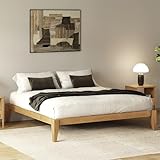
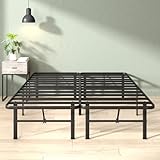
Key takeaways
- 16-18 gauge steel frame rails (lower gauge number means thicker, stronger steel)
- An upholstered or metal-mesh headboard, usually 38-42 inches tall
- 2-3 center support legs instead of 4-5
- 10-13 wooden or metal slats spaced 3-4 inches apart
- A weight rating between 500-700 lbs total (mattress plus occupants plus box spring, if used)
A queen bed frame with a headboard under $100 will get you a functional metal or metal-and-upholstered-panel frame that holds a queen mattress safely, but it cuts corners in steel gauge, center leg support, slat count, and headboard construction. Some of those cuts are harmless. Others predict a frame that sags, creaks, or loosens within a year. Here’s how to tell which is which before you buy.
Our top picks


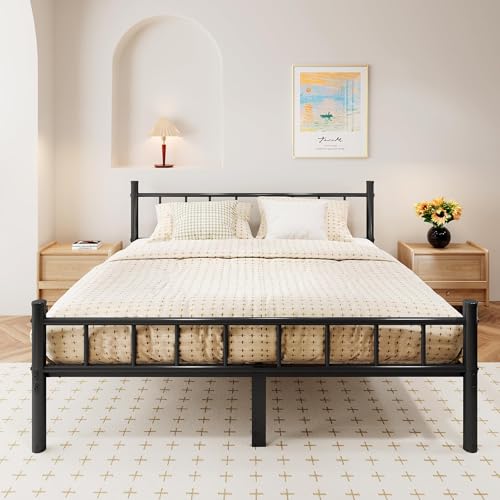

As an Amazon Associate we earn from qualifying purchases at no extra cost to you. Ratings are shown as listed on Amazon.
What under-$100 actually buys you
At this price, you’re almost always looking at a powder-coated steel frame with a thin upholstered headboard panel, or a bare metal frame with a slatted headboard stamped from the same steel as the rails. True solid wood queen bed frames with a headboard, and especially wood queen bed frames with a headboard and footboard, rarely appear under $100 because lumber, joinery, and shipping weight cost more than steel tubing. If you see “solid wood” at that price, check the listing specs closely; it’s often a wood-look laminate over particleboard or MDF, not solid lumber.
What you typically get for under $100:
- 16-18 gauge steel frame rails (lower gauge number means thicker, stronger steel)
- An upholstered or metal-mesh headboard, usually 38-42 inches tall
- 2-3 center support legs instead of 4-5
- 10-13 wooden or metal slats spaced 3-4 inches apart
- A weight rating between 500-700 lbs total (mattress plus occupants plus box spring, if used)
That weight rating sounds generous, but it assumes even distribution and a properly assembled frame sitting flat on all legs. Uneven floors, missing center legs, or a mattress with no box spring changes that math.
The corners that are safe to cut
Not every cost-saving choice affects durability. These trade-offs are mostly cosmetic or personal preference:
- Upholstered panel over MDF instead of solid wood. A headboard is a vertical, low-stress panel. MDF wrapped in linen or velvet holds up fine for years as long as it isn’t repeatedly leaned on hard or exposed to moisture.
- No footboard. A queen platform bed frame with no headboard, or one with a headboard only, isn’t a durability compromise, it’s a style and space choice. Footboards mainly matter if you want a finished look on all sides or need something to anchor a bed-end bench.
- Low profile height. A low profile queen bed frame with a headboard (mattress top around 18-20 inches off the floor instead of 24-25) isn’t weaker, it just sits closer to the ground, which some buyers with back pain actually prefer for easier standing leverage.
- Basic hardware finish. Painted bolt heads or unfinished leg caps don’t affect structural integrity, just appearance.
The specs that predict sagging or rattling
These are the numbers and design details that actually correlate with frames failing within a year:
- Fewer than 3 center support legs on a queen. A queen frame spans 60 inches wide. With only side rails and 2 legs, the center third of the mattress has minimal support, which is where most sagging starts, especially with memory foam mattresses that flex more than innerspring.
- Slat gaps wider than 3.5 inches. Most mattress warranties require support slats no more than 3 inches apart (check yours). Wider gaps let foam mattresses sag between slats over months, which can void the mattress warranty even if the frame itself survives.
- Steel gauge 18 or thinner with no gauge listed at all. If a listing doesn’t mention steel gauge, that’s usually because it’s on the thin side. Thin tubing flexes under repeated weight shifts and eventually develops a permanent bow in the side rails.
- Headboard attached only by hooks with no bolt-through connection. A queen bed frame with hooks for the headboard and footboard is common and fine when the hooks are heavy-gauge and the headboard has a lower stabilizer bar. It becomes a rattle problem when the hooks are thin wire and the panel has no bottom bracing, since the headboard rocks every time someone leans back against a pillow.
- No center rail support beam, just cross-slats resting on side rails. Frames with a solid center beam running head-to-foot distribute weight far better than ones relying on slats alone.
Quick spec comparison
| Spec | Likely to hold up | Likely to sag/rattle within a year |
|---|---|---|
| Steel gauge | 14-16 gauge (thicker) | 18+ gauge or unlisted |
| Center legs | 4-5 legs | 2 legs or none |
| Slat spacing | 2.5-3 inches apart | 4+ inches apart |
| Headboard mount | Bolted or hooks + lower brace | Hooks only, no brace |
| Weight capacity | 700+ lbs stated | Under 500 lbs or unstated |
| Center support | Solid beam + legs | Slats resting on rails only |
Materials trade-off: what you’re really choosing between
| Frame type | Typical price range | Durability | Best for |
|---|---|---|---|
| Bare metal frame, no headboard | $40-$80 | Good if legs ≥4 and gauge ≤16 | Renters, minimalists, platform bed with own headboard |
| Metal frame + upholstered MDF headboard | $70-$120 | Moderate; headboard wears first at hook points | Small apartments wanting a finished look cheaply |
| Metal frame + storage drawers | $150-$200 | Moderate; drawer slides are the weak point | Small bedrooms needing extra storage (a queen bed frame with storage under $200 typically falls here) |
| Solid wood frame with headboard | $250-$500+ | High; wood joinery outlasts steel welds | Long-term homeowners, heavier mattresses, back pain sufferers wanting rigidity |
| Solid wood frame with headboard and footboard | $350-$700+ | High | Buyers wanting a complete, furniture-grade bed |
The pattern is consistent: every $50-100 you spend above the sub-$100 tier typically buys either thicker steel, more legs, tighter slat spacing, or a shift from MDF to real wood, roughly in that order.
Matching the frame to your situation
| Your situation | What to prioritize |
|---|---|
| Small apartment, moving in a year or two | Bare metal frame, no headboard or a light upholstered one, under $100, easy to disassemble and carry through a standard 32-inch doorway |
| Renter with no long-term plans | Metal frame with hooks-and-brace headboard; avoid anything over 60 lbs boxed since you’ll move it again |
| Kids’ room or guest room, infrequent heavy use | Under-$100 metal frame is genuinely fine here; low usage means slower wear |
| Pets that jump on the bed daily | Spend up to $150-200 for 4+ center legs and tighter slats; repeated jumping stresses exactly the weak points listed above |
| Back pain, want firm consistent support | Either a low profile queen bed frame with a solid center beam, or step up to solid wood; avoid wide slat gaps entirely |
| Need storage in a small bedroom | Queen bed frame with storage under $200; expect drawer slides to be the first failure point, not the frame |
| Want a twin for a kid’s room instead | A twin bed frame under $100 has an easier time meeting the good-spec column above, since less width means less center sag risk |
Assembly and moving realities
Boxed weight for a bare metal queen frame runs 25-40 lbs; add an upholstered headboard and it climbs to 40-60 lbs, still light enough for one person to carry through a standard doorway without disassembly. Assembly typically takes 20-40 minutes with a hex key, most of it spent attaching legs and headboard brackets. The most common assembly mistake is skipping the center support legs because the frame “looks stable” on the box springs and mattress alone; add them anyway, since that’s precisely the support that prevents the sag described above.
For fit, a queen frame measures roughly 60-63 inches wide and 82-85 inches long including the headboard. In a 10×12 ft room, that leaves about 27-30 inches on each side for a queen frame centered against one wall, enough for nightstands but tight for a bench at the foot.
Bottom line
Under $100 is a reasonable price for a queen frame with a headboard if you check three things before buying: at least 3-4 center legs, slat gaps under 3.5 inches, and a headboard that bolts or hooks into a lower brace rather than swinging free. Skip anything missing all three specs in the listing, since that omission is usually the first sign the frame won’t make it past year one.