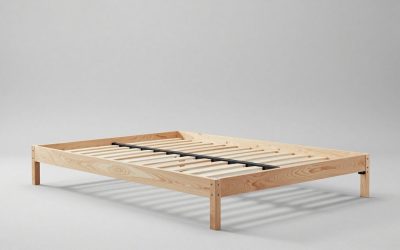
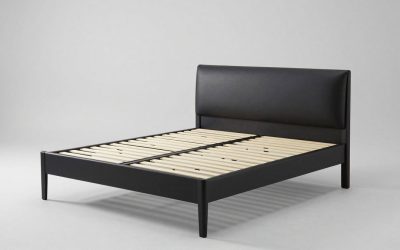
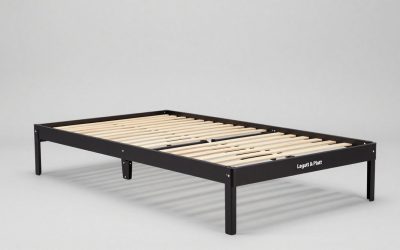
The best wood for bed slats is beech or birch if you want the stiffest, most sag-resistant support over a wide span, poplar for a balanced middle ground, and pine only when the span is short or centrally supported and you are prioritizing cost.
Our top picks
 Meliusly Queen Bunkie Board 60x80
- Reinforce Weak Frames or Replace Your Box Spring…
- Transform Any Standard Bed Frame Into a Platform…
- Compatible With Every Mattress Type - While typical…
 LAVEVE Heavy Duty Bunkie Board Queen Size
- UPGRADED 0.43" THICKNESS FOR STRONG SUPPORT-LAVEVE Bunkie Board…
- Available in 6 sizes, LAVEVE Bunkie Board fits…
- Made with thick 600D Oxford fabric and a…
 Zinus 1.6 Inch Deepak Easy Assembly Wood
- Features a 1.6-inch profile for robust support—ideal for…
- Designed for quick setup and ships in a…
- Provides extra support for spring, hybrid, and memory…
As an Amazon Associate we earn from qualifying purchases at no extra cost to you.
Ranked by Stiffness and Sag Resistance
Not all slat woods deflect the same under the same load. Stiffness is measured by modulus of elasticity (MOE) – higher MOE means less sag at a given thickness and span. For standard solid slats cut to 3/4 inch thick by 3 inches wide, the ranking is consistent:
1. Beech: The stiffest common slat wood. European beech resists long-term creep and is the default for high-end laminated slats. It holds its spring under heavy memory foam and latex mattresses.
2. Birch: Nearly as stiff as beech, slightly more available in North America as solid lumber and as Baltic birch plywood for laminated slats. Excellent sag resistance for queen and king spans.
3. Poplar: A noticeable step down from birch/beech but about 15-20% stiffer than pine. It is stable, less knotty than pine, and less prone to splitting at screw points.
4. Pine: The softest and most flexible of the four. Southern yellow pine is stiffer than white pine, but both will sag sooner than hardwoods at the same dimensions. Pine works only with correct thickness, narrow spacing, and a center support.
| Wood Species | Modulus of Elasticity (MOE) | Janka Hardness | Relative Sag at 30″ Span* | Best Use |
|---|---|---|---|---|
| European Beech | ~1,990,000 psi (13.7 GPa) | 1,450 lbf | Baseline (least sag) | Long spans, heavy sleepers, latex mattresses |
| Yellow Birch | ~1,790,000 psi (12.3 GPa) | 1,260 lbf | +11% vs. beech | Same as beech, slightly lower cost |
| Poplar (Yellow Poplar) | ~1,580,000 psi (10.9 GPa) | 540 lbf | +26% vs. beech | Twin/full, or queen/king with center rail |
| Southern Yellow Pine | ~1,360,000 psi (9.4 GPa) | 690 lbf | +46% vs. beech | Budget, short spans, bunk beds with many slats |
| Eastern White Pine | ~1,240,000 psi (8.5 GPa) | 380 lbf | +60% vs. beech | Light use only, needs support and narrow gaps |
*Estimated mid-span deflection for a solid 0.75″ x 3″ slat supported at both ends with a 150 lb concentrated load at center. Actual deflection varies with grain, moisture content, and knots. Laminated bentwood slats deflect more initially by design but recover better.
Recommended Size and Spacing to Prevent Sag
Wood species alone does not prevent sag – dimensions and support layout do. For adult use in 2026, use this as the minimum for solid lumber slats:
Minimum Dimensions for Solid Slats
- Thickness: 3/4 inch (19mm) minimum. 5/8 inch slats flex noticeably beyond a 28 inch span and take a permanent set within 12-24 months under a foam mattress.
- Width: 2.75 to 3.5 inches wide. Narrower than 2.5 inches concentrates load and cuts into mattress foam. Wider than 3.5 inches restricts airflow.
- Support: Any bed wider than 42 inches (full, queen, king) needs a center support rail with at least one leg to the floor. This cuts the free span from ~60 inches to ~30 inches for a queen, which reduces deflection by roughly 8 times.
Spacing for Mattress Type
- Memory foam, latex, and hybrid mattresses: 2 to 2.75 inches gap between slats, no more than 3 inches. Wider gaps let foam bulge between slats, causing premature body impressions and voiding many mattress warranties which usually require gaps under 3 inches.
- Traditional innerspring: Up to 3.5 inches gap is acceptable, but 2.5 to 3 inches still gives more even support and less noise.
- Count guide: For a 80-inch long queen platform with 3-inch wide slats and 2.5-inch gaps, you need 14 to 15 slats. For a twin (38″ x 75″), 12 to 13 slats of the same size.
If your existing slats are thinner than 3/4 inch, do not compensate by adding more thin slats. Replace them with fewer, thicker slats or add a 3/4 inch plywood bunkie board with ventilation holes drilled every 6 inches.
Solid Lumber vs. Laminated Bentwood: Which Lasts Longer?
Most slat systems you can buy in 2026 use one of two constructions, and the trade-off is not just wood species.
| Feature | Solid Lumber Slats (Pine, Poplar, Beech/Birch) | Laminated Bentwood Slats (Usually Beech or Birch) |
|---|---|---|
| Construction | Single solid board, flat | 5-7 thin veneers glued and curved upward (camber) |
| Stiffness Feel | Rigid, no give | Springy, flexes then returns |
| Long-Term Deflection | May take permanent sag if undersized or knots are present | Resists permanent set better due to lamination and arch |
| Noise | Quiet if screwed down; can squeak if just laid in | Often sits in plastic holders – can creak if holders wear |
| Airflow | Good with proper gaps | Very good, curved shape lifts mattress slightly |
| Weight Limit (Queen Set) | 600-800 lbs total when 3/4″ x 3″ with center rail | 500-700 lbs total, check holder rating |
| Cost Range (Set Only) | Usually $40-$90 for pine/poplar, $90-$180 for hardwood | Usually $80-$200 depending on adjustability and caps |
| Replaceability | Easy – cut any hardware store board to length | Harder – needs matching length, width, and curvature |
Solid beech or birch flat slats give the firmest, most durable platform and are the closest to a solid foundation. Laminated bentwood excels for sleepers who want a bit of suspension and better pressure distribution, and for curved bed frames where flat boards would not sit correctly. Pine is only cost-effective as solid flat slats; pine laminated slats offer little advantage for the extra cost.
Decision Matrix: Pick by Your Situation
| Your Situation | Recommended Choice | Why |
|---|---|---|
| Queen or king with heavy foam/latex mattress (over 90 lbs) or sleepers over 230 lbs combined | Solid beech or birch, 3/4″ x 3.25″, 2-2.5″ gaps + center rail with 2 legs | Maximum stiffness prevents body impressions between slats |
| Renter or frequent mover, small apartment with narrow doorways (28-30″ doors) and stairs | Laminated birch/beech bentwood with plastic end caps | Lighter to carry, flexes without breaking, easier to roll up and transport |
| Kids’ twin, bunk bed, or guest room on a budget | Solid poplar or southern yellow pine, 3/4″ x 3″, 2.5″ gaps, add center leg for twin XL or larger | Low cost, adequate for lighter loads and shorter spans |
| Back pain, want firm support without a box spring | Solid beech flat slats, no more than 2.5″ gap | Rigid support keeps spine neutral, no hammocking |
| Platform bed with wide 60-76″ unsupported span and no center rail | Add a center rail first, then beech/birch. Do not use pine. | Without a center rail, even hardwood at 60″ will sag beyond 0.5″ under load |
Assembly, Moving, and What Wears First
Slats are the first part of a platform bed to fail, before the frame joints. In a typical 10×12 ft bedroom, a queen frame with headboard needs at least 32 inches of clearance on one side for passage and 24 inches at the foot to open drawers. Measure your doorway before buying solid hardwood slats: a queen set of 15 solid beech slats at 60 inches long does not bend and will not turn a tight 28-inch apartment hallway without angling.
For noise, secure flat solid slats with screws or Velcro strips rather than just laying them on ledgers. For laminated slats, replace cracked plastic holders – they are the noise source long before the wood itself fails. Expect pine slats to show denting and knot cracking after 2-4 years of continuous use, poplar after 4-6 years, birch and beech after 7-10+ years if kept dry and properly spaced. Moisture and central heating cycles cause more warping than weight alone, so keep slats off damp floors and leave at least 1/2 inch expansion space between slat ends and the frame.
FAQ
Can I use 1×4 pine boards from the hardware store?
A nominal 1×4 is actually 3/4″ x 3.5″, which meets the minimum size if it is straight, kiln-dried, and free of large knots. Select southern yellow pine over white pine and sand sharp edges to prevent mattress wear. Inspect each board – a single large knot in the middle can reduce stiffness by 30%.
Do I need a bunkie board over the slats?
Only if your slats are too far apart, too thin, or you want an extra-firm feel. A bunkie board does not fix sagging slats underneath; it just hides the problem and traps heat if it has no ventilation.
How do I know if my slats are sagging too much?
Remove the mattress and lay a straight edge across the slats. If any slat shows more than 1/4 inch dip at center when unloaded, or you can flex it more than 1/2 inch by pressing with one hand, it has taken a permanent set and should be replaced.