Key takeaways
- Material honesty: “Wood” is a marketing word; solid pine, walnut, or rubberwood are specifications. Composite panels — MDF, particleboard, engineered veneer — are held together by resins that can emit formaldehyde for months, with emissions rising in warm, humid rooms. If a listing won’t name the species, assume composite.
- Finish chemistry: Water-based lacquers, hardwax oils, and unfinished raw wood are the cleanest options. Ask whether the frame ships with a cured factory finish, since fully cured surfaces release far less than freshly sprayed ones.
- Metal as a shortcut: Powder-coated steel is inert once cured, contains no resins, and skips the adhesive question entirely — often the simplest low-emission route if aesthetics allow.
- Upholstery and fill: Fabric frames are fine when the textile is undyed or low-impact and the padding is polyester rather than treated foam. Look for a tag confirming no added flame retardants, now standard on most reputable US-market furniture.
- Joinery and noise: Bolted or interlocking joints outlast glue-and-dowel construction and stay silent. Squeaks cause micro-arousals you won’t remember but will feel, so slat sleeves and rubber-padded contact points matter more than they sound.
Most people spend a third of their life within inches of their bed frame, breathing whatever it quietly releases into the air. That’s rarely on the shopping list. Buyers compare headboard styles and slat counts, then discover — usually after the box is opened and the room smells faintly of a new car — that the “solid wood” frame is largely particleboard bonded with urea-formaldehyde adhesive, or that the upholstered panel was treated with a flame-retardant chemistry nobody disclosed. Sleep hygiene advice tends to obsess over screens and caffeine while ignoring the largest piece of furniture in the room.
This guide approaches bed frames the way I’d approach any element of a sleep environment: as a variable that either supports overnight recovery or works against it. Below are six frames chosen for honest material construction, low or negligible off-gassing potential, and mechanical designs that don’t rely on adhesive-heavy composites for structural strength. You’ll also find what to actually look for on a spec sheet, how to shorten the off-gassing window on anything new, and answers to the questions I hear most from clients rebuilding their bedrooms from the floor up.
Our top picks



As an Amazon Associate we earn from qualifying purchases at no extra cost to you. Ratings are shown as listed on Amazon.
🛒 Best Price Today on Amazon
Prime members get fast, free shipping on everything above, plus member-only deals. New members get a 30-day free trial — cancel anytime.
How to Choose a Non Toxic Bed Frame (2026)
- Material honesty: “Wood” is a marketing word; solid pine, walnut, or rubberwood are specifications. Composite panels — MDF, particleboard, engineered veneer — are held together by resins that can emit formaldehyde for months, with emissions rising in warm, humid rooms. If a listing won’t name the species, assume composite.
- Finish chemistry: Water-based lacquers, hardwax oils, and unfinished raw wood are the cleanest options. Ask whether the frame ships with a cured factory finish, since fully cured surfaces release far less than freshly sprayed ones.
- Metal as a shortcut: Powder-coated steel is inert once cured, contains no resins, and skips the adhesive question entirely — often the simplest low-emission route if aesthetics allow.
- Upholstery and fill: Fabric frames are fine when the textile is undyed or low-impact and the padding is polyester rather than treated foam. Look for a tag confirming no added flame retardants, now standard on most reputable US-market furniture.
- Joinery and noise: Bolted or interlocking joints outlast glue-and-dowel construction and stay silent. Squeaks cause micro-arousals you won’t remember but will feel, so slat sleeves and rubber-padded contact points matter more than they sound.
The Best Non Toxic Bed Frames of 2026, Reviewed
Mellow Naturalista Classic 12″ Solid Wood Platform
This is the cleanest starting point on the list: solid pine, wooden slats, no composite panels, and no headboard to complicate the material picture. The 12-inch clearance also promotes airflow beneath the mattress, which helps moisture dissipate rather than accumulate — a small but real factor in mattress longevity and dust-mite control.
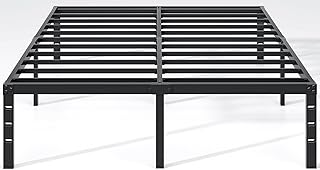
NEW JETO 14″ Heavy Duty Metal Frame
Powder-coated steel sidesteps resins and adhesives altogether, making this the most predictable choice for anyone with genuine chemical sensitivity. The 14-inch height and generous under-bed storage are practical bonuses, and the load rating means it won’t develop the flex that leads to overnight noise.
AMERLIFE Full Solid Wood Bed with 48″ Headboard
Mid-century proportions on a solid walnut-finished frame, with silent slats and a tall headboard that works for reading without a separate cushion. Because the structure is solid wood rather than veneered board, the emission profile stays low even in a warm room.
Allewie Full Upholstered Platform Bed
A well-executed fabric frame for people who want softness without foam-heavy construction: polyester upholstery over a slatted wood base, with padded contact points that keep it noise-free. Air it out for a few days before dressing the bed and any packaging odor resolves quickly.
Allewie Queen Velvet Wingback Platform Bed
The boho geometric wingback creates a partial sound and light buffer at the head of the bed, which subtly benefits sleep in bright or shared rooms. Strong slat support and a no-box-spring design keep the build simple, with fewer materials to scrutinize.
Frequently Asked Questions
How long does a new bed frame off-gas?
Solid wood with a cured finish is typically unremarkable within a few days. Composite-heavy frames can emit measurably for weeks to months, with output roughly doubling for every 7°C rise in room temperature.
Can I speed up the process?
Yes. Assemble in a ventilated space, run cross-ventilation for 72 hours, keep the room cooler rather than warmer, and delay adding bedding. Heat and humidity accelerate emissions but also exhaust them faster when paired with airflow.
Is metal or wood the safer choice?
Cured powder-coated steel is the most inert. Solid wood is close behind and preferable if you dislike metal’s thermal feel or acoustics.
Do I need a box spring?
No. Every frame here uses slat support engineered for modern foam and hybrid mattresses, and adding a box spring can void mattress warranties.
Final Thoughts
For the purest material profile, the Mellow Naturalista Classic in solid pine is hard to beat at its price, while the NEW JETO metal frame is the safest bet for anyone who reacts to wood finishes or adhesives. If you want design presence without compromising on construction, the AMERLIFE solid wood frame with its 48-inch headboard is the one I’d put in my own room.