Key takeaways
- The best air mattresses for guests are usually raised models 18–22 inches high with a built-in pump, a flocked sleeping surface, a stated capacity of at least 600 pounds, and a packed length short enough to fit in your storage…
The best air mattresses for guests are usually raised models 18–22 inches high with a built-in pump, a flocked sleeping surface, a stated capacity of at least 600 pounds, and a packed length short enough to fit in your storage closet.
Our top picks


As an Amazon Associate we earn from qualifying purchases at no extra cost to you. Ratings are shown as listed on Amazon.
Quick picks by guest situation
| Guest situation | Best choice | Why it fits | Trade-off |
|---|---|---|---|
| Small apartment | Raised twin air mattress, 18–22 inches | Uses roughly 20 square feet and is easier to carry through narrow rooms | Less sleeping width for couples |
| Couples or larger adults | Raised queen with a reinforced perimeter | About 60 inches wide and typically supports 600–700 pounds | Needs a clear floor area of about 9 by 7 feet |
| Back pain or older guests | 20–22-inch raised model with adjustable firmness | More closely resembles getting in and out of a regular bed | Heavier and bulkier when stored |
| Children, pets, or frequent visitors | Durable PVC or reinforced multi-layer air bed | Better resistance to ordinary bumps and repeated setup | Still vulnerable to claws, sharp toys, and dragging |
| Occasional emergency use | Standard-height twin or queen | Lower purchase price and smaller packed size | Harder to rise from and closer to a cold floor |
Our best air mattress picks for guests
Best all-around: SoundAsleep Dream Series
The SoundAsleep Dream Series is a strong general-purpose choice for a spare room, living room, or visiting couple. It is a raised air bed with an integrated pump, a flocked top, and a multi-layer construction designed to reduce the rolling sensation that inexpensive air mattresses can produce. Queen and twin versions are commonly available, and the queen is generally rated around 500 pounds, depending on the exact model.
Its main advantage is balance: it is high enough to make sitting down and standing up reasonably comfortable without becoming as awkward to move as some extra-tall models. Inflation is usually measured in several minutes rather than a long manual pumping session. Expect a queen to occupy approximately 80 by 60 inches when inflated, plus several inches of clearance around it for walking and bedding.
Choose it for guests who will stay more than one night. For a frequently used guest bed, inspect the pump connection and seams periodically, and top up the air before guests arrive rather than waiting until bedtime.
Best for a taller, bed-like feel: King Koil Luxury Raised Air Mattress
The King Koil Luxury Raised Air Mattress is suited to guests who dislike sleeping close to the floor. Its raised profile, built-in pump, flocked upper surface, and thicker-looking perimeter give it a more conventional bed shape than a thin camping mattress. The queen commonly supports up to about 600 pounds, although capacity varies by size and production version.
The extra height is useful for adults with stiff knees or limited mobility. It also leaves a small amount of under-bed storage, although the clearance is not a substitute for a real bed frame: luggage and shallow storage bins may fit, but anything tall can interfere with the mattress.
The cost of that comfort is bulk. A packed queen may weigh roughly 20–25 pounds and occupy a bag around 16 by 16 by 10 inches, depending on how tightly it is folded. Measure the route from the storage area to the guest space before buying, especially in an apartment with a narrow hallway or stairwell.
Best value for occasional use: Intex Dura-Beam Plus or Dura-Beam Deluxe
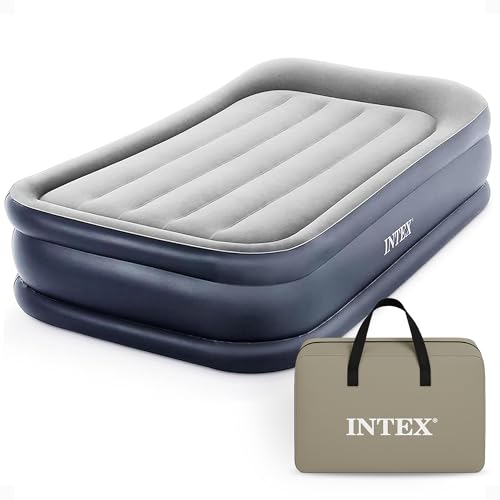
Intex Dura-Beam Plus and Dura-Beam Deluxe air mattresses are practical choices when the bed will be used a few times a year. These lines include standard and raised heights, internal fiber-beam structures, built-in electric pumps on many versions, and flocked surfaces that help fitted sheets stay in place.
A raised twin is useful in a child’s room or compact apartment because it is usually about 39 inches wide and requires less floor space than a queen. A raised queen provides more room but can be slower to pack neatly and more difficult to carry in its storage bag. Intex models vary significantly, so confirm the exact height, weight capacity, and pump type on the box rather than assuming every Dura-Beam mattress has the same specification.
This is the sensible category for a host who wants a low general market price, often about $40–$100 depending on size and height. It is less ideal for daily sleeping, where repeated folding, heat, and pressure can expose weaknesses sooner.
Best for transport: a standard-height twin air mattress
For renters, college rooms, and homes without a dedicated guest room, a standard-height twin is often the most practical answer. It weighs less than a raised queen, fits through crowded spaces, and can be stored vertically in a closet. A typical twin footprint is about 75 by 39 inches, so it can fit in many living rooms without blocking the main walkway.
Look for an integrated pump, a puncture-repair patch, and a soft flocked top. A camping-style mattress can be useful for floor sleeping, but its lower height is less welcoming for older guests and may feel colder on an uninsulated floor. If you choose a separate pump, check that its nozzle matches the air valve before guests arrive.
Height, firmness, and inflation speed: what matters most
Height: A 9–13-inch mattress is compact and often cheaper, but it requires more effort to get up from. An 18–22-inch model is easier for most adults and keeps bedding farther from the floor. A 22-inch mattress can make a small room feel crowded, so allow at least 24 inches of walking space along the accessible side and 30 inches where guests will dress or open luggage.
Firmness: Firm is not automatically better. An overinflated bed transfers more motion and can feel hard on shoulders and hips. Inflate until the surface is supportive but has slight give under body weight. Many air beds lose a small amount of pressure after the first fill as the material stretches; topping up the bed after 30–60 minutes is normal. Do not exceed the manufacturer’s fill guidance.
Inflation speed: Built-in pumps commonly take about 3–6 minutes for a twin and 4–8 minutes for a queen, though voltage, pump design, and mattress volume affect the result. A pump that is fast but loud may be annoying in a studio apartment. If noise matters, inflate before guests arrive and deflate after they leave rather than during sleeping hours.
Room-fit measurements before you buy
In a 10-by-12-foot guest room, a queen air mattress leaves approximately 42 inches at the foot and 60 inches along one side if centered, before accounting for furniture. That sounds generous, but a dresser 18 inches deep, a nightstand 16 inches wide, and an open closet door can reduce usable clearance quickly. A twin is easier to position beside existing furniture and leaves room for a folding luggage stand.
In a living room, measure the fully inflated footprint, not the folded package. A queen blocks about 25 square feet, and its 18–22-inch height can cover sofa seats, drawers, or low cabinet doors. Leave access to an electrical outlet without running the pump cord across a walkway. Keep at least one clear exit route around the mattress.
Construction and durability trade-offs
| Feature | Benefit | Limitation |
|---|---|---|
| Multi-layer PVC body | Resists ordinary stretching and supports repeated inflation | Can still puncture on rough floors or sharp objects |
| Internal air coils or fiber beams | Spreads weight more evenly and reduces hammock-like sagging | More internal structure can increase packed weight |
| Flocked top | Quieter than bare plastic and helps sheets grip | Collects dust and must be completely dry before storage |
| Raised perimeter | Improves edge stability and makes the bed feel less slippery | Reduces the usable sleeping surface slightly |
| Built-in electric pump | Fast setup and no separate equipment to misplace | Requires an outlet and may be too loud for late-night inflation |
Setup and storage details that prevent problems
- Clear the floor of screws, pet toys, gravel, and furniture corners. A thin rug or blanket can protect the underside, but avoid thick padding that destabilizes a tall mattress.
- Inflate the bed in its final position. Moving a fully inflated queen can strain seams and may require two adults.
- Let the mattress settle, then adjust firmness. Use sheets with deep enough pockets for the mattress height, and avoid tucking tightly enough to pull on the corners.
- Keep pets away from the exposed mattress and do not place it directly beside a radiator, heater, or sunny window.
- For storage, deflate fully, wipe away moisture, fold along the existing creases, and store it loosely in its bag. Never pack it while damp.
The parts most likely to cause trouble are usually the pump valve, seams, and top surface—not the internal air beams themselves. A repair patch is useful for a small puncture, but a leaking valve or split seam generally calls for a warranty claim or replacement. For most homes, a raised twin is the best space-saving choice, while a raised queen from SoundAsleep, King Koil, or Intex is the better guest-room option when comfort and easier access matter more than storage space.