The remote and motion type matter more than the brand name on a queen adjustable bed frame, because they determine whether you’ll actually use the zero-gravity preset five years from now or just leave the base flat like a regular mattress foundation. Here’s what’s worth paying extra for, and what’s marketing noise.
Our top picks

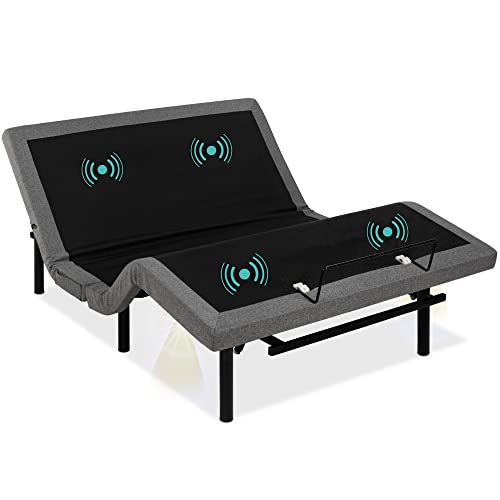 Best Choice Products Ergonomic Queen Size Adjustable
- Find your ultimate sleeping position
- Adjust massage and positions with the click of…
- Manage stress and find unmatched comfort when you…


As an Amazon Associate we earn from qualifying purchases at no extra cost to you.
Head-only vs. head-and-foot vs. split-king motion
Queen adjustable bases come in three motion types, and the jump in price between them is usually justified by how much you’ll use the extra function.
- Head-only lift: The cheapest option, usually $300–$500 for the base alone. Good for reading, watching TV, or reducing acid reflux. No foot articulation means less relief for swollen legs or lower-back pressure.
- Head-and-foot (dual articulation): Usually $600–$1,200. Lets you raise the foot section to take pressure off the lower back and improve circulation. This is the sweet spot for most couples with a single queen mattress, since it covers sleep, recovery, and lounging without paying for features you won’t use.
- Split-king motion in queen sizing (rare, but worth knowing): True independent left/right control only exists on split-king setups, since a queen is a single mattress on one frame. If two sleepers want different positions, the actual solution is switching to a split king with two adjustable twin XL bases, not a queen. Don’t buy a queen adjustable frame expecting split control — it isn’t physically possible on one mattress.
Wired remotes, wireless remotes, and app control
The remote type affects daily convenience more than any spec sheet number.
- Wired remote: Tethered to the base by a cord, usually 5–6 feet long. Reliable, never needs charging, but the cord limits where you can leave it and can get lost between the mattress and headboard.
- Wireless remote (RF or infrared): Runs on watch batteries or a small rechargeable pack. RF remotes work through the mattress and blankets; infrared ones need a clear line of sight to a sensor, which is a common source of frustration when the remote ends up under a pillow.
- App control via Bluetooth: Adds $50–$150 to the price. Useful for setting custom presets, scheduling a gentle wake-up incline, or controlling the base without hunting for a physical remote. The trade-off is dependency on a phone with charge and Bluetooth range, usually 30 feet or less, so it’s a nice-to-have layered on top of a physical remote, not a replacement for one.
If you have to pick one upgrade, prioritize a wireless remote with a backlit keypad over app control. You’ll use the remote every night; the app is a convenience for occasional adjustments.
Zero-gravity presets: worth it or gimmick?
Zero-gravity mode raises the head and foot simultaneously to a position that distributes weight evenly and takes pressure off the lower spine, roughly mimicking the posture used in astronaut training seats. On a base with true dual motors, this is a one-button preset rather than something you dial in manually every night.
It’s genuinely useful for people with lower-back pain, mild sleep apnea, or restless legs, since the slight elevation reduces snoring and swelling. It’s less useful if you sleep on your stomach or side and rarely use the head incline anyway. Bases advertising “zero gravity” without independent head and foot motors are usually just offering a moderate flat incline, so check that the base has two motors (one per section) before assuming you’re getting the real feature.
Weight capacity: what 850 lb dynamic load actually means
Load ratings on adjustable bases come in two numbers, and only one of them tells you what you need to know.
| Rating type | What it measures | Typical queen spec |
|---|---|---|
| Static load | Total weight the frame can support when flat and motionless | 1,000–1,200 lb |
| Dynamic load | Weight the motors can lift and hold while articulating | 700–850 lb |
An 850 lb dynamic rating means the motors can still raise the head and foot smoothly with that combined weight of mattress, bedding, and occupants on board. Below that threshold, cheaper bases (500–600 lb dynamic) may strain or move slowly under two heavier sleepers plus a dense mattress. If you’re pairing the base with a memory foam or hybrid mattress in the 70–100 lb range for a queen, plus two adults, an 850 lb dynamic rating gives real headroom rather than running near its limit every night.
Which mattresses flex safely on an articulating base
Not every queen mattress is built to bend at the head and foot without damage, and this is where a lot of buyers waste money.
| Mattress type | Adjustable base compatibility | Why |
|---|---|---|
| Memory foam | Excellent | Flexes evenly, no internal coils to shift or fatigue |
| Hybrid (foam + pocketed coils) | Good, check manufacturer specs | Individually wrapped coils flex independently; look for “adjustable base compatible” labeling |
| Latex | Good | Flexible and durable under repeated bending, similar to memory foam |
| Innerspring (traditional, connected coils) | Poor to unsafe | Interconnected coil systems can bend, squeak, or break under repeated articulation |
| Any mattress with a box spring | Not compatible | Box springs are rigid and don’t bend; a queen size bed frame with a box spring setup has to be replaced with a low-profile foundation or the mattress placed directly on the adjustable base’s deck |
This matters for anyone shopping a queen size adjustable bed frame with remote alongside a mattress that’s compatible with adjustable bases: check the mattress warranty specifically, since some manufacturers void coverage if a traditional innerspring mattress is used on a motorized base. If you already own a boxspring-and-innerspring setup, plan on budgeting for a new mattress at the same time, usually $600–$1,500 for a queen hybrid or foam model rated for adjustable use.
Headboards, footboards, and frame styles that work with a base
Adjustable bases change what “frame” even means, and this trips up a lot of shoppers who picture a queen size platform bed frame with headboard in the traditional sense.
- Bases with headboard brackets: Most adjustable bases include universal brackets that let you attach almost any queen size bed frame with headboard and footboard you already own, as long as the headboard legs can be removed or the brackets reach the frame’s mounting holes.
- Queen size wood bed frame with headboard: Works fine with an adjustable base as long as the base sits inside the frame’s rails rather than the frame’s slats supporting weight, since the base itself becomes the support structure once the mattress is on it.
- No headboard setups: A queen size bed frame without a headboard, or a bare adjustable base with legs, is the simplest and cheapest path, usually saving $150–$400 versus a framed setup. This is the most common choice for platform-style rooms or anyone prioritizing the base’s function over bedroom furniture aesthetics.
One thing to check before buying: the base’s height with legs attached, typically 7–15 inches depending on the model, needs to clear the headboard bracket height so the mattress doesn’t sit too high or too low relative to the headboard’s frame rail.
Queen vs. king base sizing for two sleepers
If two people share a queen and only one wants motorized adjustment, that’s not solvable on a queen frame since the mattress moves as one piece. A king size bed frame for adjustable base use, paired with two twin XL adjustable bases side by side (a split king), is the only way to get independent motion for each sleeper. Queen adjustable frames make sense when both sleepers are fine sharing the same incline settings, which covers most couples using the base mainly for TV, reading, or a shared zero-gravity position at night.
Quick decision guide
| Situation | Recommended pick |
|---|---|
| Budget-conscious, mainly want to prop up for reading | Head-only motor, wired remote |
| Back pain or swelling, sharing incline settings with a partner | Head-and-foot motors, wireless remote, zero-gravity preset |
| Already own an innerspring mattress with a box spring | Budget for a new foam or hybrid mattress rated for adjustable bases before buying the frame |
| Want a finished bedroom look | Base with universal headboard brackets, paired with an existing or new wood queen frame |
| Two sleepers who each want different positions | Skip the queen adjustable base; go with a split king setup instead |