Key takeaways
- Joint design over material: Steel isn’t inherently louder than wood — loose fasteners are. Look for frames with bolted, threaded connections rather than slot-and-hook assembly, since hooked joints rub with every movement and loosen over time.
- Slat contact points: Bare metal slats resting in bare metal channels are the single most common noise source. Frames that wrap slats in fabric, seat them in plastic sleeves, or use wooden slats in upholstered rails stay quiet far longer.
- Center support and leg count: A queen needs a center rail with at least one or two dedicated legs. Fewer support points mean flex, and flex means joints working against each other all night.
- Weight capacity headroom: Choose a frame rated well above your combined sleeping weight plus mattress. Operating near a frame’s limit is what turns a silent bed into a creaky one by month six.
- Floor interface: Rubber or felt-capped feet prevent the whole frame from shuffling and knocking on hardwood or tile. Bare metal feet transmit every shift straight into the floor and back up as a thud.
As someone who spends their days talking with people about why they wake up at 3 a.m. and can’t get back down, I’ve learned that the culprit is rarely the mattress. It’s the frame underneath it. A joint that shifts a millimeter every time you roll over produces a sharp metallic complaint, and even if you don’t fully wake, your nervous system registers the sound as an interruption. Over weeks, those micro-arousals fragment deep sleep in ways you feel but can’t quite explain. Couples have it worse: one partner’s turn becomes both partners’ problem.
The good news is that squeak is an engineering issue, not a mystery, and it’s solvable at purchase. Below I’ve assessed six popular queen frames specifically through the lens of noise behavior — how the joints are fastened, how the slats meet the rails, and whether the structure distributes load or concentrates it. This guide covers what actually causes frame noise, what to look for on a spec sheet, and my honest read on each option.
Our top picks


As an Amazon Associate we earn from qualifying purchases at no extra cost to you. Ratings are shown as listed on Amazon.
🛒 Best Price Today on Amazon
Prime members get fast, free shipping on everything above, plus member-only deals. New members get a 30-day free trial — cancel anytime.
How to Choose a Non Squeaky Bed Frame (2026)
- Joint design over material: Steel isn’t inherently louder than wood — loose fasteners are. Look for frames with bolted, threaded connections rather than slot-and-hook assembly, since hooked joints rub with every movement and loosen over time.
- Slat contact points: Bare metal slats resting in bare metal channels are the single most common noise source. Frames that wrap slats in fabric, seat them in plastic sleeves, or use wooden slats in upholstered rails stay quiet far longer.
- Center support and leg count: A queen needs a center rail with at least one or two dedicated legs. Fewer support points mean flex, and flex means joints working against each other all night.
- Weight capacity headroom: Choose a frame rated well above your combined sleeping weight plus mattress. Operating near a frame’s limit is what turns a silent bed into a creaky one by month six.
- Floor interface: Rubber or felt-capped feet prevent the whole frame from shuffling and knocking on hardwood or tile. Bare metal feet transmit every shift straight into the floor and back up as a thud.
The Best Non Squeaky Bed Frame (2026)s Reviewed
Allewie Queen Upholstered Platform Bed Frame
This is my default recommendation for noise-sensitive sleepers: the fully upholstered rails mean wooden slats sit against fabric-covered wood rather than metal, eliminating the primary friction point before it exists. The tradeoff is a heavier assembly and no under-bed clearance to speak of, but it’s genuinely quiet from night one.
Fluest Queen Velvet Upholstered Bed Frame
A strong pick if you want the softness of an upholstered headboard with a steel skeleton underneath, and the internal metal supports keep flex minimal across the width. Take the assembly instructions seriously here — fully torquing every bolt in sequence is what separates the silent units from the squeaky ones in owner feedback.
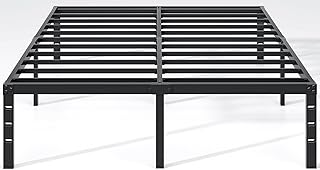
NEW JETO Metal Bed Frame with Storage, 14 Inch
The 14-inch height and open underside make this the most practical choice for small bedrooms where under-bed storage is doing real work, and the heavy-gauge steel handles substantial load without deflecting. Because it’s an all-metal design, I’d add felt washers at the slat contact points as cheap insurance and plan on a bolt re-tightening at the three-month mark.
SHA CERLIN Queen Wrought Iron-Art Bed Frame
The Victorian headboard and footboard give this frame real visual presence, and the welded decorative sections are rigid rather than articulated, which helps acoustically. Ornate metal frames live or die on assembly quality, so build it on a level surface and check that all four legs bear weight evenly before you put the mattress on.
GRUSIGN Queen Velvet Platform Bed with Adjustable Height
The adjustable-height legs are an underrated feature: you can dial in clearance for storage bins or drop the deck for a lower profile, and it accommodates a mattress with or without a box spring. Wooden slats in an upholstered surround make for a quiet foundation, and it’s among the more forgiving frames to assemble solo.
Frequently Asked Questions
Why do metal bed frames squeak more than wooden ones?
Metal-on-metal contact has a very low damping coefficient — vibration travels rather than absorbing, and it produces a high-frequency sound the brain is primed to notice. Wood and fabric absorb that same energy. This is why a well-built metal frame with insulated contact points can be quieter than a poorly bolted wooden one.
Can I fix a squeaky frame I already own?
Often, yes. Strip the bed, tighten every fastener in a star pattern, then add felt pads or fabric strips wherever two hard surfaces touch. A candle-wax rub on metal slat ends works surprisingly well, and beeswax on wooden joints does the same.
Does a heavier mattress make squeaking worse?
Generally the opposite. Heavier mattresses like all-foam or hybrid models press slats firmly into their channels and reduce the slight lift-and-drop cycle that generates noise. Problems arise when total weight approaches the frame’s rated capacity.
Is a box spring needed with these frames?
No — each of these is a platform design with slat support engineered for direct mattress contact. Adding a box spring raises height unnecessarily and introduces its own internal coils as a new noise source.
Final Thoughts
If quiet is your top priority and you’re willing to spend an hour on assembly, the Allewie upholstered platform is the safest bet by design, with the Fluest velvet frame close behind for anyone who wants a similar acoustic profile in a slightly more modern silhouette. For sleepers who need storage clearance more than they need absolute silence, the NEW JETO 14-inch metal frame is the practical choice — just commit to a bolt check every few months and it’ll stay well-behaved.