Key takeaways
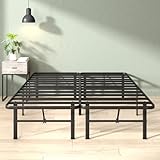
- Rigid side rails: Steel rails with thick tubing or solid hardwood rails resist twisting better than thin stamped metal or narrow particleboard.
- A supported center system: A queen or king should have a center beam running from headboard to footboard, with several legs that contact the floor. One center leg is rarely enough for a king.
- Positive-lock connections: Through-bolts, corner brackets, threaded inserts, and interlocking wood joints are preferable to friction-fit hooks alone.
- Even floor contact: Leveling feet prevent the frame from rocking and reduce the repeated impact that loosens hardware.
- A well-supported mattress deck: Closely spaced slats or a solid platform prevent localized flexing. Check the mattress warranty for its maximum slat gap, commonly 2–3 inches.
The best quiet bed frame for an active couple is a rigid platform with a center-supported deck, bolted or interlocking joints, adjustable feet, and a published weight capacity of at least 800 pounds for a queen or 1,000 pounds for a king.
Noise usually comes from movement between parts rather than from the mattress: loose bolts, slotted metal tabs, wood rubbing against wood, unsupported center rails, and feet that do not sit level. A frame can look substantial in a listing yet wobble if its side rails flex or its center support does not reach the floor.
Our top picks


As an Amazon Associate we earn from qualifying purchases at no extra cost to you. Ratings are shown as listed on Amazon.
What makes a bed frame quiet and stable?
- Rigid side rails: Steel rails with thick tubing or solid hardwood rails resist twisting better than thin stamped metal or narrow particleboard.
- A supported center system: A queen or king should have a center beam running from headboard to footboard, with several legs that contact the floor. One center leg is rarely enough for a king.
- Positive-lock connections: Through-bolts, corner brackets, threaded inserts, and interlocking wood joints are preferable to friction-fit hooks alone.
- Even floor contact: Leveling feet prevent the frame from rocking and reduce the repeated impact that loosens hardware.
- A well-supported mattress deck: Closely spaced slats or a solid platform prevent localized flexing. Check the mattress warranty for its maximum slat gap, commonly 2–3 inches.
For couples, stability matters as much as static capacity. A frame rated for 1,000 pounds may still creak if the rating assumes evenly distributed weight and the frame experiences repeated side-to-side force. Select a capacity at least 25–30 percent above the combined weight of both sleepers, the mattress, bedding, and occasional movement.
Head-to-head: which frame construction is quietest?
| Construction | Noise and rigidity | Typical capacity | Best use | Main trade-off |
|---|---|---|---|---|
| Bolted solid hardwood platform | Very quiet when joints are tight; low flex | 800–1,200 lb | Couples wanting a substantial, furniture-like frame | Heavy; can cost more and require careful leveling |
| Engineered-wood platform with metal inserts | Quiet when reinforced; moderate flex depending on panel thickness | 600–1,000 lb | Bedrooms where a finished upholstered or wood look matters | Threaded inserts can loosen if over-tightened or repeatedly moved |
| Heavy-gauge steel platform | Rigid, but metal-on-metal joints can squeak when loose | 800–1,500 lb | A sturdy king bed frame for an active couple or frequent movers | Needs washers, tight hardware, and protection at contact points |
| Hook-in metal rail frame | Can be quiet initially; more likely to develop play over time | 500–800 lb | Low-cost guest rooms or temporary housing | Connection points may lift, shift, or rattle under lateral force |
| Low-profile upholstered platform | Fabric masks minor contact noise; internal structure determines stability | 600–1,000 lb | Couples who want a softer appearance and reduced impact noise | Harder to inspect or repair once upholstery is attached |
Best choices by bedroom and lifestyle
| Your situation | Most suitable frame | Specifications to prioritize |
|---|---|---|
| Small apartment | Low-profile steel or knock-down hardwood platform | Parts under 36 inches long, no wider than 32 inches through a doorway, 8–12 inches of under-bed clearance |
| Kids or pets under the bed | Enclosed platform or frame with protected center supports | At least 10 inches of clearance, rounded edges, no exposed sharp brackets |
| Renter or frequent mover | Bolted steel frame with replaceable feet | Tool-accessible fasteners, modular rails, packages under about 70 pounds each |
| Back pain or difficult entry | Rigid platform at a planned total bed height | Mattress top about 24–27 inches from the floor; little side-to-side flex |
| Active couple sharing a king | Heavy-duty hardwood or thick-gauge steel platform | 1,000–1,500-pound rating, two or more center legs, six or more floor contact points |
In a 10-by-12-foot bedroom, a queen frame leaves approximately 33 inches at the sides and 48 inches at the foot before accounting for other furniture. A king leaves roughly 27 inches at each side and 36 inches at the foot. Those narrower walkways make a bulky upholstered headboard or wide side rail feel impractical, even if the frame itself is exceptionally stable.
Measurements that matter before buying
Do not compare only the outside dimensions. Measure the following:
- Mattress fit: A standard queen mattress is about 60 by 80 inches; a king is about 76 by 80 inches. Allow only a small fitting gap so the mattress cannot slide noticeably.
- Frame height: Add the platform height to mattress thickness. A 12-inch frame with a 12-inch mattress creates a 24-inch sleeping surface, while a 16-inch frame with the same mattress may feel high for shorter sleepers.
- Clearance: Measure from the floor to the lowest crossbar, not just the advertised space beneath the bed. A 10-inch clearance may become 8 inches where a center beam or foot is located.
- Slat spacing: Choose spacing compatible with the mattress. Foam mattresses commonly require tighter support than traditional innerspring mattresses.
- Doorway access: A fully assembled queen or king rarely passes through a standard 30–32-inch doorway. Look for rails that separate from the headboard and legs that unscrew.
How to assemble a quiet bed frame
1. Prepare the floor and hardware
Assemble the frame on a hard, level surface. Separate bolts by length and use every washer supplied. On a wood floor, place thin felt or rubber pads under feet; on carpet, use firm furniture pads rather than soft foam that allows rocking.
2. Square the frame before tightening
Attach the side rails and headboard loosely, then measure both diagonals. If the measurements differ by more than about 1/4 inch on a queen or king, the frame is skewed. Push it square before tightening, or the mattress deck may sit unevenly and place extra stress on one corner.
3. Tighten in stages
Snug all connections first, then tighten the corner joints, center beam, and legs in sequence. Do not use excessive force on particleboard or threaded inserts. Over-tightening can crush the material and create a joint that loosens faster.
4. Isolate contact points
If metal tabs touch metal rails, add the manufacturer-approved washers or thin protective material at the contact point. For wood-on-wood rubbing, a small amount of paraffin or beeswax on the rubbing surface can reduce friction; avoid liquid oil, which can stain wood and attract dust.
5. Recheck after use
After two to four weeks, inspect every accessible bolt and leveling foot. New wood can compress slightly, and metal hardware can settle. A quarter-turn may be appropriate, but do not keep tightening a joint that still moves; replace a damaged insert, washer, or bracket instead.
What usually wears out first?
On an active couple’s frame, the first weak points are commonly center-support feet, hook-in rail connections, plastic glides, and slats near the shoulders or hips. A center leg that barely touches the floor contributes little until the frame deflects. Adjustable feet should be turned down only enough to make solid contact; extending them too far can make them bend or wobble.
Fabric itself is not a guarantee of quietness. Upholstery can damp a rattle, but the frame underneath still needs a reinforced corner and a center support. Conversely, a bare steel platform can remain silent when its joints use tight bolts, wide washers, and non-slip feet.
How much should a quiet frame cost?
Basic hook-in or light steel frames usually cost $150–$300. A dependable queen platform with a center beam and better hardware commonly falls around $300–$600. Heavy-duty king platforms, hardwood construction, and upholstered frames with reinforced internal rails often range from $600–$1,200 or more. Spend toward stronger joints and better support rather than decorative headboard thickness.
For the most reliable choice, select a frame with a clearly stated capacity, replaceable hardware, accessible connections, and support legs that reach the floor along the full centerline. That combination is more important to a quiet bed frame for active couple than brand styling, extra storage, or a tall headboard.