Key takeaways
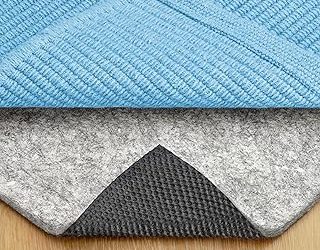
- Construction: Felt-and-rubber composites are the gold standard for hardwood. The felt layer absorbs impact and muffles footfall; the natural rubber layer grips without needing tack or adhesive. Pure PVC mesh grips well initially but degrades faster and can react with floor finishes over time.
- Thickness: A quarter inch is the sweet spot for bedrooms — enough loft to soften each step and reduce sound transmission, thin enough that doors still clear the rug. Go thinner only for low-clearance thresholds; go thicker only under thin flatweaves.
- Finish safety: Look for explicit language about being safe on all floors, and avoid anything with a sticky or coated backing. Adhesive residue on a waterborne polyurethane finish is a costly mistake that shows up months later as a cloudy haze.
- Grip pattern coverage: More contact points beat aggressive stickiness. Pads with dense silicone dot or strip patterns distribute holding force evenly, which keeps the rug flat instead of tensioned into ripples that catch a toe.
- Sizing strategy: Buy the pad to match your rug’s nominal size and trim roughly an inch in from each edge. That inset lets the rug drape naturally at the perimeter and prevents the pad from peeking out — a small detail that separates a finished room from a rushed one.
What's inside
Most people shopping for a rug pad are solving a visible problem: a runner that creeps toward the doorway, a corner that curls, a rug that slides underfoot on a slick oak floor. As someone who spends most of my working hours helping people build better sleep environments, I’d add a quieter concern to that list. Hardwood transmits sound and shock beautifully, which is wonderful for acoustic guitars and terrible for 2 a.m. trips to the bathroom. Every creak, every hollow footfall, every scrape of a shifting rug is a micro-arousal waiting to happen — for you, for a partner, or for a child sleeping in the room below.
A good pad does three things at once: it anchors the rug so nobody trips in the dark, it dampens impact noise, and it puts a protective buffer between coarse rug backing and your floor’s finish. This guide breaks down what actually matters in 2026 — material construction, thickness, adhesive behavior on modern polyurethane finishes — and reviews the pads I recommend most often for bedrooms, nurseries, and hallways where nighttime footing matters.
As an Amazon Associate we earn from qualifying purchases.



🛒 Best Price Today on Amazon
Prime members get fast, free shipping on everything above, plus member-only deals. New members get a 30-day free trial — cancel anytime.
How to Choose a Rug Pad For Hardwood Floors (2026)
- Construction: Felt-and-rubber composites are the gold standard for hardwood. The felt layer absorbs impact and muffles footfall; the natural rubber layer grips without needing tack or adhesive. Pure PVC mesh grips well initially but degrades faster and can react with floor finishes over time.
- Thickness: A quarter inch is the sweet spot for bedrooms — enough loft to soften each step and reduce sound transmission, thin enough that doors still clear the rug. Go thinner only for low-clearance thresholds; go thicker only under thin flatweaves.
- Finish safety: Look for explicit language about being safe on all floors, and avoid anything with a sticky or coated backing. Adhesive residue on a waterborne polyurethane finish is a costly mistake that shows up months later as a cloudy haze.
- Grip pattern coverage: More contact points beat aggressive stickiness. Pads with dense silicone dot or strip patterns distribute holding force evenly, which keeps the rug flat instead of tensioned into ripples that catch a toe.
- Sizing strategy: Buy the pad to match your rug’s nominal size and trim roughly an inch in from each edge. That inset lets the rug drape naturally at the perimeter and prevents the pad from peeking out — a small detail that separates a finished room from a rushed one.
The Best Rug Pad For Hardwood Floors (2026)s Reviewed
RUGPADUSA Dual Surface Felt + Rubber
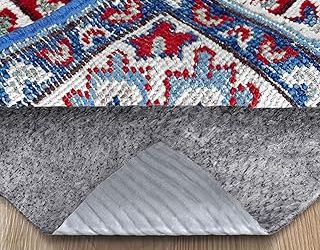
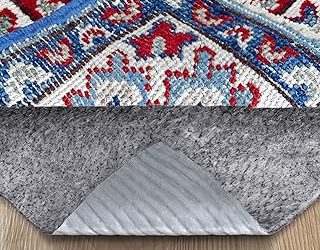
This is the pad I point people toward when the rug lives in a bedroom and budget allows: dense recycled felt bonded to natural rubber, with genuinely reassuring hold and the best impact-noise reduction in this group. If someone in your household is a light sleeper, the acoustic difference underfoot is immediately noticeable.
Mohawk Home Non Slip Rug Pad
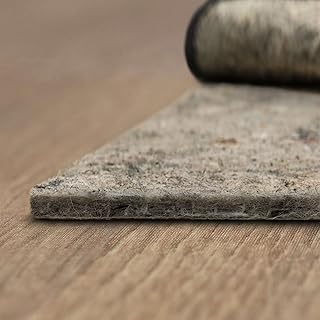
A quarter-inch felt-and-latex-rubber build made in the USA, and a strong value for large 8×10 areas. It lies flat quickly out of the box, which matters more than people expect — a pad that fights you for two weeks means two weeks of tripping hazards.
Veken Cushioned Rug Pad Gripper (8×10)
The standout feature here is coverage: nearly a hundred anti-slip strips spread grip across the whole footprint rather than concentrating it at the edges. Pair that with the felt cushion layer and you get a pad that quiets a room without over-lifting the rug pile.
Jorvila Non-Slip Rug Pad Gripper
A thick, cushioned option for anyone whose main complaint is a rug that wanders across bare oak. It prioritizes hold and underfoot softness over minimal profile, so measure your door clearance before committing.
Gorilla Grip Strong Rug Pad Gripper (2×3)
Small-format pads are where most people cut corners, and it’s exactly where slips happen — bedside, bathroom doorway, top of a stair landing. This 2×3 version delivers serious hold for accent rugs and is worth buying in multiples.
Frequently Asked Questions
Will a rug pad damage my hardwood finish?
A properly made felt-and-natural-rubber pad won’t. Problems come from cheap PVC or adhesive-backed pads, whose plasticizers can migrate into the finish and leave discoloration. If a pad feels tacky to the touch, it doesn’t belong on hardwood.
Does a rug pad really reduce noise?
Yes, meaningfully. A quarter-inch felt layer absorbs the high-frequency slap of a footstep and damps the hollow resonance hardwood produces over a joist bay. It won’t soundproof a room, but for bedroom and nursery floors it lowers the odds that a late-night walk wakes someone.
What thickness should I choose for a bedroom?
Quarter inch for nearly everyone. It gives you cushion and sound absorption while keeping the rug low enough that doors swing freely and the edge doesn’t create a lip you can catch a foot on.
How do I keep the pad from shifting or bunching?
Let it relax flat for a day before laying the rug, trim it slightly smaller than the rug, and vacuum the bare floor first — dust between the rubber and the finish is the most common cause of lost grip. Lift and shake out the pad once or twice a year.
Final Thoughts
For a bedroom where quiet and safe footing are the priorities, the RUGPADUSA Dual Surface pad is the one I’d choose without hesitation, with the Mohawk Home felt-and-rubber pad close behind at a friendlier price for large rooms. For bedside and doorway accent rugs — the spots most likely to cause a stumble in the dark — add a Gorilla Grip 2×3 pad and stop worrying about it.