Key takeaways
- Match seat depth to your inseam: Anything under 21 inches of usable depth leaves taller bodies perched on the edge. Aim for 22–25 inches if you’re over 5’9″, and pair deeper seats with lumbar cushions so shorter users aren’t left with dangling legs and compressed hamstrings.
- Interrogate the fill: Feather-down wrapped over a foam core gives the sink-in feel that helps muscles release, but it needs daily fluffing. High-resilience foam holds shape better for anyone who naps in the same spot every day. Avoid low-density polyfoam that develops a hip-catching trough within a year.
- Check the seat-to-back angle: A reclined backrest of roughly 100–110 degrees supports passive rest; anything more upright fights your body during a nap, anything flatter makes standing up a project. Tufted backs vary widely here, so sit before you settle.
- Understand the hide: Full-grain leather breathes, patinas, and lasts decades. Quality faux leather resists spills and claws and costs far less, but choose a perforated or textured finish rather than a sealed sheet, which will feel clammy against bare skin in summer.
- Prioritize a hardwood frame: Kiln-dried hardwood with corner blocking tolerates the concentrated load of a sleeping adult. Metal legs are fine and often more stable, but a frame that creaks in the showroom will wake you at home.
What's inside
Most people shop for a sofa the way they shop for a rug: they look at it. But if you spend any time studying rest — and I’ve spent the better part of a decade looking at how people actually recover during their waking hours — you learn that the living room couch is a sleep surface in disguise. It absorbs the twenty-minute Sunday nap, the post-dinner slump, the half-hour of horizontal scrolling before bed. A shallow seat forces the pelvis forward and the lumbar spine into a C-curve, which is exactly the posture that leaves you stiff and oddly unrested after a nap that should have helped. Deep seating solves this by letting the femurs rest fully supported, the hips settle back, and the spine stack the way it does on a decent mattress.
Leather adds a second layer to the equation: thermoregulation. Core temperature has to drop for drowsiness to set in, and unlike loop-pile upholstery that traps a warm microclimate around your back, quality hide sheds heat and wicks nothing back at you. This guide looks at deep-seat leather sofas through that lens — seat depth against body height, fill density and how it recovers overnight, frame construction that survives being slept on, and surface materials that stay breathable through a long afternoon. Below are the models worth your attention in 2026, followed by the specifications I’d check before committing.
As an Amazon Associate we earn from qualifying purchases.


🛒 Best Price Today on Amazon
Prime members get fast, free shipping on everything above, plus member-only deals. New members get a 30-day free trial — cancel anytime.
How to Choose a Deep Seat Leather Sofa (2026)
- Match seat depth to your inseam: Anything under 21 inches of usable depth leaves taller bodies perched on the edge. Aim for 22–25 inches if you’re over 5’9″, and pair deeper seats with lumbar cushions so shorter users aren’t left with dangling legs and compressed hamstrings.
- Interrogate the fill: Feather-down wrapped over a foam core gives the sink-in feel that helps muscles release, but it needs daily fluffing. High-resilience foam holds shape better for anyone who naps in the same spot every day. Avoid low-density polyfoam that develops a hip-catching trough within a year.
- Check the seat-to-back angle: A reclined backrest of roughly 100–110 degrees supports passive rest; anything more upright fights your body during a nap, anything flatter makes standing up a project. Tufted backs vary widely here, so sit before you settle.
- Understand the hide: Full-grain leather breathes, patinas, and lasts decades. Quality faux leather resists spills and claws and costs far less, but choose a perforated or textured finish rather than a sealed sheet, which will feel clammy against bare skin in summer.
- Prioritize a hardwood frame: Kiln-dried hardwood with corner blocking tolerates the concentrated load of a sleeping adult. Metal legs are fine and often more stable, but a frame that creaks in the showroom will wake you at home.
The Best Deep Seat Leather Sofas of 2026, Reviewed
Garvee 81″ Modern Leather Couch, Brown
A tidy 81-inch footprint with genuinely deep seating and handmade button tufting that keeps the cushion faces from migrating — a small detail that matters over years of use. The mid-century proportions suit apartments where a full sectional would swallow the room.
80″ Genuine Full-Grain Leather Chesterfield, Caramel
The standout for restorative comfort: feather-down fill over a deep seat platform produces the enveloping give that helps shoulders and hips fully unload. Full-grain hide means it breathes well during long naps and improves in appearance rather than degrading.
111.81″ Brown 4-Seater Faux Leather Sofa
At nearly 112 inches, this is the pick for households where someone actually stretches out full-length. The wood frame and metal legs give it the rigidity a genuine sleeping surface requires, and the faux leather stays cool enough for extended lounging.
EASE MOOSE Oversized Modular Sectional, Brown
Wide, deep modules that you can reconfigure as your room and habits change — useful if you’re not yet sure whether you nap sprawled or curled. The scratch-resistant surface makes it a sane choice for homes with pets who share the couch.
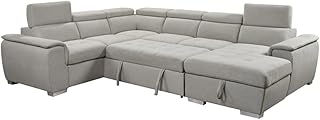
EASE MOOSE 100″ L-Shaped Sectional, Black
The movable ottoman is the quiet hero here, converting a corner seat into a proper leg-elevated recovery position that helps with circulation and swelling. Removable, waterproof covers mean you can wash away the realities of daytime sleeping.
Frequently Asked Questions
Is napping on a sofa actually bad for you?
Not inherently. Short daytime naps of 20–30 minutes support alertness and mood. Problems arise from the surface, not the nap — a sofa that twists the spine or overheats your back fragments sleep and creates the grogginess people blame on napping itself.
How deep is too deep?
Once your feet can’t reach the floor comfortably while seated, you’ve crossed into lounge-only territory. Depths beyond about 26 inches typically require a footstool or bolster for upright sitting, which is fine if rest is the priority.
Does leather really sleep cooler than fabric?
Quality leather conducts heat away from the skin rather than insulating it, so it feels cooler on contact and doesn’t build a warm pocket the way plush textiles do. Sealed synthetic finishes are the exception — they can feel sticky in humid conditions.
How do I keep deep cushions from going flat?
Rotate and flip seat cushions monthly, fluff down-filled units after each use, and vary where you sit. Uneven compression, not total wear, is what makes a sofa feel old.
Final Thoughts
For pure restorative comfort, the 80″ full-grain Chesterfield in caramel is hard to beat — breathable hide and feather-down fill deliver the kind of pressure relief usually reserved for good mattresses. If you need room to lie down fully, the 111.81″ four-seater offers the length and frame rigidity to do it properly, while the EASE MOOSE L-shaped sectional with its movable ottoman is the smartest pick for anyone who wants elevated legs and washable covers in one package.