Key takeaways
- Recline depth and infinite positioning: A two-position mechanism forces you into someone else’s idea of comfortable. Look for infinite-position or dual-motor designs that let the backrest and footrest move independently — this is what allows you to find a mild zero-gravity posture, where the knees sit slightly above the heart and pressure comes off the lumbar spine.
- Independent headrest adjustment: The single biggest cause of morning neck pain from chair sleeping is a fixed headrest that shoves the chin toward the chest, narrowing the airway and encouraging snoring. An adjustable headrest lets you keep the cervical spine neutral once you’re fully reclined.
- Motion quality over motion quantity: Slow, low-amplitude rocking is genuinely sleep-promoting; the vestibular system reads it as safety. Fast, springy, or noisy rocking does the opposite. Test for a smooth glide arc and a swivel base that turns without shudder or click.
- Heat placement, not just heat presence: Lumbar-focused warmth relaxes paraspinal muscles and encourages the peripheral vasodilation that precedes sleep onset. Whole-back heat that runs all night, by contrast, can raise core temperature and fragment sleep — so prioritize models with zone control and an auto shut-off.
- Width, weight rating, and upholstery breathability: Extra-wide seats (38–40 inches) reduce the micro-adjusting that keeps you shallowly awake. Chenille and woven fabrics breathe better for long sessions; PU leather wipes clean more easily but traps heat, so factor in your bedroom temperature.
What's inside
Most people shopping for a rocker recliner aren’t really shopping for furniture — they’re shopping for rest. I hear it constantly in sleep consultations: the new parent who needs somewhere to feed a baby at 3 a.m. without fully waking up, the shift worker whose body clock refuses to cooperate with a flat mattress, the retiree whose hips ache too much to lie supine. A chair becomes the compromise. The problem is that most rocker recliners are engineered for television, not for physiology. They pitch your neck forward, stop reclining at an angle that keeps your abdomen compressed, and rock with a mechanism that squeaks the moment you begin to drift off.
This guide approaches the category through a sleep-wellness lens rather than a decor one. I’ve focused on the features that actually determine whether you’ll doze comfortably and wake without stiffness: recline geometry, headrest independence, motion quality, and thermal control. Below you’ll find the highest-rated oversized rocker recliners available in 2026, followed by a buying framework and answers to the questions that come up most often when a chair is doing double duty as a rest surface.
As an Amazon Associate we earn from qualifying purchases.


🛒 Best Price Today on Amazon
Prime members get fast, free shipping on everything above, plus member-only deals. New members get a 30-day free trial — cancel anytime.
How to Choose a Rocker Recliner (2026)
- Recline depth and infinite positioning: A two-position mechanism forces you into someone else’s idea of comfortable. Look for infinite-position or dual-motor designs that let the backrest and footrest move independently — this is what allows you to find a mild zero-gravity posture, where the knees sit slightly above the heart and pressure comes off the lumbar spine.
- Independent headrest adjustment: The single biggest cause of morning neck pain from chair sleeping is a fixed headrest that shoves the chin toward the chest, narrowing the airway and encouraging snoring. An adjustable headrest lets you keep the cervical spine neutral once you’re fully reclined.
- Motion quality over motion quantity: Slow, low-amplitude rocking is genuinely sleep-promoting; the vestibular system reads it as safety. Fast, springy, or noisy rocking does the opposite. Test for a smooth glide arc and a swivel base that turns without shudder or click.
- Heat placement, not just heat presence: Lumbar-focused warmth relaxes paraspinal muscles and encourages the peripheral vasodilation that precedes sleep onset. Whole-back heat that runs all night, by contrast, can raise core temperature and fragment sleep — so prioritize models with zone control and an auto shut-off.
- Width, weight rating, and upholstery breathability: Extra-wide seats (38–40 inches) reduce the micro-adjusting that keeps you shallowly awake. Chenille and woven fabrics breathe better for long sessions; PU leather wipes clean more easily but traps heat, so factor in your bedroom temperature.
The Best Rocker Recliners Reviewed
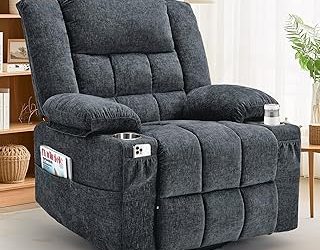
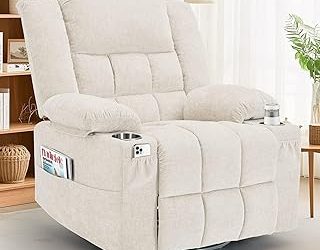
Oversized Power Swivel Rocker Recliner for Big and Tall (Chenille, Blue)
The 375-pound capacity and overstuffed chenille build make this the most forgiving option here for extended reclining, and the breathable fabric matters more than buyers expect during long night feeds. Power actuation means you can adjust position without bracing against a lever — a real advantage when you’re holding a sleeping infant.
Power Oversized Swivel Rocker with Dual Motor and Adjustable Headrest
This is the most sleep-literate chair on the list: dual motors separate back and leg movement, and the independent headrest lets you dial in cervical alignment once you’re near-horizontal. The LED lighting and USB-C port also mean less fumbling with your phone at night, which protects your melatonin better than switching on an overhead lamp.
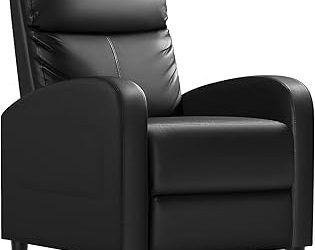
Bonzy Home Oversized Swivel Rocker Recliner (Black PU Leather)
At 40 inches wide, this is the roomiest seat reviewed, and the extra shoulder space genuinely reduces restless repositioning. The PU leather is easy to keep clean but runs warmer than fabric, so it suits cooler rooms or shorter rest sessions best.
ANJ Dual Motor Oversized Power Recliner with Massage and Heat
The 270-degree swivel and adjustable headrest combine well for anyone who reclines to read before sleep and wants to reorient toward a bed or window afterward. Massage intensity is moderate rather than aggressive, which is what you actually want pre-sleep — deep percussion tends to be arousing rather than calming.
Korser 360° Swivel Rocker Recliner (Fabric, Dark Gray)
A manual mechanism keeps the price and the failure points down, and the full 360-degree swivel makes it unusually flexible in tight nursery layouts. Choose this if you value a quiet, cable-free chair and don’t mind pushing back into the recline yourself.
Frequently Asked Questions
Is sleeping in a recliner bad for you?
Occasional recliner sleep is generally fine and can even help people with reflux, sleep apnea, or post-surgical restrictions by keeping the head elevated. The risks come from prolonged immobility — reduced circulation in the lower legs and stiffness in the hips — so shift position periodically and don’t let it become your only sleep surface without discussing it with a clinician.
What recline angle is best for rest?
Somewhere between 30 and 45 degrees from vertical suits most people, with the footrest raised enough that the knees sit level with or slightly above the hips. That combination reduces lumbar load and eases breathing compared with a fully upright or nearly flat position.
Do heat and massage functions actually improve sleep?
Indirectly, yes. Gentle warmth and low-intensity vibration lower muscle tension and support the drop in core temperature that triggers sleep onset. Use them for fifteen to twenty minutes before you intend to rest, then turn them off — continuous use through the night is more likely to disturb sleep than deepen it.
Will a rocker recliner fit in a nursery?
Oversized models need roughly four feet of clearance behind the seat back and space for the footrest to extend. Wall-hugger or swivel-heavy designs like the Korser adapt better to small rooms, but always measure your fully reclined footprint before ordering.
Final Thoughts
If rest quality is your priority, the Power Oversized Swivel Rocker with Dual Motor and Adjustable Headrest is the strongest all-round choice, thanks to its independent headrest and infinite positioning. Larger or taller users will be better served by the Big and Tall Chenille Power Recliner, whose breathable upholstery and 375-pound rating hold up to nightly use, while the Korser 360° Swivel Recliner remains the smartest pick for smaller nurseries and anyone who prefers a quiet manual mechanism.