The best bunk bed for young kids in 2026 is a low-profile twin-over-twin with stairs instead of a ladder, 14-inch or higher guardrails on the top bunk, and Greenguard Gold or low-VOC certified finishes — models like the Max & Lily Low Bunk with Stairs, Storkcraft Caribou Solid Wood Bunk with Ladder and Guardrail, and Delta Children Twin Over Twin Bunk with Stairs are the safest, most age-appropriate picks for ages 4 to 8 because they keep the top bunk under 50 inches tall and prioritize fall protection over maximizing under-bed space.
Our top picks
 Max & Lily Fundamental Twin Low Bunk
- Fundamental Twin Bunk: Our low bunk bed for…
- Crafted with Care: Made with solid wood and…
- Sturdy & Stable: This kids twin bunk bed…
 Max & Lily Low Bunk Bed
- Twin High Loft Bed: Fun and functional, our…
- Sturdy & Stable: High, 400-pound resting weight capacity…
- Low Bunk + Staircase , Clean Design: Slatted…
 Max & Lily Solid Wood Twin Over
- Space-Saving Design with Slide: Create a playful haven…
- Superior Quality Construction: Crafted from durable, knot-free solid…
- Sturdy & Secure Support: Capable of accommodating up…
As an Amazon Associate we earn from qualifying purchases at no extra cost to you.
What Actually Makes a Bunk Bed Safe for a 4 to 8 Year Old
Standard adult or teen bunk beds are often 60 to 65 inches tall with a 10-inch guardrail and a vertical ladder. For young kids, that design creates two problems: a higher fall risk and a climb that is difficult to navigate at night. For this age group, look for these four specs first:
- Overall height under 50 inches: Low bunks typically measure 42 to 50 inches tall, compared to 61+ inches for standard bunks. Lower height reduces injury severity and makes it easier for a parent to reach the top bunk.
- Guardrail height 14 to 16 inches above the mattress foundation: The CPSC recommends at least 5 inches above the top of the mattress. For young kids, a 14+ inch rail measured from the slats ensures even a 5 to 6-inch thick mattress still leaves 8 to 10 inches of protection. Gaps between rails should be under 3.5 inches to prevent entrapment.
- Stairs vs. ladder: Stairs with enclosed sides and a handrail are safer for ages 4 to 6. Look for stair treads at least 3.5 inches deep and a stair angle under 60 degrees. Ladders are fine for ages 6+ if they are angled and have flat, grooved steps rather than round rungs.
- Non-toxic finishes: Look for Greenguard Gold certification, CARB Phase 2 compliance for any engineered wood, or finishes labeled low-VOC / water-based. Solid wood models using New Zealand pine or rubberwood are most common in this certified category. Avoid beds that do not list their finish or certification at all.
One more rule: children under 6 should not sleep on the top bunk, even on a low bunk. For ages 4 and 5, use the low bunk as a floor-level twin + play/read space, or choose a model that separates into two individual twin beds.
Best Bunk Beds for Young Kids by Situation
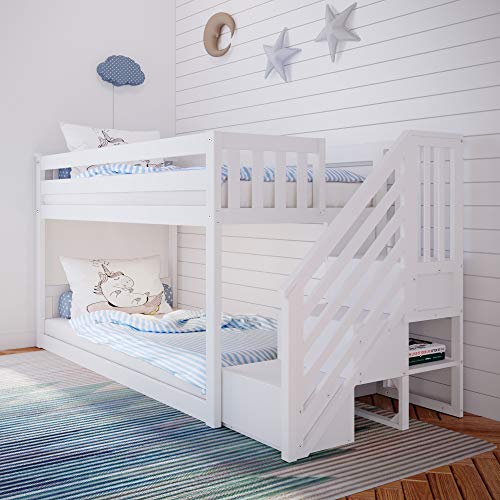
Best Overall Low Bunk with Stairs: Max & Lily Low Bunk Bed with Stairs
This is the benchmark for the 4 to 8 age range because it was designed specifically for low height and stair access. The top bunk sits around 45 to 47 inches tall, guardrails are 15 inches above the slats, and the staircase includes built-in storage drawers. It is solid New Zealand pine with a low-VOC finish and separates into two twins when kids outgrow the bunk setup. It usually costs in the $500–$800 range and requires two boxes to ship. The stairs add about 18 to 20 inches to the overall footprint, so it needs more floor length than a ladder model.
Best for Small Rooms: Storkcraft Caribou Solid Wood Twin Bunk with Ladder
If you are fitting a bunk into a 10×12 ft room, a ladder model saves critical space. The Caribou measures about 78.5″ L x 42″ W x 48″ H in low-bunk configuration and fits with about 30 inches of clearance left on one side for a dresser if placed on the 10-foot wall. Its solid pine construction keeps weight manageable, and it converts to two twins. Trade-off: the ladder is better for ages 6 to 8 than for 4-year-olds, and you will want to place the ladder against a wall. Usually $300–$500.
Best Twin-Over-Twin with Stairs and Storage: Delta Children Twin Over Twin Bunk with Stairs and Guardrail
Delta Children’s stair models are popular for young families because the stairs double as deep drawers or cubbies and the finish options are Greenguard Gold certified. Height is typically 47 to 49 inches, with 14-inch guardrails and an angled staircase that is easier for small feet than a straight ladder. It is slightly heavier due to the storage stairs, which also makes it more stable and less likely to wobble when a child climbs. Usually $500–$750.
Best Modular / Convertible Option: IKEA KURA Reversible Bed
The KURA is not a traditional bunk but a reversible low loft that can be set as a 44-inch high loft with an open play area below, or flipped as a low bunk-style setup. It is solid pine, very low to the ground, and the ladder is intentionally shallow. Many parents use it for ages 4 to 7 as a first elevated bed, then reconfigure it later. It is the most affordable solid wood option, usually $250–$400, but guardrail panels are fabric and the maximum mattress thickness for the top is strictly 5 inches.
Head-to-Head Comparison: Real Dimensions and Limits
Product listings often bury guardrail height and clearance numbers. This table compares young-kid-appropriate models on the specs that matter most for safety and room fit:
| Model Type | Overall Height | Guardrail Above Slats | Stairs / Ladder Footprint | Top Bunk Weight Limit | Mattress Thickness (Top) |
|---|---|---|---|---|---|
| Max & Lily Low Bunk with Stairs | 45.5 inches | 15 inches | Adds 19 inches to length | 175 lbs | 5 – 6 inches max |
| Storkcraft Caribou Low Bunk | 48 inches | 14 inches | Adds 3 inches (ladder) | 165 lbs | 6 inches max |
| Delta Children Bunk with Storage Stairs | 48.5 inches | 14 inches | Adds 20 inches to length | 200 lbs | 6 inches max |
| IKEA KURA Loft | 44 inches | Fabric panel, 13 inches | Adds 16 inches (ladder) | 100 lbs | 5 inches max |
| Standard Teen Bunk (for contrast) | 62 inches | 10 – 12 inches | Adds 18 inches (vertical ladder) | 225 lbs | 8 inches max |
For ceiling clearance: with an 8-foot (96-inch) ceiling and a 6-inch mattress, a 45-inch low bunk leaves about 45 inches of sitting space above the top mattress — enough for a child to sit up without hitting the ceiling. A 62-inch standard bunk leaves only 28 inches, which forces kids to crouch.
Room Fit and Clearance: Will It Fit Without Blocking the Room?
A twin-over-twin bunk is typically 79 to 81 inches long and 42 to 45 inches wide including guardrails. In a 10×12 ft room (120″ x 144″), placing the bunk on the 10-foot wall leaves:
- About 40 to 42 inches of open floor width if centered on the 12-foot wall, enough for a 30-inch dresser and walkway
- At least 30 inches of clearance needed in front of stairs to step down safely — do not place stairs facing a wall or closet door
- 2 to 3 feet of open space around the ladder side if you choose a ladder model, so kids do not climb over toys or a nightstand
Measure your doorway before buying. Most stair boxes are 52 to 58 inches long and 18 to 22 inches wide. Low bunks ship in two boxes, each 60 to 85 lbs. Hallways and apartment doorways under 30 inches wide will make it difficult to carry assembled stair sections through. Assembling in the room is strongly recommended.
Material and Construction Trade-Offs
| Material | Durability for Young Kids | Safety / Finish Notes | Weight and Stability | What Wears First |
|---|---|---|---|---|
| Solid Wood (pine, rubberwood) | Very good; resists dents better than engineered wood, can be re-tightened | Easiest to find with Greenguard Gold / low-VOC certification | Heaviest, 120 – 160 lbs assembled; most stable, least wobble | Scratches on finish, loose bolts at joints after 12-18 months |
| Engineered Wood (MDF / particleboard) | Fair; chips and swells with moisture, screws strip more easily | Requires CARB Phase 2 / TSCA Title VI compliance; check for formaldehyde standards | Lighter, 90 – 120 lbs; can feel less solid on top bunk | Laminate peeling at edges, cam locks loosening |
| Metal Frame | Good; will not crack but can bend at welds | Powder-coated finishes are low-VOC but check for sharp weld points and guardrail gaps | Light to moderate, 80 – 110 lbs; can be noisy when kids move | Paint chipping at ladder hooks, squeaking at bolt joints |
For ages 4 to 8, solid wood with a water-based finish is the most practical long-term choice. It tolerates repeated disassembly if you plan to separate the bunk into two twins later, and it holds screws better after multiple moves. If you are renting or expect to move within a year, a solid wood low bunk that uses metal-on-metal bolt connectors rather than wood screws will survive the move better.
Decision Matrix: Match Your Situation to the Right Choice
| Your Situation | Choose This | Why It Works |
|---|---|---|
| Youngest child is 4 or 5, room shared with sibling | Low bunk with stairs that separates into two twins | Keeps top bunk low and allows you to use both beds on the floor until age 6 |
| Small apartment or 10×10 ft room | Low bunk with ladder (Storkcraft/IKEA type) | Saves 18-20 inches of floor length vs. stairs |
| Kids and pets in the same room, frequent climbing | Solid wood stairs with closed backs and handrail | Prevents pets from going under stairs, gives kids stable footing |
| Renter who may move in 1-2 years | Solid wood that converts to two twins, metal bolt hardware | Easier to move as two twins than as a full bunk; hardware survives reassembly |
| Child has anxiety about heights | Lowest loft option (IKEA KURA or 42-inch low bunk) | Top bunk is only 35-40 inches off the floor with a thin mattress |
Assembly, Moving and Long-Term Durability Realities
Bunk beds for young kids typically take 90 to 150 minutes to assemble with two adults. Stair models have 8 to 12 steps and 30 to 40 bolts, so allocate more time than a ladder model. You will need a Phillips screwdriver and included Allen keys; a power drill speeds up slat installation but can strip particleboard if over-torqued.
Plan for retightening every 6 months. The first place bunks loosen is at the top guardrail bolts and the stair-to-frame connection. Use thread-locking washers if included and avoid overloading storage stairs — most stair drawers are rated for 15 to 25 lbs each, not for a child sitting inside.
Mattress fit matters more than most parents expect. The mattress should sit at least 5 inches below the top of the guardrail. A common mistake is using an 8-inch memory foam mattress on a low bunk; it leaves only 6 to 7 inches of guardrail above the mattress, which defeats the safety design. Choose a 5 to 6-inch innerspring or low-profile foam mattress for the top bunk, even if the bottom bunk uses a thicker one.
FAQ: Real Follow-Up Questions from Parents
Can a 4-year-old sleep on the bottom bunk of a low bunk bed?
Yes. The bottom bunk is typically 8 to 12 inches off the floor with a 6-inch mattress, so fall risk is minimal. Add a removable rail on the bottom bunk if the bed is placed away from a wall, and keep the area around it clear.
Are stairs really safer than a ladder for young kids?
For ages 4 to 6, yes. Stairs provide a handrail, deeper steps, and enclosed sides that prevent a foot from slipping through. Angled ladders are acceptable for ages 6 to 8 if the child is coordinated and the ladder has flat treads, but stairs remain easier for nighttime bathroom trips.
What ceiling height do I need for a low bunk?
A low bunk at 45 to 49 inches works safely with a standard 96-inch ceiling. If your ceiling is under 92 inches (common in basements or attics), measure carefully and keep the top mattress to 5 inches to preserve sitting height.