Key takeaways
- Sone rating first, always: A sone is a perceived-loudness unit, not a decibel, and it scales linearly — a 2.0-sone fan sounds roughly twice as loud as a 1.0-sone fan. Stay at or below 1.5 sones for any bathroom sharing a wall, floor, or duct run with a bedroom.
- Match CFM to room volume: The standard rule is one CFM per square foot for baths under 100 sq ft, with a 50 CFM floor. Add 50 CFM for a jetted tub and 50 for an enclosed shower, then confirm your duct is wide enough (usually 4″ or 6″) to actually deliver the rated airflow.
- Insist on dimming and tunable color: Selectable CCT models let you run 2700K–3000K at night and 4000K–5000K for grooming. Warm, dimmed light at 2 a.m. is the single easiest change you can make to protect your ability to fall back asleep.
- Automate the runtime: Humidity-sensing fans start when steam rises and shut off once the room dries, which means moisture actually leaves the house instead of settling into caulk. It also removes the need to remember a switch when you’re half-conscious.
- Check the housing and certifications: Confirm the ceiling cutout, housing depth against your joist bay, and ETL or UL listing. Damp-location rating is essential; a shower-zone installation also requires GFCI protection.
What's inside
Anyone who has been startled awake by a roaring bathroom fan at 2 a.m. understands that ventilation is a sleep issue as much as a plumbing one. In my work on bedroom and bathroom sound environments, the en suite exhaust fan is one of the most overlooked disruptors in the house — a 3.5-sone unit running beside a bedroom wall pushes the same acoustic load as a window air conditioner, and a bare 100-watt-equivalent bulb overhead delivers a burst of blue-heavy light precisely when your melatonin curve is at its most fragile. The result is a household that ventilates properly during the day and avoids the fan entirely at night, which is exactly backward: humid, stagnant air after a late shower is what breeds mildew on grout and drywall.
This guide looks at bathroom ceiling fan-and-light combinations through two lenses at once — how well they move moisture out, and how gently they treat a sleeping body. I’ve weighed sone ratings against real CFM output, examined dimming and color-temperature options for late-night use, considered humidity sensing so the unit does the thinking after you’ve stumbled back to bed, and factored in the retrofit realities of ceiling openings, duct diameter, and existing wiring. Below are six units worth your attention in 2026, followed by the criteria I’d use to narrow them down.
As an Amazon Associate we earn from qualifying purchases.



🛒 Best Price Today on Amazon
Prime members get fast, free shipping on everything above, plus member-only deals. New members get a 30-day free trial — cancel anytime.
How to Choose a Bathroom Ceiling Fan With Light (2026)
- Sone rating first, always: A sone is a perceived-loudness unit, not a decibel, and it scales linearly — a 2.0-sone fan sounds roughly twice as loud as a 1.0-sone fan. Stay at or below 1.5 sones for any bathroom sharing a wall, floor, or duct run with a bedroom.
- Match CFM to room volume: The standard rule is one CFM per square foot for baths under 100 sq ft, with a 50 CFM floor. Add 50 CFM for a jetted tub and 50 for an enclosed shower, then confirm your duct is wide enough (usually 4″ or 6″) to actually deliver the rated airflow.
- Insist on dimming and tunable color: Selectable CCT models let you run 2700K–3000K at night and 4000K–5000K for grooming. Warm, dimmed light at 2 a.m. is the single easiest change you can make to protect your ability to fall back asleep.
- Automate the runtime: Humidity-sensing fans start when steam rises and shut off once the room dries, which means moisture actually leaves the house instead of settling into caulk. It also removes the need to remember a switch when you’re half-conscious.
- Check the housing and certifications: Confirm the ceiling cutout, housing depth against your joist bay, and ETL or UL listing. Damp-location rating is essential; a shower-zone installation also requires GFCI protection.
The Best Bathroom Ceiling Fans With Light (2026), Reviewed
Ultra Quiet 120 CFM Fan with 1000-Lumen LED
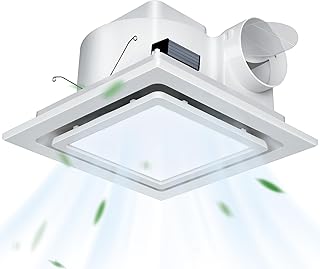
At 1.0 sone with 120 CFM, this is the sweet spot for a shared-wall bathroom: enough airflow for a 100+ sq ft space with a genuinely low acoustic signature. The 10″ × 10″ ceiling mount and straightforward wiring make it one of the easier same-day retrofits here.
Panasonic WhisperFit FV-0511VFL1
Panasonic’s Pick-A-Flow switch lets you set 50, 80, or 110 CFM after installation, which is invaluable when your duct run underperforms the spec sheet. The low-profile housing fits shallow ceilings, and the dimmable LED is the most refined light quality in this group — my default recommendation for a primary en suite.
110 CFM Round Fan with Light and Nightlight
The separately switched nightlight is the standout feature from a sleep standpoint: it gives you enough orientation to navigate the room without triggering a full cortisol-and-light wake-up. The matte black round trim also reads as a light fixture rather than a vent.
80 CFM Round Fan Light Combo, Brushed Nickel
At 2.0 sones this is the loudest unit on the list, so reserve it for a powder room or a bath well away from bedrooms. In exchange you get 3CCT switchable lighting behind an acrylic diffuser and finish hardware that coordinates cleanly with brushed-nickel fixtures.
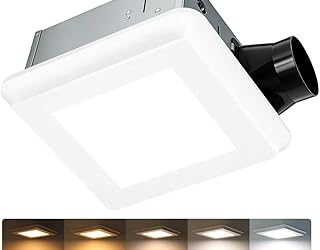
130 CFM Fan with Humidity Sensor and 5CCT Light
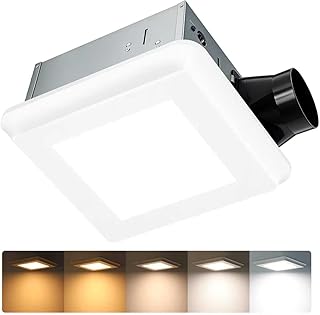
This is the thinking person’s choice: 130 CFM at 1.0 sone, five color temperatures, and a humidity sensor that handles runtime without any input from you. For households where nobody remembers the fan switch, the automation alone justifies the price.
Frequently Asked Questions
How long should the fan run after a shower?
Twenty minutes past the end of the shower is the working minimum for clearing suspended moisture. A timer switch or humidity sensor removes the guesswork entirely.
Will a quiet fan disturb someone sleeping nearby?
A 1.0-sone unit produces a low, broadband hum that most sleepers habituate to within minutes — some find it functions as mild sound masking. Anything above 2.0 sones tends to intrude, particularly during lighter sleep stages toward morning.
Do I need a heater function?
In cold climates, yes. The Broan-NuTone heater model warms the room enough that you’re not jolted by cold air on wet skin, which is more disruptive to a wind-down routine than most people assume.
Can I install one of these myself?
If you’re replacing an existing fan with a similar cutout and duct diameter, it’s a manageable afternoon project. New ductwork, roof or soffit penetrations, or a new circuit warrant a licensed electrician.
Final Thoughts
For most bathrooms adjacent to a sleeping space, the Panasonic WhisperFit FV-0511VFL1 is the safest investment — adjustable airflow, a shallow housing, and dimmable light of genuine quality. If you want the room to manage itself, the 130 CFM humidity-sensing model with 5CCT lighting is the smarter buy, while the Broan-NuTone heater fan earns its place in any cold-weather home where stepping out of the shower shouldn’t feel like a shock to the system.