Key takeaways
- Profile height: Aim for roughly 10 to 14 inches. Below that, you lose pressure relief at the hip; above it, the mattress becomes a lever that resists the motor and creates an awkward, shallow bend instead of a clean fold.
- Coil architecture: If you want a hybrid, insist on individually pocketed coils. Connected innerspring grids — Bonnell, offset, continuous wire — behave like a single rigid panel and will eventually deform under repeated articulation.
- Layer bonding: Foam layers should be laminated across their full surface, not spot-glued at the perimeter. Full-surface bonding is what prevents internal shifting and the hollow gap that develops under your lumbar spine after a few hundred cycles.
- Heat management: Raising the head reduces airflow beneath your torso. Gel infusions, graphite additives, or open-cell foam structures offset that, and matter more on an adjustable base than on a flat platform.
- Split configurations: Two sleepers with different position preferences need a split king, full stop. It is the only format that lets one person sit upright while the other stays flat, and it removes motion transfer as a variable.
An adjustable base promises a lot: elevated reading, snore-reducing head tilt, weightless zero-gravity recline. Then you drop the wrong mattress on top of it and none of it works. Rigid innerspring units resist articulation, thick slabs bottom out at the hinge, and glued-down foam layers separate at the shoulder break within a season. Sleepers end up with an expensive motorized frame that groans through half its range while the mattress fights back.
Flexibility is the deciding variable, and it comes from construction rather than marketing copy. This guide breaks down what makes a mattress genuinely articulation-friendly — profile height, coil architecture, foam density, edge behavior — then reviews the strongest bed-and-base combinations available this year. Several are sold as matched sets, which sidesteps compatibility guesswork entirely.
Our top picks


As an Amazon Associate we earn from qualifying purchases at no extra cost to you. Ratings are shown as listed on Amazon.
🛒 Best Price Today on Amazon
Prime members get fast, free shipping on everything above, plus member-only deals. New members get a 30-day free trial — cancel anytime.
How to Choose a/an Mattress For Adjustable Bed Frame (2026)
- Profile height: Aim for roughly 10 to 14 inches. Below that, you lose pressure relief at the hip; above it, the mattress becomes a lever that resists the motor and creates an awkward, shallow bend instead of a clean fold.
- Coil architecture: If you want a hybrid, insist on individually pocketed coils. Connected innerspring grids — Bonnell, offset, continuous wire — behave like a single rigid panel and will eventually deform under repeated articulation.
- Layer bonding: Foam layers should be laminated across their full surface, not spot-glued at the perimeter. Full-surface bonding is what prevents internal shifting and the hollow gap that develops under your lumbar spine after a few hundred cycles.
- Heat management: Raising the head reduces airflow beneath your torso. Gel infusions, graphite additives, or open-cell foam structures offset that, and matter more on an adjustable base than on a flat platform.
- Split configurations: Two sleepers with different position preferences need a split king, full stop. It is the only format that lets one person sit upright while the other stays flat, and it removes motion transfer as a variable.
The Best Mattress For Adjustable Bed Frame (2026)s Reviewed
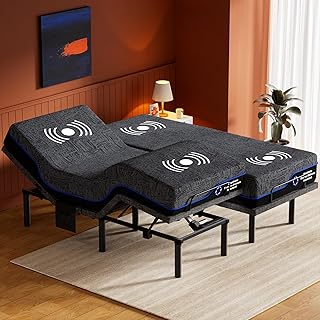
Split King Adjustable Bed Frame with 14″ Luxury Hybrid Mattress
A well-balanced package: the 14-inch hybrid delivers pocketed-coil support without the stiffness that fights the base, while app control, massage, zero gravity, and anti-snore presets cover the functional range most sleepers actually use. The medium-soft feel suits side sleepers and anyone who spends evening hours propped up reading.
Celestial Aurora Adjustable Base + 12″ Gel Memory Foam
All-foam at 12 inches is close to ideal geometry for articulation — it tracks the base contour smoothly rather than tenting at the break. CertiPUR-US certification and programmable memory positions make this a sensible pick for sleepers managing reflux or circulation issues who need to return to a precise angle nightly.
Liberty 11″ Hybrid Cool Sleep Graphite Memory Foam
The unusual 70×75 footprint solves a real problem for RV and short-king setups where standard sizes simply won’t fit the chassis. Graphite-infused foam over pocket coils gives it genuine thermal performance, and the 11-inch profile flexes readily on a motorized base.
Serta Perfect Sleeper Hybrid 12″ Medium Queen + Adjustable Base
The most conventional recommendation here, and that’s a strength — Serta’s medium hybrid lands in the feel range that suits the broadest mix of body types and sleep positions. A solid default for single sleepers or couples with compatible preferences who don’t need split functionality.
EGOHOME Split King Base + 14″ Cooling Memory Foam
The 12-inch removable legs are the standout detail, letting you match the base to an existing bed frame or drop it to a low platform height. Cooling foam and independent head-and-foot incline per side make this a strong value for couples with mismatched schedules.
Frequently Asked Questions
Can I use my current mattress on an adjustable base?
Possibly, if it’s an all-foam, latex, or pocketed-coil hybrid under about 14 inches. Traditional connected-innerspring mattresses and anything with a rigid perimeter frame should not be articulated — the internal structure isn’t designed to bend and will fatigue.
Does adjustable-base use shorten mattress lifespan?
With a properly matched mattress, the effect is negligible. Compatible builds are engineered for tens of thousands of flex cycles. The damage people report almost always traces back to using an unsuitable mattress rather than to articulation itself.
Is a box spring or foundation still needed?
No. The adjustable base replaces the foundation entirely and provides its own support surface. Adding a box spring blocks movement and voids most warranties.
Which firmness works best with an adjustable base?
Medium to medium-soft generally performs best, because softer foams conform to the contour rather than resisting it. Very firm mattresses can create pressure points at the hinge when the head is raised.
Final Thoughts
For most couples, the Split King Adjustable Bed Frame with 14″ Luxury Hybrid is the most complete package — app control, real hybrid support, and independent sides in one purchase. The Celestial Aurora set is the better choice if you want foam’s smoother articulation and repeatable memory positions, while the EGOHOME split king offers the most installation flexibility thanks to its adjustable leg height.