Key takeaways
- Ease into it. Start with a small incline for a week before increasing the angle — your body needs time to adapt to a new spinal position.
- Use a fitted sheet with deep pockets and elasticated corners. Standard sheets pop off within days on an articulating base.
- Save zero gravity as a preset and use it for reading or evening wind-down, then finish flat or slightly inclined for the actual sleep block.
- Vacuum beneath the base and inspect the power cord and cable routing every few months; pinched cables are the leading cause of premature motor failure.
Sleep is the only thing we do for a third of our lives without consciously managing our posture — and for a surprising number of people, that unmanaged posture is the reason they wake up stiff, congested, or still tired. An adjustable base changes the equation. By letting you raise your torso a few degrees or lift your knees into a neutral, unloaded position, it addresses mechanical problems that no mattress alone can solve: reflux that flares when you lie flat, snoring driven by a collapsing airway, lumbar discomfort from an unsupported spinal curve, and swelling in the lower legs that gravity happily worsens overnight.
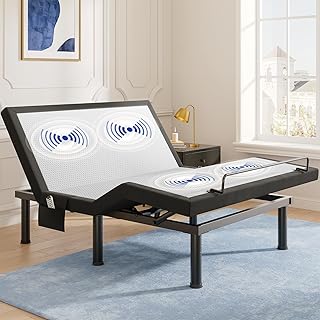
The trouble is that the 2026 market is saturated with bases that look nearly identical in photographs and differ enormously in the things you actually live with — motor noise at 2 a.m., whether the frame creaks when you shift, whether the remote is intuitive enough for a half-asleep hand, and whether the whole assembly survives five years of nightly cycling. This guide walks through how to evaluate an adjustable bed frame on the criteria that matter clinically and practically, how to match a model to your specific sleep complaint, and what to check before you commit. Below are the picks we consider strongest right now across sizes and budgets.
Our top picks


As an Amazon Associate we earn from qualifying purchases at no extra cost to you.
🛒 Best Price Today on Amazon
Prime members get fast, free shipping on everything above, plus member-only deals. New members get a 30-day free trial — cancel anytime.
Start With the Sleep Problem, Not the Feature List
Buying by feature count is the most common mistake. Work backward from your symptom instead. If reflux or nighttime cough is the issue, you need reliable head articulation to roughly a 30-degree torso incline — wedge pillows rarely hold that angle. If snoring is the concern, a modest 10 to 15 degrees of head lift is often enough to keep the airway patent, so a simpler base like the Tami Tami T450 or the Best Choice Products Ergonomic Full will do the job without paying for extras. If you have lumbar pain or sciatica, prioritise independent foot articulation and a zero-gravity preset, which distributes weight across the whole body rather than concentrating it at the lower back. And if you share a bed with someone whose ideal position differs from yours, a split configuration or a king with independent head and foot tilt is the only real answer.
Motor Quality and Noise Are the Real Dividing Line
A base is a piece of machinery you operate while trying to fall asleep, so motor behaviour matters more than any specification sheet suggests. Look for language about quiet operation — the Tami Tami T600 and T450 both advertise low-noise motors — and pay attention to lift capacity relative to your mattress. A dense 12-inch hybrid plus two adults is a genuine load; underpowered motors respond by moving slowly, whining, and wearing out early. If you’re a heavier sleeper, a couple, or you use a thick mattress, the Heavy Duty King with its dedicated lift motor is the safer structural bet. One practical detail people forget: check whether the base has emergency battery backup, which returns the bed to flat during a power outage.
Size, Height and Room Fit
Adjustable bases don’t behave like static frames. When the head raises, the mattress travels backward slightly — leave two to four inches of clearance from the wall so headboards and nightstands aren’t scuffed. Height is equally important and often overlooked. Adjustable legs let you tune the sleep surface to a height where your feet reach the floor with knees at roughly 90 degrees, which is the single best thing you can do for safe transfers in and out of bed. The Amada Queen offers four height positions and the T450 offers three, which is meaningful if you’re pairing the base with a tall mattress or need under-bed storage. For a single sleeper, guest room, or care setup, the Twin XL base with 12-inch gel memory foam mattress removes the compatibility guesswork entirely by shipping matched components.
Judge the Extras Honestly
Massage, USB ports, under-bed lighting and nightlights are pleasant but shouldn’t drive the decision. That said, some earn their place. Under-bed or nightlight illumination genuinely reduces fall risk on night-time bathroom trips without the melatonin-suppressing jolt of an overhead light — a real benefit for older sleepers. Bedside USB charging, four ports on the Amada, dual-side on the T600, keeps phones off the floor. Massage is best understood as a relaxation aid rather than therapy; some people find the vibration helps them downshift, others find it distracting. Treat it as a bonus on a base you already like, not a reason to choose one.
Mattress Compatibility
Not every mattress flexes. All-foam, latex and most pocketed-coil hybrids articulate well. Traditional interconnected innerspring mattresses and anything with a rigid perimeter will resist bending, fight the motor, and may void your mattress warranty. Aim for ten to fourteen inches of thickness — thinner mattresses can feel the frame’s joints, thicker ones become heavy and unwieldy to articulate. Confirm your model includes retainer bars or a non-slip surface so the mattress doesn’t creep down the base over weeks of use.
Tips
- Ease into it. Start with a small incline for a week before increasing the angle — your body needs time to adapt to a new spinal position.
- Use a fitted sheet with deep pockets and elasticated corners. Standard sheets pop off within days on an articulating base.
- Save zero gravity as a preset and use it for reading or evening wind-down, then finish flat or slightly inclined for the actual sleep block.
- Vacuum beneath the base and inspect the power cord and cable routing every few months; pinched cables are the leading cause of premature motor failure.
Frequently Asked Questions
Can an adjustable bed actually reduce snoring?
Often, yes. Elevating the head and torso reduces the tendency of soft tissue in the throat to collapse backward under gravity. It’s a meaningful improvement for positional snoring but is not a treatment for obstructive sleep apnoea — if you have witnessed pauses in breathing, daytime sleepiness, or morning headaches, get assessed properly.
Do I need a headboard or an existing frame?
No. These bases are self-supporting and stand on their own adjustable legs. A headboard is purely aesthetic; if you want one, choose a wall-mounted or freestanding design rather than one that bolts to the base.
Is a split model worth the extra cost?
If two people share the bed and disagree about positioning, it’s the best money you’ll spend. If you sleep alone, or you and your partner want the same angle, a standard queen or king base is the more sensible purchase.
How difficult is assembly?
Far easier than it used to be. Most current bases, including the Tami Tami models, arrive largely pre-assembled with tool-free leg attachment and take five to fifteen minutes. The genuine challenge is weight — enlist a second person to move the base into position.
Conclusion
The best adjustable bed frame is the one matched to your actual sleep complaint, sized correctly for your room, powerful enough for your mattress and body weight, and quiet enough that you’ll use it every night — everything else is negotiable. Identify your primary issue, verify your mattress will flex, measure your wall clearance and preferred sleep-surface height, then choose the simplest base that covers those needs. Get those fundamentals right and the improvement in how you feel at 7 a.m. tends to arrive within the first couple of weeks.