Key takeaways
- Clean at the start and midpoint of cooling season; a filter rinse every three weeks costs two minutes and preserves airflow.
- Wear nitrile gloves and safety glasses — fin edges are genuinely sharp and foam overspray stings.
- Never pressure-wash a window unit; you’ll drive water into the control board and fan motor bearings.
- Set a reminder to clean two weeks before you’ll need the unit, so a discovered problem doesn’t cost you a hot night.
What's inside
As someone who spends my working life untangling why people wake at 3 a.m. staring at the ceiling, I’ve learned that the culprit is rarely the mattress. More often it’s the window air conditioner rattling away six feet from the pillow — an appliance that started life whisper-quiet and has since accumulated a felt-like layer of dust, pollen, and biofilm across its coils. That buildup forces the compressor to run longer and louder, pushes musty air into a closed bedroom, and nudges the room temperature away from the 65–68°F band most sleep researchers consider ideal. Cleaning the unit isn’t housekeeping. It’s sleep hygiene with a screwdriver.
Below is the method I walk clients through every spring, refined over years of bedroom audits: how to open the unit without breaking the fins, which cleaners are safe to use in a room you’ll sleep in that night, how to reach the coils you can’t see, and how to dry everything properly so you don’t trade dust for mildew. I’ve also flagged the tools that genuinely earn their storage space — most of what’s sold as an “AC cleaning kit” is redundant, but a few pieces solve problems nothing else does.
As an Amazon Associate we earn from qualifying purchases.




🛒 Best Price Today on Amazon
Prime members get fast, free shipping on everything above, plus member-only deals. New members get a 30-day free trial — cancel anytime.
Start By Cutting Power and Assessing the Grime
Unplug the unit at the wall — not just the front panel switch — and let it sit ten minutes so the fan motor stops fully. Pop off the front grille (usually two clips or two Phillips screws at the bottom) and lift out the filter. Now look past the filter at the aluminum evaporator coil. If you see grey fuzz you can wipe with a fingertip, you’re doing routine maintenance. If the fins are matted flat and there’s a sour, gym-bag smell, you have biological growth and should plan on a foaming cleaner plus a full dry-out cycle before the unit goes back in the bedroom window. Take a phone photo of the fin orientation before you touch anything; it’s the reference you’ll want when you’re straightening bent metal later.
Wash the Filter, Then Comb the Fins
Reusable filters go in the sink with warm water and a drop of dish soap, rinsed until the water runs clear, then air-dried flat — never reinstalled damp, and never put in the dryer, which warps the frame. While it dries, address the coil. Aluminum fins bend if you breathe on them wrong, and every bent fin is airflow you’ve lost permanently unless you straighten it. A fin comb with switchable tooth spacing pulls flattened sections back into parallel in a single pass; the three-piece fin comb and brush kit is the practical choice here because it pairs the comb with a stiff detail brush for the same job. Work in the direction the fins run, never across them, and use light pressure.
Choose a Cleaner You Can Sleep Beside
This is where most people go wrong. Heavy-duty acidic condenser cleaners are formulated for rooftop commercial equipment, not for a coil that will blow air directly at your face for eight hours. Look for a no-rinse foaming formula that expands into the fin pack, lifts debris toward the drain pan, and dissipates without leaving a perfumed residue. The Arm & Hammer biodegradable coil cleaner foam is the low-odor benchmark and the one I recommend for bedrooms and nurseries. If you’re cleaning multiple units or a heavily loaded coil, the 38 oz foaming coil cleaner covers a season of maintenance, and the 57 oz version is worth it for deeper seasonal work where you want penetration through a thick fin pack. Spray, wait the stated dwell time, and let the foam collapse on its own — don’t scrub it.
Reach the Places You Can’t See
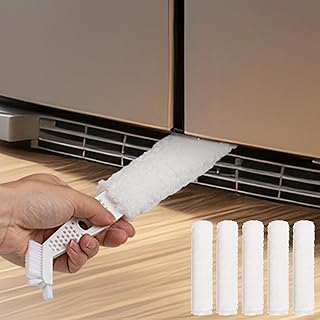
The rear condenser coil, the fan blades, and the drain pan collect the worst of it, and on a window unit they’re mostly hidden behind the shroud. If you’d rather not fully disassemble, a slim flexible cleaning tool with replaceable brush cloths slides behind and under the chassis to pull out matted dust — the same design that clears the gap under a refrigerator works well here. For anyone who also maintains a mini split, the Oiktylr kit with its 2L pressure sprayer and leakproof drain bag lets you rinse a wall-mounted coil without water running down the drywall; it’s overkill for a window unit but excellent if you own both.
Dry Completely Before It Goes Back In the Window
A damp coil in a warm bedroom is a mold incubator. Prop the unit somewhere with airflow for four to six hours, or run the fan-only mode for thirty minutes once reassembled. Confirm the drain hole at the rear is clear by trickling water through it — a blocked drain is the single most common cause of that gurgling, dripping noise that fragments light sleep.
Tips
- Clean at the start and midpoint of cooling season; a filter rinse every three weeks costs two minutes and preserves airflow.
- Wear nitrile gloves and safety glasses — fin edges are genuinely sharp and foam overspray stings.
- Never pressure-wash a window unit; you’ll drive water into the control board and fan motor bearings.
- Set a reminder to clean two weeks before you’ll need the unit, so a discovered problem doesn’t cost you a hot night.
Frequently Asked Questions
How often should a bedroom window AC be cleaned?
Filter: every two to four weeks in use. Coils: twice per cooling season, or once if the room is low-dust and pet-free. Bedrooms accumulate skin cells and textile fibers faster than living rooms, so err toward more frequent.
Does a clean coil actually improve sleep?
Indirectly but meaningfully. Restored airflow means the unit reaches your set temperature faster and cycles less, which reduces the compressor start-up noise that causes micro-arousals. It also cuts the particulate and musty odor load in a room you occupy for a third of your day.
Can I use household bleach or vinegar on the coils?
No. Bleach corrodes aluminum fins and copper tubing; vinegar is mildly acidic and can pit the coating over repeated use. Use a cleaner formulated for HVAC coils.
Do no-rinse foaming cleaners really not need rinsing?
Correct, when used as directed. The foam liquefies as it works and exits through the condensate drain along with the debris it has lifted. Over-application is the only real risk — follow the label rather than emptying the can.
Conclusion
A window air conditioner is the noisiest, dustiest object in most bedrooms, and it’s also the one nobody thinks to maintain until it fails in a heatwave. Give it an hour twice a season — unplug, rinse the filter, comb the fins, foam the coils, dry it properly — and you’ll get a quieter room, cleaner air, steadier temperature, and the kind of uninterrupted sleep that no supplement or gadget can manufacture.