Key takeaways
- Match CFM to cubic volume, not floor area: Vaulted ceilings and open-plan rooms need considerably more airflow than square footage alone suggests. A bedroom under 200 square feet is well served by 6,000–8,000 CFM; a garage or shop bay realistically wants 15,000 CFM or more.
- Insist on a DC motor: Beyond the roughly 60–70% energy savings over AC equivalents, DC motors run cooler and vibrate less. For anything within earshot of a bed, this single specification does more for perceived quietness than blade design ever will.
- Count the speed steps: Three-speed fans force a choice between too little and too much. Six-speed control lets you find the setting that moves air across your skin without stirring papers or drying out your sinuses overnight.
- Check for reverse and a timer: Reversible motors redistribute warm ceiling air in winter, cutting heating load meaningfully. A sleep timer matters even more — running airflow for 90 minutes while you fall asleep, then letting the room settle, avoids the pre-dawn chill that fragments sleep.
- Consider colour temperature if the fan carries light: 3CCT selectable fixtures let you run warm 2700K in the evening. Cool white light near bedtime suppresses melatonin; treat any bedroom fan light as part of your circadian environment.
What's inside
Air movement is the most underrated variable in sleep quality. I spend my working life helping people troubleshoot restless nights, and a surprising share of cases trace back to a bedroom that sits two or three degrees too warm with stagnant air. Core body temperature has to drop before deep sleep consolidates, and a room that traps heat quietly sabotages that process. The instinct is to buy a bigger fan — but plenty of oversized fans push disappointing volumes of air while humming, ticking, or wobbling their way into your awareness at 2 a.m.
What actually matters is airflow measured honestly in CFM, paired with a motor quiet enough to disappear. This guide breaks down what high-CFM really means in a residential or workshop setting, which specifications deserve your attention, and how six current fans — from compact 52-inch bedroom models to 120-inch industrial giants — perform against those criteria in 2026.
As an Amazon Associate we earn from qualifying purchases.




🛒 Best Price Today on Amazon
Prime members get fast, free shipping on everything above, plus member-only deals. New members get a 30-day free trial — cancel anytime.
How to Choose a High Cfm Ceiling Fan (2026)
- Match CFM to cubic volume, not floor area: Vaulted ceilings and open-plan rooms need considerably more airflow than square footage alone suggests. A bedroom under 200 square feet is well served by 6,000–8,000 CFM; a garage or shop bay realistically wants 15,000 CFM or more.
- Insist on a DC motor: Beyond the roughly 60–70% energy savings over AC equivalents, DC motors run cooler and vibrate less. For anything within earshot of a bed, this single specification does more for perceived quietness than blade design ever will.
- Count the speed steps: Three-speed fans force a choice between too little and too much. Six-speed control lets you find the setting that moves air across your skin without stirring papers or drying out your sinuses overnight.
- Check for reverse and a timer: Reversible motors redistribute warm ceiling air in winter, cutting heating load meaningfully. A sleep timer matters even more — running airflow for 90 minutes while you fall asleep, then letting the room settle, avoids the pre-dawn chill that fragments sleep.
- Consider colour temperature if the fan carries light: 3CCT selectable fixtures let you run warm 2700K in the evening. Cool white light near bedtime suppresses melatonin; treat any bedroom fan light as part of your circadian environment.
The Best High Cfm Ceiling Fan (2026)s Reviewed
120″ Extra Large Industrial Ceiling Fan
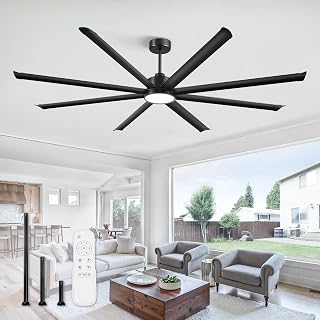
This is the fan you choose when you need to destratify air across an entire shop, patio, or garage bay rather than cool a single seated position. Six aluminium blades on a quiet DC motor move genuinely enormous volumes of air at low RPM, which is precisely why it stays subjectively quiet despite its scale — three included downrods let you dial in clearance under high ceilings.
ZMISHIBO 96″ Ceiling Fan with Lights
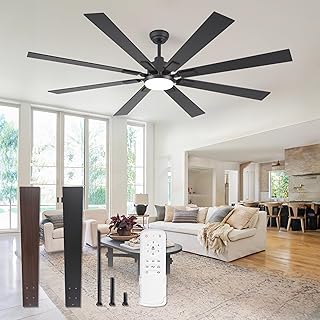
Eight reversible aluminium blades and a damp rating make this the most versatile large-format option here, equally at home over a gazebo or an open-plan great room. The 3CCT lighting and six-speed remote give you enough granularity to run it as a gentle evening air-mover rather than an all-or-nothing industrial unit.
60″ Ceiling Fan, 7400+ CFM
My pick for main bedrooms and primary living spaces: 7,400 CFM from a three-blade DC design is a strong airflow-to-noise ratio, and the timer plus 3CCT combination is exactly the feature set I recommend for temperature-sensitive sleepers. The mute remote is a genuinely thoughtful touch for anyone who adjusts settings after lights-out.
Ohniyou 96″ Industrial Ceiling Fan
A no-light, purpose-built air mover for warehouses, gyms, and workshops where you already have overhead lighting sorted. App control alongside the remote is unusually convenient in commercial settings, and the eight-blade aluminium assembly holds up to sustained daily duty cycles.
ZMISHIBO 72″ Ceiling Fan with Lights
The sweet spot for larger bedrooms, covered porches, and long living rooms that a 52-inch fan simply cannot reach. Dual-finish blades and a damp rating give it a finished, furniture-grade appearance, while the DC motor keeps it well below the threshold where fan noise starts intruding on sleep.
Frequently Asked Questions
How much CFM does a bedroom actually need?
For a standard bedroom with eight- to nine-foot ceilings, 5,000–8,000 CFM is ample. The goal is gentle, continuous movement across the sleeping surface — not a wind tunnel. Excess airflow tends to cause dry airways and nasal congestion, which undermines the benefit.
Will a ceiling fan lower my room temperature?
Not the ambient air temperature, but it lowers perceived temperature by several degrees through evaporative and convective cooling at the skin. That perceived drop is what supports the core temperature decline sleep depends on, and it lets you raise your thermostat setpoint without discomfort.
Are DC motor fans genuinely quieter?
Yes, measurably. DC motors eliminate the electromagnetic hum characteristic of AC units and generally produce less structural vibration. In a quiet bedroom, that difference is the gap between a fan you notice and one you forget is running.
Should I run a fan all night?
It depends on your thermal profile. Many people sleep best with airflow through the first sleep cycles, then benefit from a cooler, calmer room as the night progresses — which is what a sleep timer accomplishes. If you wake with a dry throat or stiff neck, reduce speed or redirect airflow before abandoning the fan entirely.
Final Thoughts
For most bedrooms, the 60″ 7400+ CFM fan offers the best balance of airflow, quiet DC operation, and sleep-friendly features like timer control and warm 3CCT lighting. Step up to the ZMISHIBO 72″ for larger rooms or covered outdoor spaces where reach matters, and reserve the 120″ Extra Large Industrial model for garages, shops, and patios where sheer air volume — not subtlety — is the objective.