Key takeaways
- Understand what “washable” actually covers: On most units, only the outer pre-filter is rinseable — it captures hair, lint, and larger dust before they clog the HEPA layer. A handful of systems, like Nuwave’s, extend washability across nearly the whole stack. Read the filter diagram, not the headline.
- Prioritize sleep-mode sound over peak CADR: A purifier running at 55 dB on high is useless if you shut it off at bedtime. Look for a documented low-speed figure in the low-to-mid 20s dB range, and check that the display dims or goes fully dark. Blue LEDs at eye level are a genuine sleep disruptor.
- Size up, then run it slow: Buy a unit rated for roughly double your bedroom’s square footage. Oversizing lets you run a lower, quieter speed and still turn the air over several times an hour — the single best trick for silent overnight filtration.
- Insist on a real particle sensor: A PM2.5 readout tells you whether your room genuinely improves overnight or whether the problem is your bedding, your pet, or a leaky window. Auto mode is only as good as the sensor feeding it.
- Factor in drying time and access: A washable pre-filter you can pop out in ten seconds gets rinsed monthly. One buried behind screws gets ignored. Confirm the panel is tool-free and that the filter air-dries within a few hours.
What's inside
Most people shop for an air purifier the way they shop for a fan — grab the one with the biggest square-footage claim and plug it in. Then, about four months later, an app or a blinking amber light announces that the filter is spent, and a $60 replacement order becomes a recurring line item. Multiply that across a bedroom, a nursery, and a living room, and the “cheap” purifier quietly becomes one of the more expensive appliances in the house. Worse, filters that get ignored past their lifespan lose airflow, force the motor to work harder, and turn a quiet sleep companion into a droning distraction at 2 a.m.
As someone who spends most days helping people troubleshoot their sleep environments, I care about air purifiers for one specific reason: overnight air quality has a measurable effect on how easily you fall asleep, how often you surface from deep sleep, and how congested you feel at sunrise. Washable-filter models solve two problems at once — they cut long-term cost, and they make it far more likely you’ll actually maintain the unit. Below, I’ve broken down the machines worth your money in 2026, what to look for before you buy, and how these units behave in a dark, quiet bedroom rather than in a showroom.
As an Amazon Associate we earn from qualifying purchases.


🛒 Best Price Today on Amazon
Prime members get fast, free shipping on everything above, plus member-only deals. New members get a 30-day free trial — cancel anytime.
How to Choose an Air Purifier With Washable Filters (2026)
- Understand what “washable” actually covers: On most units, only the outer pre-filter is rinseable — it captures hair, lint, and larger dust before they clog the HEPA layer. A handful of systems, like Nuwave’s, extend washability across nearly the whole stack. Read the filter diagram, not the headline.
- Prioritize sleep-mode sound over peak CADR: A purifier running at 55 dB on high is useless if you shut it off at bedtime. Look for a documented low-speed figure in the low-to-mid 20s dB range, and check that the display dims or goes fully dark. Blue LEDs at eye level are a genuine sleep disruptor.
- Size up, then run it slow: Buy a unit rated for roughly double your bedroom’s square footage. Oversizing lets you run a lower, quieter speed and still turn the air over several times an hour — the single best trick for silent overnight filtration.
- Insist on a real particle sensor: A PM2.5 readout tells you whether your room genuinely improves overnight or whether the problem is your bedding, your pet, or a leaky window. Auto mode is only as good as the sensor feeding it.
- Factor in drying time and access: A washable pre-filter you can pop out in ten seconds gets rinsed monthly. One buried behind screws gets ignored. Confirm the panel is tool-free and that the filter air-dries within a few hours.
The Best Air Purifiers With Washable Filters, Reviewed
Nuwave Forever Smart Air Purifier
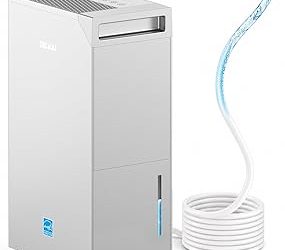
This is the closest thing to a zero-consumable purifier on the market — its patented seven-stage system uses washable, reusable filters throughout, so ongoing cost drops to essentially nothing. Coverage up to roughly 2,000 sq ft plus an adjustable flow panel makes it a strong choice for a large primary bedroom where you want directed airflow away from the bed.
Nuwave OxyPure Zero Plus
With coverage past 3,200 sq ft, the OxyPure Zero Plus is overkill for a small room — and that’s precisely why it works so well as a nighttime unit, since it can idle on its quietest setting and still clear the air. It’s the pick for open-plan homes or anyone whose bedroom connects to a hallway or kitchen.
PuroAir 400
The PuroAir 400 pairs a HEPA CarbonTech filter with a responsive air-quality sensor and a genuinely quiet sleep mode, covering up to 2,000 sq ft. Its carbon stage is the standout here: if your sleep is disturbed by cooking odors, smoke, or off-gassing from new furniture, this is the unit I’d point you toward.
DREO HEPA Air Purifier (DR-HAP008)
AHAM Verifide certification means DREO’s coverage claims have been independently tested rather than estimated — rare at this price. Four speeds, a PM2.5 monitor, and a quiet sleep mode make it an easy nightstand-adjacent choice, though the scent diffuser is best left empty if you’re sensitive to fragrance before bed.
VEWIOR 2-Pack H13 HEPA Purifiers
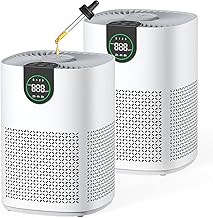
Buying two smaller washable-pre-filter units instead of one large one is an underrated strategy: you can treat a bedroom and a nursery simultaneously and run both on low. Each covers up to 1,200 sq ft with true H13 media, a PM2.5 display, and auto and sleep modes.
Frequently Asked Questions
How often should I wash the pre-filter?
Every three to four weeks in a bedroom, more often with shedding pets. Rinse under cool water, shake off excess, and let it air-dry completely before reinstalling — a damp filter can breed mildew inside the housing.
Do washable filters remove pollen and fine dust?
Not on their own. The washable layer handles the coarse debris; the HEPA stage behind it captures fine particulates down to 0.3 microns. Fully reusable systems like Nuwave’s use additional stages to compensate.
Should I run it all night or just before bed?
All night, on auto or sleep mode. Particulate levels rise as you move in bed and disturb settled dust, so continuous low-speed operation outperforms a pre-bedtime blast.
Where should I place it in a bedroom?
Six to ten feet from the bed, clear of walls and curtains, with the airflow directed across the room rather than at your face. Direct airflow dries out nasal passages and can leave you waking up with a sore throat.
Final Thoughts
If you want to stop buying filters permanently, the Nuwave Forever Smart is the most complete answer, with the OxyPure Zero Plus stepping in for larger or open-plan spaces. For those who’d rather rinse a pre-filter and keep a conventional HEPA stack, the PuroAir 400 delivers the best balance of sensor accuracy, odor control, and genuinely quiet overnight operation — and your sleep will show the difference within a week.