Key takeaways
- Carbon mass, not carbon coating: Smoke odor is gas, and gases are captured by adsorption. A thin carbon-dusted mesh saturates within weeks. Prioritize units with a genuinely thick pelletized or granular carbon stage — this is the single specification that separates a smoke purifier from a dust purifier.
- H13-grade or better particulate media: Tobacco particles cluster in the 0.1–0.3 micron range, precisely where cheap filters underperform. Look for H13 True HEPA or an UltraHEPA equivalent with a stated efficiency at 0.1 microns rather than the easier 0.3-micron benchmark.
- Air changes over headline square footage: Marketing coverage figures usually assume a single hourly air change, which is far too slow for active smoke. Halve or quarter the advertised room size to reach four or five changes per hour — the rate that actually keeps a bedroom clear.
- Nighttime acoustics: Anything above roughly 30 dB begins to intrude on light sleep stages. Check that the sleep setting still moves meaningful air rather than simply switching the fan off, and confirm all status LEDs can be fully extinguished.
- Filter economics and access: Smoke shortens filter life dramatically. Before buying, price a full replacement set and check availability, because a purifier with an expensive or discontinued filter is a disposable appliance in disguise.
What's inside
Tobacco smoke is one of the most stubborn indoor pollutants a household can face, and it rarely stays where it starts. A cigarette lit on a balcony drifts back through a window screen; a neighbor’s habit travels up through shared walls and outlet gaps; a guest’s jacket carries the residue onto your sofa cushions. The result is a two-part problem: fine particulate matter small enough to reach the deepest part of the lung, plus a cocktail of gaseous compounds that cling to soft furnishings and reappear every time the room warms up. Ordinary “HEPA-only” machines catch the first half and let the second half walk right past.
As someone who spends most of my working life on sleep environments, I care about smoke for a specific reason: it degrades the quality of the eight hours you spend motionless in one room. Airborne irritants inflame nasal passages, which narrows the airway and fragments sleep architecture in ways people rarely connect to the previous evening’s smoke. This guide looks at cigarette smoke purifiers through that lens — filtration chemistry, honest coverage figures, and above all how the unit behaves at 2 a.m. Below you will find the models worth your money in 2026, followed by a buying framework and answers to the questions I get asked most.
As an Amazon Associate we earn from qualifying purchases.


🛒 Best Price Today on Amazon
Prime members get fast, free shipping on everything above, plus member-only deals. New members get a 30-day free trial — cancel anytime.
How to Choose a Cigarette Smoke Air Purifier (2026)
- Carbon mass, not carbon coating: Smoke odor is gas, and gases are captured by adsorption. A thin carbon-dusted mesh saturates within weeks. Prioritize units with a genuinely thick pelletized or granular carbon stage — this is the single specification that separates a smoke purifier from a dust purifier.
- H13-grade or better particulate media: Tobacco particles cluster in the 0.1–0.3 micron range, precisely where cheap filters underperform. Look for H13 True HEPA or an UltraHEPA equivalent with a stated efficiency at 0.1 microns rather than the easier 0.3-micron benchmark.
- Air changes over headline square footage: Marketing coverage figures usually assume a single hourly air change, which is far too slow for active smoke. Halve or quarter the advertised room size to reach four or five changes per hour — the rate that actually keeps a bedroom clear.
- Nighttime acoustics: Anything above roughly 30 dB begins to intrude on light sleep stages. Check that the sleep setting still moves meaningful air rather than simply switching the fan off, and confirm all status LEDs can be fully extinguished.
- Filter economics and access: Smoke shortens filter life dramatically. Before buying, price a full replacement set and check availability, because a purifier with an expensive or discontinued filter is a disposable appliance in disguise.
The Best Cigarette Smoke Air Purifier (2026)s Reviewed
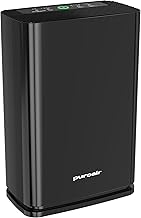
PuroAir 240 HEPA Air Purifier
The pairing of true HEPA media with PuroAir’s CarbonTech stage is what earns this unit a place at the top — the carbon volume is substantial enough to keep working on stale smoke well after competitors have gone odor-neutral in name only. Its auto and sleep modes are sensibly tuned, and it clears a mid-sized bedroom quickly enough that you can run it hard before bed and drop it to whisper level once you’re under the covers.
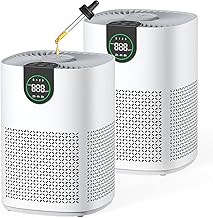
DREO HEPA Air Purifier (Dreo 338)
AHAM verification and an onboard PM2.5 readout make this the most transparent choice here; you can watch the number climb when smoke enters and fall as the machine responds, which is oddly reassuring at 11 p.m. Four speeds plus a genuinely quiet sleep mode give you fine control, though I would leave the scent diffuser empty in a bedroom — masking fragrance is the opposite of what a smoke sufferer needs.
PuroAir 240 (2-Pack)
Smoke infiltration is rarely confined to one room, and two mid-sized purifiers in separate spaces consistently outperform one large unit trying to serve both. This bundle is the most cost-effective way to protect a bedroom and a living area simultaneously, particularly in apartments with smoke arriving from a neighboring unit.
LEVOIT Core 300-P
At a measured 24 dB on its lowest setting, the Core 300-P is the quietest machine I recommend for people who wake at the slightest change in room noise. Treat its coverage claim as a peak-flow figure and site it within a few feet of the bed, where its H13 filter and odor-eliminating carbon layer will do the most good.
AIRDOCTOR AD3500
This is the specialist option: UltraHEPA media rated below the standard 0.3-micron threshold, backed by a premium carbon and VOC stage that handles the gaseous fraction of tobacco smoke better than anything else on this list. It costs more to buy and to maintain, but for heavy, persistent exposure — a smoking household, or a long-term third-hand smoke problem in an older property — it is the one I would choose.
Frequently Asked Questions
Can an air purifier fully remove cigarette smoke?
It can remove the airborne fraction very effectively, both particles and much of the gas phase. What it cannot do is strip residue already absorbed into carpet, curtains and upholstery, which continues to off-gas for months. Pair filtration with washing textiles and wiping hard surfaces for a real reduction.
Where should I place the unit in a bedroom?
Roughly six to eight feet from the head of the bed, with at least a foot of clearance on the intake and outflow sides. Avoid tucking it behind furniture or under a shelf, and keep the airstream from blowing directly across your face, which dries the airway and can itself disturb sleep.
Should I leave it running all night?
Yes. Continuous overnight operation on a low or sleep setting maintains a steady clean-air baseline, whereas cycling the unit on and off allows particle counts to rebuild during the hours you are most vulnerable to them. Modern models are designed for uninterrupted use.
How often will I need new filters?
Expect to replace carbon roughly twice as often as the manufacturer’s general-use estimate in a smoking environment — commonly every four to six months. The clearest signal is olfactory: when odors linger despite the unit running, the carbon is saturated regardless of what the indicator light says.
Final Thoughts
For most bedrooms, the PuroAir 240 strikes the best balance of serious carbon filtration, fast clearance and civilized nighttime noise, and the two-pack is the smartest buy if smoke reaches more than one room. Choose the Levoit Core 300-P if silence is your non-negotiable, and step up to the AirDoctor AD3500 when exposure is constant and you want the most thorough particle and gas removal available this year.