Key takeaways
- Know which physics you’re buying: Evaporative coolers lower air temperature by adding humidity — excellent in dry climates, marginal above roughly 60% relative humidity. Compressor units genuinely remove heat but must exhaust it somewhere. There is no windowless compressor AC, despite what listings imply.
- Find your alternate vent path: Before dismissing a real AC, check for a sliding patio door, casement window, dryer vent, drop ceiling, or a door to an unoccupied hallway. A vented unit through an imperfect opening still beats an unvented one.
- Judge noise by texture, not just decibels: A steady 48 dB of broadband fan noise is far more sleep-compatible than a 42 dB unit whose compressor cycles on and off. Cycling creates arousals; constant sound masks them.
- Match runtime to your sleep window: Look for a 12-hour timer minimum, or a tank large enough to last until morning. Waking at 3 a.m. to refill a reservoir defeats the entire purpose.
- Watch the humidity trade-off: If you already sleep in a damp basement, prioritize a unit with a dehumidifier mode. Adding moisture to a humid room makes sleep feel worse even as the thermometer dips.
What's inside
Sleep researchers have a boringly consistent answer to “what temperature should my bedroom be?” — somewhere in the 60–68°F range, because your core body temperature has to drop roughly a degree for sleep to initiate and stay consolidated. That drop is the physiological starting gun. The problem is that plenty of the rooms we sleep in weren’t designed with thermoregulation in mind: basement conversions, attic bedrooms, dorms with sealed glass, studio apartments where the only window sits behind a built-in wardrobe. If you can’t hang a vent hose, the standard advice collapses.
This guide is written for exactly that situation. Below you’ll find two distinct categories — evaporative coolers, which need no venting at all and work by moving air across water-saturated media, and compressor-based portable units that can often be vented through something other than a sash window. I’ll be direct about what each type can and can’t do for sleep, because the wrong expectation here is worse than no purchase at all. Every recommendation is judged on three things: measured or perceived temperature change, noise character at night, and whether the unit can run unattended for a full sleep cycle.
As an Amazon Associate we earn from qualifying purchases.


🛒 Best Price Today on Amazon
Prime members get fast, free shipping on everything above, plus member-only deals. New members get a 30-day free trial — cancel anytime.
How to Choose a Portable Air Conditioner Without Window Access (2026)
- Know which physics you’re buying: Evaporative coolers lower air temperature by adding humidity — excellent in dry climates, marginal above roughly 60% relative humidity. Compressor units genuinely remove heat but must exhaust it somewhere. There is no windowless compressor AC, despite what listings imply.
- Find your alternate vent path: Before dismissing a real AC, check for a sliding patio door, casement window, dryer vent, drop ceiling, or a door to an unoccupied hallway. A vented unit through an imperfect opening still beats an unvented one.
- Judge noise by texture, not just decibels: A steady 48 dB of broadband fan noise is far more sleep-compatible than a 42 dB unit whose compressor cycles on and off. Cycling creates arousals; constant sound masks them.
- Match runtime to your sleep window: Look for a 12-hour timer minimum, or a tank large enough to last until morning. Waking at 3 a.m. to refill a reservoir defeats the entire purpose.
- Watch the humidity trade-off: If you already sleep in a damp basement, prioritize a unit with a dehumidifier mode. Adding moisture to a humid room makes sleep feel worse even as the thermometer dips.
The Best Portable Air Conditioners Without Window Access (2026) Reviewed
25.3″ Windowless Evaporative Air Cooler with 4 Ice Packs
The bedside-height form factor and 90° oscillation make this the most sleep-appropriate evaporative pick — you get moving, cooled air across the bed rather than a column aimed at the ceiling. The included ice packs meaningfully sharpen the output for the first couple of hours, which is precisely the window when sleep onset happens.
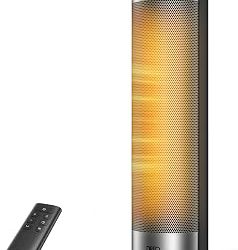
38.6″ Windowless Evaporative Cooler with 12H Timer
The taller tower and larger tank solve the two weaknesses of compact evaporative units: reach and endurance. With a 12-hour timer and 120° sweep, it can run from lights-out to sunrise without intervention, and the black finish disappears in a dark room instead of glowing at you.
Serantzon 4-in-1 Personal Evaporative Cooler
Treat this as a personal microclimate device rather than a room cooler — at 1200ml, it cools the air immediately around you, which is often enough if your discomfort is localized to the bed. The 7 LED lights are the one caveat for sleep hygiene; switch them off, since even dim ambient light can suppress melatonin.
Shinco 12,000 BTU Portable AC (7,500 BTU SACC)
If you can find any exhaust route at all, this is where real cooling begins — genuine heat removal plus a dehumidifier mode that evaporative units fundamentally cannot offer. Its dehumidify setting alone can transform a clammy basement bedroom even on nights when you don’t need aggressive cooling.
12,000 BTU Auto-Evaporation Portable AC for Large Rooms
Rated to 550 sq. ft. with low-noise operation and auto-evaporation, this handles open-plan studios where a small cooler simply gets swallowed by the volume of air. The self-evaporating design removes the drain-bucket chore, which matters more than buyers expect over a long summer.
Frequently Asked Questions
Do windowless air conditioners actually cool a room?
Evaporative coolers lower the temperature of the air passing through them, typically by several degrees, but they don’t remove heat from the room. In dry air the effect is genuinely refreshing; in humid air it’s mostly airflow.
Will added humidity hurt my sleep?
It can. Sleep quality tends to decline once bedroom relative humidity climbs past about 60%, because evaporative cooling from your skin — your body’s own primary night-time heat-shedding mechanism — becomes less effective.
Can I vent a portable AC through a door instead of a window?
Yes, if the space on the other side is unoccupied and ventilated, such as a garage or exterior hallway. Never exhaust into another room you or anyone else uses; you’re simply relocating the heat.
Is fan noise bad for sleep?
Steady, low-frequency fan noise is usually beneficial, masking the intermittent sounds that fragment sleep. Intermittent noise — a compressor kicking in, water gurgling — is what causes trouble.
Final Thoughts
For a genuinely vent-free bedroom, the 38.6″ Windowless Evaporative Cooler is the strongest all-night performer thanks to its tank capacity and 12-hour timer, with the 25.3″ model with ice packs as the better bedside choice for smaller rooms. If you can improvise any exhaust route at all, the Shinco 12,000 BTU unit is worth the effort — real heat removal and dehumidification will do more for your sleep than any windowless alternative.