Key takeaways
- Match the technology to your climate: Evaporative cooling only works when the surrounding air is dry enough to absorb moisture. In Denver or Phoenix, expect a real 6–12°F drop at the outlet; in Houston in August, expect airflow and little else. Check your typical summer dew point first.
- Read decibel claims as a range, not a number: Advertised figures such as 38 dB are measured on the lowest fan speed. What matters is whether speed two is tolerable, because that is where most sleepers settle. Anything above 45 dB beside the bed tends to fragment light sleep.
- Size the tank to a full night: A 3-gallon reservoir running low-to-medium generally clears 8–10 hours, while a 1-gallon tank may run dry before your alarm. Being woken by a low-water alert undoes the entire point of the purchase.
- Prioritize timers and sleep modes over raw output: A 12- to 15-hour timer paired with a graduated night mode lets the unit work hardest during sleep onset — the window where cooling has the most influence — then taper once your body has settled.
- Audit the light and the upkeep: Bright blue LED panels are melatonin-relevant, so look for auto-dimming displays. Then check how easily the tank, pad, and filter come out, because standing water plus warm air breeds biofilm within days.
What's inside
Falling asleep is a thermal event before it is anything else. Core body temperature has to drop roughly one to two degrees as the evening progresses, and a bedroom sitting above 70°F stalls that process — which is why hot nights produce more awakenings, shallower stage-2 sleep, and noticeably less REM toward morning. The obvious remedy is air conditioning. The obvious obstacle is the window: casement frames, sliding panes, dorm rules, and rental agreements make a standard exhaust hose impossible for millions of sleepers.
That is the gap hoseless units try to fill. Nearly all of them are evaporative coolers — swamp coolers, technically — that draw warm air across a wet media pad and return it several degrees cooler and considerably moister. They are not refrigerant compressors, and any listing implying otherwise deserves skepticism. Judged for what they actually are, though, the better models are legitimate bedroom appliances. Below, I have assessed the leading 2026 options the way I would assess any sleep-environment tool: noise floor, overnight runtime, airflow pattern, light pollution, and hygiene.
As an Amazon Associate we earn from qualifying purchases.


🛒 Best Price Today on Amazon
Prime members get fast, free shipping on everything above, plus member-only deals. New members get a 30-day free trial — cancel anytime.
How to Choose a Portable Air Conditioner Without a Hose (2026)
- Match the technology to your climate: Evaporative cooling only works when the surrounding air is dry enough to absorb moisture. In Denver or Phoenix, expect a real 6–12°F drop at the outlet; in Houston in August, expect airflow and little else. Check your typical summer dew point first.
- Read decibel claims as a range, not a number: Advertised figures such as 38 dB are measured on the lowest fan speed. What matters is whether speed two is tolerable, because that is where most sleepers settle. Anything above 45 dB beside the bed tends to fragment light sleep.
- Size the tank to a full night: A 3-gallon reservoir running low-to-medium generally clears 8–10 hours, while a 1-gallon tank may run dry before your alarm. Being woken by a low-water alert undoes the entire point of the purchase.
- Prioritize timers and sleep modes over raw output: A 12- to 15-hour timer paired with a graduated night mode lets the unit work hardest during sleep onset — the window where cooling has the most influence — then taper once your body has settled.
- Audit the light and the upkeep: Bright blue LED panels are melatonin-relevant, so look for auto-dimming displays. Then check how easily the tank, pad, and filter come out, because standing water plus warm air breeds biofilm within days.
The Best Portable Air Conditioners Without a Hose (2026), Reviewed
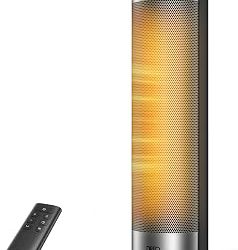
38.6″ Windowless Evaporative Air Cooler (Black)
The tall cabinet and 120° oscillation sweep conditioned air across an entire mattress rather than one shoulder, which affects perceived comfort more than peak output does. Its large tank and 12-hour timer cover a full night without intervention, and the four-mode system includes a genuinely restrained sleep profile.
DeWalt 20V-Compatible Windowless Air Conditioner
Running on either wall power or a 20V Max battery makes this the only pick here that keeps working through a summer outage — worth weighing if heat waves in your region arrive alongside grid strain. The 3-gallon tank and 15-hour timer also give it the longest unattended runtime of the group.
24.4″ Compact Evaporative Air Cooler (White)
Best suited to small bedrooms and studio corners, this shorter tower delivers air at roughly bed height without consuming floor space. The four included ice packs measurably sharpen outlet temperature for the first hour or two, which is precisely when sleep onset is happening.
38 dB Evaporative Cooler Fan
Six speeds allow far finer control of the noise floor than the usual three, letting you find the setting where airflow is sufficient and the sound stays broadband rather than intrusive. A 3-gallon tank and 12-hour auto-off suit anyone who dislikes mid-night adjustments.
24″ 3-in-1 Ventless Swamp Cooler (White)
A sensible middle path: cooler, humidifier, and fan in a single 24-inch body, with wide oscillation and a 15-hour timer. The 2-gallon reservoir is the trade-off, so plan on a top-up if you run it hard through the evening.
Frequently Asked Questions
Do hoseless portable air conditioners really cool a room?
They cool the air passing through them, not the room as a whole. Expect targeted relief where the airflow lands, plus a modest ambient drop in dry conditions — not the aggressive pulldown a vented compressor unit provides.
Will an evaporative cooler make my bedroom too humid?
It can. These units add moisture by design, so leave a window or door slightly open to let saturated air escape, and keep an inexpensive hygrometer nearby. Sleep is most comfortable between roughly 30 and 50 percent relative humidity.
How quiet does a bedroom unit need to be?
Bedroom guidance sits near 30 dB, which no fan-driven cooler achieves. In practice, a steady 38–45 dB is workable: consistent broadband sound masks street noise, whereas rattles and shifts in pitch are what actually wake people.
How often should I clean the tank and pad?
Empty and rinse the reservoir every couple of days, and let the cooling pad dry out weekly. Warm standing water cultivates bacteria and mold quickly, and that airborne load is being directed straight at your pillow.
Final Thoughts
For most bedrooms, the 38.6-inch black tower is the balanced choice, combining wide oscillation, all-night capacity, and a genuinely quiet low speed. Compact rooms are better served by the 24.4-inch white model with its ice-pack assist, while anyone in an outage-prone area should look closely at the DeWalt battery-compatible unit. Keep expectations realistic about humidity, and any of the three will make August nights considerably easier to sleep through.