Key takeaways
- Match CFM to room volume, not floor area: Vaulted or double-height spaces need far more airflow than square footage suggests. For sleeping rooms with standard ceilings, 5,000–7,500 CFM is generous; open living areas want 8,000+, and warehouse-scale rooms belong in HVLS territory above 20,000.
- Insist on a DC or PMSM motor: These pull roughly 60–70% less power than AC motors and, critically, run quieter at high speed. For overnight use, the absence of a low-frequency hum matters more than almost any other spec.
- Check the decibel figure at maximum, not minimum: Manufacturers love quoting whisper ratings on speed one. Ask what the fan sounds like on four or five — that’s where you’ll actually run it in August.
- Prioritize adjustable color temperature: A 3CCT light lets you drop to warm 2700K in the evening, limiting the short-wavelength exposure that suppresses melatonin, then shift cooler for daytime tasks.
- Confirm reversibility and downrod options: Winter reverse mode redistributes trapped ceiling heat without a draft, and the correct downrod length keeps blades 8–9 feet off the floor for optimal circulation.
What's inside
Airflow is the most underrated sleep variable in the average bedroom. As a sleep-wellness consultant, I see the same pattern constantly: someone invests in a cooling mattress, blackout curtains, and a white-noise machine, then lies awake in stagnant, humid air that keeps their core temperature stubbornly above the threshold where deep sleep consolidates. A ceiling fan solves this cheaply — but only if it actually moves air. The industry’s spec for that is CFM (cubic feet per minute), and it varies wildly between fans that look nearly identical on a showroom ceiling.
This guide focuses on high-CFM ceiling fans for 2026, spanning compact 52-inch bedroom units through 120-inch HVLS models built for garages, gyms, and open-plan great rooms. I’ve weighted three things heavily: measured airflow relative to blade span, motor acoustics at usable speeds (a fan that only whispers on setting one is useless), and whether the light output supports a healthy evening wind-down rather than sabotaging it. Below you’ll find the current standouts, followed by a selection framework and answers to the questions I field most often.
As an Amazon Associate we earn from qualifying purchases.




🛒 Best Price Today on Amazon
Prime members get fast, free shipping on everything above, plus member-only deals. New members get a 30-day free trial — cancel anytime.
How to Choose a Cfm Ceiling Fan (2026)
- Match CFM to room volume, not floor area: Vaulted or double-height spaces need far more airflow than square footage suggests. For sleeping rooms with standard ceilings, 5,000–7,500 CFM is generous; open living areas want 8,000+, and warehouse-scale rooms belong in HVLS territory above 20,000.
- Insist on a DC or PMSM motor: These pull roughly 60–70% less power than AC motors and, critically, run quieter at high speed. For overnight use, the absence of a low-frequency hum matters more than almost any other spec.
- Check the decibel figure at maximum, not minimum: Manufacturers love quoting whisper ratings on speed one. Ask what the fan sounds like on four or five — that’s where you’ll actually run it in August.
- Prioritize adjustable color temperature: A 3CCT light lets you drop to warm 2700K in the evening, limiting the short-wavelength exposure that suppresses melatonin, then shift cooler for daytime tasks.
- Confirm reversibility and downrod options: Winter reverse mode redistributes trapped ceiling heat without a draft, and the correct downrod length keeps blades 8–9 feet off the floor for optimal circulation.
The Best Cfm Ceiling Fan (2026)s Reviewed
120-Inch HVLS Industrial Fan (AA-Orion 120″)
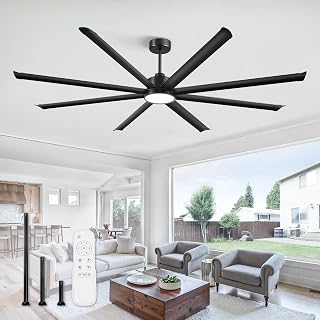
With more than 28,000 CFM from a PMSM motor, this is genuine industrial-grade air movement — the kind that turns over an entire warehouse or gym rather than cooling a single zone. The six-speed remote and reversible operation make it surprisingly practical in a converted barn or large open loft, provided you have the ceiling height to hang it safely.
120 Inch Extra Large Industrial Ceiling Fan
Six heavy-duty silver aluminum blades and a quiet DC motor give this fan a gentler acoustic signature than most commercial units of its size, which matters if the space doubles as a workshop where you spend hours. The three included downrods are a thoughtful inclusion, letting you dial in blade height without a separate hardware order.
ZMISHIBO 96 Inch Ceiling Fan with Lights
Eight reversible aluminum blades spread the load across a wide sweep, producing high volume airflow at moderate rotational speed — the acoustically ideal combination. The damp rating and 3CCT lighting make it a strong fit for covered patios or gazebos where you want both circulation and controllable evening ambiance.
60 in Ceiling Fan, 7400+ CFM
This is my most frequent recommendation for primary bedrooms and mid-sized living rooms: 7,400-plus CFM is well beyond typical residential output, yet the three-blade noiseless DC motor stays genuinely unobtrusive at higher speeds. The built-in timer is an underrated sleep feature, letting airflow taper as your body temperature naturally drops overnight.
ZMISHIBO 72″ Ceiling Fan with Lights
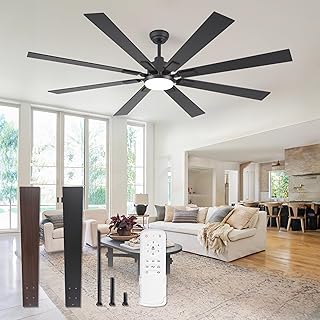
A well-judged middle ground — enough sweep for a great room or deep covered patio without the visual bulk of a 96-inch fan. The dual-finish blades and 24W 3CCT LED give it a more considered look than most high-airflow models, and the damp rating covers outdoor installations.
Frequently Asked Questions
Does sleeping with a fan on actually improve sleep?
For most people, yes. Moving air accelerates evaporative heat loss from the skin, supporting the modest core-temperature drop that initiates and sustains deep sleep. The steady broadband sound also masks intermittent noise that would otherwise cause micro-arousals.
How much CFM do I need for a bedroom?
A standard 12×14 bedroom with 8-foot ceilings is well served by 4,000–6,000 CFM. Going higher isn’t wasteful — a high-CFM fan simply delivers the same comfort at a lower, quieter speed setting.
Can a fan running all night cause problems?
Direct airflow across the face can dry nasal passages and irritate sinuses in some sleepers. Aim the fan to circulate the room rather than blow straight onto the bed, and use a lower speed with a humidifier if you wake up congested.
Is a 52-inch fan enough, or should I size up?
For rooms under roughly 225 square feet, a well-engineered 52-inch model like the modern white and gold high-CFM fan is entirely sufficient. Beyond that, larger spans move more air more quietly than forcing a small fan to its top speed.
Final Thoughts
For bedrooms and typical living spaces, the 60-inch 7400+ CFM fan is the most sleep-friendly pick on this list — powerful, quiet, and equipped with the timer and warm-light options that support a proper wind-down. Step up to the ZMISHIBO 72″ for great rooms and covered patios, and reserve the AA-Orion 120″ HVLS for garages, gyms, and barns where nothing smaller will move the volume of air you need.