Key takeaways
- Downrod length, not fan size, sets your comfort: Blades belong 8–9 feet off the floor regardless of how high the peak goes. On a 12-foot ceiling that’s a 24–36 inch downrod; a fan mounted flush to a vaulted apex will circulate air you never feel. Confirm the manufacturer sells a rod long enough before you buy.
- Chase CFM per watt, not raw CFM: A big number means nothing if it arrives with a 70-watt draw and a hum. DC and PMSM motors deliver high airflow at a fraction of the wattage of legacy AC motors, which matters when the fan runs all night, every night.
- Set your noise floor deliberately: Aim for a fan whose lowest usable speed is inaudible from the pillow. Broadband whoosh is generally sleep-neutral or even masking; intermittent motor whine, blade wobble, and rattling shades are the disruptors that fragment sleep architecture.
- Insist on selectable color temperature: 3-CCT fans let you run 5000K for morning tasks and 2700K after dusk. Warm, dimmable light in the final hour before bed keeps evening melanopic exposure low — a small change with an outsized effect on sleep onset.
- Reversibility earns its keep in winter: Run the blades in reverse at low speed and you push that trapped ceiling heat back down the walls without a draft. In a high-ceiling bedroom this can let you drop the thermostat several degrees, which is exactly the direction a sleeping body wants.
What's inside
Vaulted ceilings look spectacular and behave terribly. Air stratifies — warm air pools eight feet above your head while the zone where you actually live, and sleep, stays stagnant. In a bedroom with a 14-foot peak, that means a room that reads warm on the thermostat but feels stale on your skin, and a body that struggles to shed the roughly one degree of core temperature it needs to drop before deep sleep consolidates. Most people respond by cranking the AC. The cheaper, quieter fix is moving the air that’s already there.
I evaluate fans the way I evaluate a mattress or a blackout curtain: does it support thermoregulation without introducing a new sleep disruptor? That means real air movement at head height, motor noise low enough to disappear below your arousal threshold, and light that doesn’t fight your melatonin at 10 p.m. Below are the high-ceiling fans worth your money in 2026 — a mix of oversized residential models and genuine HVLS units for lofts, barn conversions, and open-plan great rooms — plus the specs that actually predict whether you’ll sleep better.
As an Amazon Associate we earn from qualifying purchases.


🛒 Best Price Today on Amazon
Prime members get fast, free shipping on everything above, plus member-only deals. New members get a 30-day free trial — cancel anytime.
How to Choose a Ceiling Fan For High Ceilings (2026)
- Downrod length, not fan size, sets your comfort: Blades belong 8–9 feet off the floor regardless of how high the peak goes. On a 12-foot ceiling that’s a 24–36 inch downrod; a fan mounted flush to a vaulted apex will circulate air you never feel. Confirm the manufacturer sells a rod long enough before you buy.
- Chase CFM per watt, not raw CFM: A big number means nothing if it arrives with a 70-watt draw and a hum. DC and PMSM motors deliver high airflow at a fraction of the wattage of legacy AC motors, which matters when the fan runs all night, every night.
- Set your noise floor deliberately: Aim for a fan whose lowest usable speed is inaudible from the pillow. Broadband whoosh is generally sleep-neutral or even masking; intermittent motor whine, blade wobble, and rattling shades are the disruptors that fragment sleep architecture.
- Insist on selectable color temperature: 3-CCT fans let you run 5000K for morning tasks and 2700K after dusk. Warm, dimmable light in the final hour before bed keeps evening melanopic exposure low — a small change with an outsized effect on sleep onset.
- Reversibility earns its keep in winter: Run the blades in reverse at low speed and you push that trapped ceiling heat back down the walls without a draft. In a high-ceiling bedroom this can let you drop the thermostat several degrees, which is exactly the direction a sleeping body wants.
The Best Ceiling Fans For High Ceilings (2026), Reviewed
65″ Farmhouse Ceiling Fan with Lights and Remote
The most bedroom-appropriate pick here: a quiet DC motor, six speeds that give you genuine granularity at the low end, and textured glass that diffuses rather than glares. Both 6″ and 12″ downrods are included, so it drops in cleanly on ceilings up to roughly 11 feet without a hardware order.
ZMISHIBO 96″ Ceiling Fan with Lights
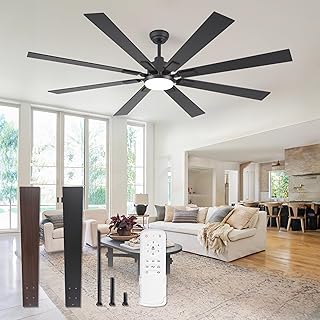
My overall recommendation for great rooms and lofts — eight reversible aluminum blades on an industrial-grade DC motor, so you get sweep-driven airflow at low RPM, which is the quietest way to move a lot of air. Damp rating and 3-CCT lighting make it equally at home over a covered patio.
TCL 72″ Large Ceiling Fan with Lights and Remote
The best-looking option for a modern high-ceiling bedroom, and the one I’d hand to someone who doesn’t want to think about settings: dimmable 3-CCT light that remembers your last state, so your 2700K evening preset is waiting for you. Dual-side blades keep the profile clean from below.
AA-Orion 120″ HVLS Industrial Ceiling Fan
Overkill for a bedroom and perfect for a barn, gym, or shop with 16-foot-plus ceilings — 28,000+ CFM from a PMSM motor that sips power. It destroys thermal stratification in spaces where conventional fans simply stir the top third of the room.
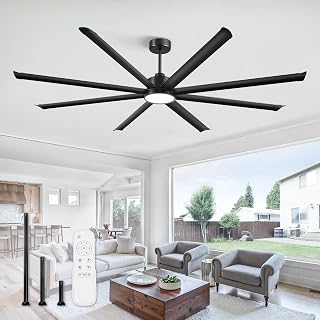
96″ Industrial Ceiling Fan without Lights
Choose this when you already have adequate lighting and want pure air movement; eliminating the light kit also eliminates the most common source of rattle and unwanted evening brightness. Eight reversible aluminum blades and six remote-controlled speeds cover both cooling and winter destratification.
Frequently Asked Questions
What size fan do I need for a room with 14-foot ceilings?
Size to floor area first — 52–65 inches for rooms up to about 300 square feet, 72–96 inches beyond that — then use a longer downrod to bring the blades down to 8–9 feet. Height dictates the rod; square footage dictates the sweep.
Is sleeping with a ceiling fan on bad for you?
For most people it’s beneficial, since it aids the evening drop in core temperature. If you wake with a dry throat or stiff neck, angle airflow away from your head by lowering the speed or shifting the bed rather than turning the fan off entirely.
Can one large fan replace several small ones?
In an open high-ceiling space, yes, and it’s usually the better choice. One large-diameter fan at low speed produces a broad, gentle column of air and far less noise than two small fans working hard.
Do I need an electrician for a long downrod install?
The wiring is standard, but the mounting isn’t — a heavy 72″–120″ fan on an extended rod must be secured to a fan-rated brace and, ideally, checked for balance at height. If the work involves ladders over 12 feet, hire the install.
Final Thoughts
For most high-ceiling living rooms and lofts, the ZMISHIBO 96″ is the strongest all-around buy — quiet DC airflow, damp rating, and tunable light in one fixture. In a bedroom, the 65″ farmhouse fan with its included dual downrods and diffused glass is the easier sleep companion, while genuinely cavernous garages, gyms, and barns should skip residential hardware entirely and go straight to the AA-Orion 120″ HVLS.