Key takeaways
- Slope rating and downrod length: Confirm the canopy’s maximum angle before anything else. Many fans cap out at 15°, which covers a gentle vault but not a cathedral pitch. Then add downrod length so the blades sit 8–9 feet off the floor — that’s the height where air actually reaches you rather than circulating uselessly overhead.
- Blade span matched to room volume: Vaulted rooms hold far more cubic footage than their square footage implies. A 72-inch span isn’t excessive in a great room with a 14-foot peak; it’s the minimum needed to establish a full-room circulation loop rather than a narrow column of air.
- DC motor with usable low speeds: DC motors draw roughly 60–70% less power than AC equivalents and, more importantly for overnight use, produce genuine airflow at speed one or two. Six-speed controls give you the granularity to find the setting that cools without creating a draft on exposed skin.
- Acoustic profile under sustained load: Motor hum, blade wobble, and downrod resonance all amplify in a vaulted room’s hard reflective geometry. Look for sealed motor housings and balanced blade sets; a fan that’s inaudible in a showroom can develop a distinct pulse once it’s on a 24-inch downrod.
- Tunable, dimmable lighting: A 3CCT fixture lets you run 5000K in the afternoon and shift to 3000K after dinner, which supports rather than suppresses evening melatonin production. Dimmability and memory recall matter — you shouldn’t have to reset your evening setting nightly.
What's inside
Vaulted ceilings do beautiful things for a room’s proportions and terrible things for its air circulation. Warm air climbs to the peak and stalls there, leaving the zone where you actually sit and sleep several degrees warmer than the thermostat suggests. From a sleep-wellness standpoint that matters more than most homeowners realize: the human body needs a modest drop in core temperature to initiate and maintain deep sleep, and stagnant air at 74°F undermines that far more than a slightly high thermostat reading with steady airflow. A standard flush-mount fan bolted eight feet up a twelve-foot slope simply cannot move enough air to fix it.
This guide looks at ceiling fans engineered specifically for pitched and vaulted installations — large-diameter blade spans, DC motors with real torque at low speed, and canopy hardware that accommodates angles most builder-grade fans refuse. I’ve weighted three things heavily: airflow at the lowest usable speed (because a fan you have to run on high to feel is a fan you’ll turn off at bedtime), acoustic behavior over long runtimes, and downrod compatibility. Below are the six models worth your attention this year, followed by the specification details that separate a genuinely effective vaulted-ceiling fan from an oversized decoration.
As an Amazon Associate we earn from qualifying purchases.



🛒 Best Price Today on Amazon
Prime members get fast, free shipping on everything above, plus member-only deals. New members get a 30-day free trial — cancel anytime.
How to Choose a Ceiling Fan For Vaulted Ceilings (2026)
- Slope rating and downrod length: Confirm the canopy’s maximum angle before anything else. Many fans cap out at 15°, which covers a gentle vault but not a cathedral pitch. Then add downrod length so the blades sit 8–9 feet off the floor — that’s the height where air actually reaches you rather than circulating uselessly overhead.
- Blade span matched to room volume: Vaulted rooms hold far more cubic footage than their square footage implies. A 72-inch span isn’t excessive in a great room with a 14-foot peak; it’s the minimum needed to establish a full-room circulation loop rather than a narrow column of air.
- DC motor with usable low speeds: DC motors draw roughly 60–70% less power than AC equivalents and, more importantly for overnight use, produce genuine airflow at speed one or two. Six-speed controls give you the granularity to find the setting that cools without creating a draft on exposed skin.
- Acoustic profile under sustained load: Motor hum, blade wobble, and downrod resonance all amplify in a vaulted room’s hard reflective geometry. Look for sealed motor housings and balanced blade sets; a fan that’s inaudible in a showroom can develop a distinct pulse once it’s on a 24-inch downrod.
- Tunable, dimmable lighting: A 3CCT fixture lets you run 5000K in the afternoon and shift to 3000K after dinner, which supports rather than suppresses evening melatonin production. Dimmability and memory recall matter — you shouldn’t have to reset your evening setting nightly.
The Best Ceiling Fan For Vaulted Ceilings (2026)s Reviewed
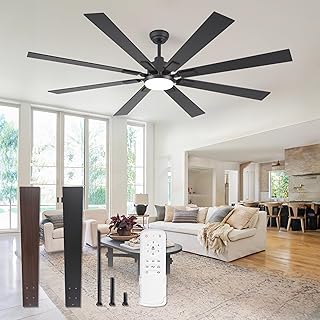
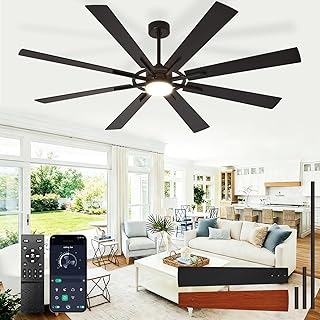
ZMISHIBO 72″ Ceiling Fan with Lights
The strongest all-around performer here, pairing a genuinely high-CFM 72-inch span with a DC motor that stays quiet across its full range — a rare combination at this diameter. Damp rating and the dual-finish blades make it equally at home over a vaulted living room or a covered porch.
Fanbulous 72 Inch with App Control
The reversible dual-sided blades let you flip the finish to match a room rather than compromise, and the memory function restores your last speed and color temperature automatically — a small feature that pays off nightly. Explicit flat and sloped ceiling compatibility makes installation planning straightforward.
Amico 72 Inch Large Ceiling Fan
Six discrete speeds plus a built-in timer give this one the most useful bedtime control set of the group: run it at speed four while falling asleep and let it step down on its own. The matte black finish reads as intentional rather than utilitarian in high-ceilinged spaces.
Modern 72 Inch 8-Blade Outdoor Fan
The eight-blade configuration moves a broad, gentle column of air rather than a concentrated stream, which suits vaulted rooms where you want even distribution over reach. App and remote control both work reliably, and the reversible motor handles winter downdraft duty well.
Fanbulous 65 Inch Black Ceiling Fan
The right call for medium vaulted rooms where 72 inches would visually crowd the space — 65 inches with eight blades still delivers substantial circulation. Indoor/outdoor rating and quiet low-speed operation make it a versatile secondary-room choice.
Frequently Asked Questions
How long a downrod do I need for a vaulted ceiling?
Measure from the mounting box down to where you want the blades — ideally 8 to 9 feet above the floor. On a 12-foot peak that typically means a 24- to 36-inch rod. Longer isn’t always better; excessive length increases wobble and resonance.
Will one large fan cool a great room, or do I need two?
A single 72-inch fan handles most great rooms up to roughly 400 square feet. Beyond that, or in long rectangular layouts, two smaller fans distribute air more evenly than one oversized unit.
Does running a fan overnight actually improve sleep?
Yes, when configured correctly. Steady low-speed airflow supports the evaporative cooling your body relies on to lower core temperature, and consistent broadband sound masks intermittent noise. Avoid pointing high-speed air directly at your face, which dries sinuses and can trigger stiffness.
Should I reverse the fan direction in winter?
In vaulted rooms, absolutely — this is where reverse mode earns its keep. Running clockwise at low speed pulls trapped warm air down from the peak without creating a perceptible draft, often recovering several degrees of usable warmth.
Final Thoughts
For most vaulted great rooms, the ZMISHIBO 72″ is the pick I’d make first — it delivers the airflow the space demands without the motor noise that usually accompanies it. If app control and reversible blade finishes matter to your design, the Fanbulous 72 Inch is the better fit, while the Amico 72 Inch offers the most refined bedtime controls thanks to its six-speed and timer combination. Whichever you choose, verify your slope angle and order the downrod length deliberately; correct mounting height does more for comfort than any spec on the box.