Key takeaways
- Slope rating first: Check the maximum pitch the canopy accepts before anything else. Many fans cap out around 15 degrees, which handles a gentle cathedral ceiling but not a steep A-frame — those need a canopy rated for 30 degrees or more, or an angled-mount adapter sold by the manufacturer.
- Downrod length over blade count: Blades should land roughly 8 to 9 feet above the floor. On a vaulted ceiling that often means an 18-, 24-, or 36-inch rod. A big fan pinned tight to the peak will always underperform a modest fan hung at the right height.
- Sweep matched to the room: Rooms over about 350 square feet benefit from 60 to 96 inches of sweep. Wide, slow-turning blades move a larger volume of air with less turbulence and less noise than a small fan spinning hard — which matters enormously in a bedroom.
- DC motor for quiet low speeds: DC motors deliver usable airflow at speed one or two, where AC motors tend to hum or shudder. For sleep, the lowest usable speed is the specification that counts, not the maximum CFM on the box.
- Light temperature and dimming: If the fan is your primary fixture in a bedroom, insist on 3CCT selection plus true dimming. A 2700K setting under 20 percent output at night protects melatonin timing; save 5000K for daytime tasks.
What's inside
Vaulted ceilings do something beautiful for a room and something frustrating to its air. Heat stacks up in the peak, the breeze you actually need at mattress height never arrives, and a standard 42-inch fan hung eleven feet overhead just stirs the upper atmosphere while you lie awake at 78 degrees. As someone who spends most of my working hours on thermal comfort and sleep quality, I can tell you that airflow you can feel on your skin is one of the most reliable, least expensive sleep interventions available — and in a vaulted room, most people simply aren’t getting it.
This guide focuses on fans engineered for the specific physics of angled, high ceilings: sweep width large enough to move air in a wide column rather than a narrow cone, DC motors that stay near-silent at the low speeds you’ll actually sleep through, downrods long enough to drop the blades into the occupied zone, and canopies rated for slope. Below you’ll find the models worth your attention in 2026, plus the selection criteria I use before recommending anything to a client.
As an Amazon Associate we earn from qualifying purchases.



🛒 Best Price Today on Amazon
Prime members get fast, free shipping on everything above, plus member-only deals. New members get a 30-day free trial — cancel anytime.
How to Choose a Fan For Vaulted Ceiling (2026)
- Slope rating first: Check the maximum pitch the canopy accepts before anything else. Many fans cap out around 15 degrees, which handles a gentle cathedral ceiling but not a steep A-frame — those need a canopy rated for 30 degrees or more, or an angled-mount adapter sold by the manufacturer.
- Downrod length over blade count: Blades should land roughly 8 to 9 feet above the floor. On a vaulted ceiling that often means an 18-, 24-, or 36-inch rod. A big fan pinned tight to the peak will always underperform a modest fan hung at the right height.
- Sweep matched to the room: Rooms over about 350 square feet benefit from 60 to 96 inches of sweep. Wide, slow-turning blades move a larger volume of air with less turbulence and less noise than a small fan spinning hard — which matters enormously in a bedroom.
- DC motor for quiet low speeds: DC motors deliver usable airflow at speed one or two, where AC motors tend to hum or shudder. For sleep, the lowest usable speed is the specification that counts, not the maximum CFM on the box.
- Light temperature and dimming: If the fan is your primary fixture in a bedroom, insist on 3CCT selection plus true dimming. A 2700K setting under 20 percent output at night protects melatonin timing; save 5000K for daytime tasks.
The Best Fan For Vaulted Ceiling (2026)s Reviewed
ZMISHIBO 72″ Ceiling Fan with Lights
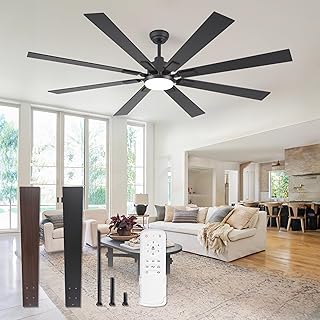
This is my default recommendation for a vaulted great room or covered patio: 72 inches of sweep, a quiet DC motor, and damp-rated construction with a dual-finish look that reads as intentional rather than utilitarian. The 24W 3CCT LED is genuinely useful as a room’s main light source, and the low speeds are quiet enough for a bedroom conversion.
Fanbulous 72 Inch DC Fan with App Control
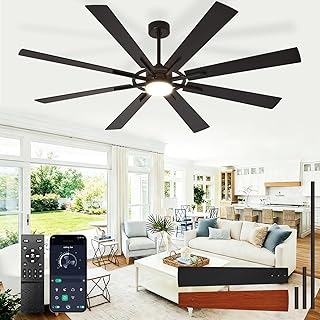
The standout here is scheduling — app control means you can ramp the fan up before bedtime and taper it in the early morning hours when core body temperature naturally rises. Reversible dual-sided blades, memory function, and confirmed flat-or-sloped mounting make it a flexible choice for rooms that change function.
ZMISHIBO 96 Inch Industrial Fan (No Light)
For soaring two-story spaces, barn conversions, and vaulted garages, this eight-blade aluminum fan is the honest answer: nothing at 72 inches will move comparable air. It ships with three downrods so you can dial in blade height precisely, and the six-speed remote lets you find that barely-there setting for sleeping spaces below.
52 Inch Fan with 3CCT Dimmable LED
A sensible pick for a vaulted bedroom of moderate size, with slope compatibility up to 15 degrees and a reversible DC motor that stays quiet where it matters. The dimmable 3CCT LED is the sleep-friendly detail — warm and low at night, bright and neutral when you need it.
Modern 72 Inch 8 Blade Outdoor Fan
Eight blades and six speeds give this one a smooth, layered airflow profile rather than the pulsing you sometimes feel from three-blade designs at height. App and remote control, dimmable light, and outdoor-ready construction make it a strong fit for vaulted porches and sunrooms.
Frequently Asked Questions
How long should my downrod be for a vaulted ceiling?
Measure from the mounting point down to the floor, then subtract 8.5 feet plus the fan’s own body height. On a sloped ceiling, measure at the exact spot where the canopy will sit, since a few feet of horizontal travel can change the height significantly.
Which direction should the fan spin at night?
Counterclockwise in warm months, so air pushes straight down and creates the evaporative cooling effect on your skin that helps trigger sleep onset. In winter, reverse it and run it slowly to pull the heat trapped at the peak back down without a draft.
Is a big fan too noisy for a bedroom?
Generally the opposite. Large blades achieve the same air movement at far lower RPM, and a quality DC motor at speed one or two typically sits below 30 decibels — quieter than most small fans working hard.
Do I need a support brace in the ceiling?
Yes, for anything in this size range. A fan-rated brace or box is required, and the wider and heavier 72- and 96-inch models make a properly secured joist mount non-negotiable. Hire an electrician if the existing box wasn’t installed for a fan.
Final Thoughts
For most vaulted living rooms and bedrooms, the ZMISHIBO 72″ is the balanced choice — big sweep, quiet DC motor, and a light worth living under. Choose the Fanbulous 72 Inch if scheduled, app-driven airflow appeals to your sleep routine, and step up to the ZMISHIBO 96 Inch when the ceiling is genuinely cavernous and raw air movement is the priority.