Key takeaways
- Rip capacity: Furniture means sheet goods. Anything under 24 inches of rip capacity forces you to break panels down with a circular saw first; 30 inches or more lets you rip a half-sheet cleanly and center your cuts on plywood cabinet backs and bed platform decks.
- Fence quality: This matters more than motor power. Look for a rack-and-pinion or twin-rail fence that locks front and back, stays parallel across its travel, and doesn’t deflect when you press stock against it. A drifting fence produces tapered rails, and tapered rails produce racked frames.
- Depth of cut at 45 degrees: Bevels are where furniture saws get exposed. Many compact models drop to roughly 2.4 inches at 45 degrees, which is fine for mitered plywood boxes but tight for thick solid-wood corner details. Check the bevel spec, not just the 90-degree number.
- Dust collection: Fine hardwood dust settles on everything, including the bedroom you’re building for. A shrouded blade with a 2.5-inch port that actually connects to a shop vac keeps your finish clean and your lungs cleaner.
- Stand and mass: Vibration transfers straight into cut quality. A rolling stand with wide, locking legs — or a benchtop saw bolted to a heavy bench — beats a lightweight folding frame every time for the long, slow feed rates that figured hardwoods require.
What's inside
Furniture making punishes imprecision in a way that rough carpentry never does. A framing stud that’s a degree out of square disappears behind drywall; a bed rail that’s a degree out of square announces itself every night as a creak, a rock, or a gap you can slide a business card into. If you build bedroom pieces — headboards, nightstands, platform beds, slatted bases — your table saw is the tool that decides whether the finished piece feels solid and quiet or restless and squeaky. Sleep suffers from bad joinery, and bad joinery usually starts at the rip fence.
The problem for most home builders is that the saws marketed hardest are jobsite saws, engineered for portability and speed rather than the repeatable, dead-square cuts furniture demands. This guide sorts through the current crop of 8-inch and 10-inch portable and benchtop saws with one question in mind: which of them can hold a fence parallel, a blade at a true 90 degrees, and a bevel setting through a full afternoon of panel work? Below you’ll find the picks, followed by a buying framework, hands-on notes on each saw, and answers to the questions that come up most often from readers building their first case piece or bed frame.
As an Amazon Associate we earn from qualifying purchases.



🛒 Best Price Today on Amazon
Prime members get fast, free shipping on everything above, plus member-only deals. New members get a 30-day free trial — cancel anytime.
How to Choose a Table Saw For Furniture Making (2026)
- Rip capacity: Furniture means sheet goods. Anything under 24 inches of rip capacity forces you to break panels down with a circular saw first; 30 inches or more lets you rip a half-sheet cleanly and center your cuts on plywood cabinet backs and bed platform decks.
- Fence quality: This matters more than motor power. Look for a rack-and-pinion or twin-rail fence that locks front and back, stays parallel across its travel, and doesn’t deflect when you press stock against it. A drifting fence produces tapered rails, and tapered rails produce racked frames.
- Depth of cut at 45 degrees: Bevels are where furniture saws get exposed. Many compact models drop to roughly 2.4 inches at 45 degrees, which is fine for mitered plywood boxes but tight for thick solid-wood corner details. Check the bevel spec, not just the 90-degree number.
- Dust collection: Fine hardwood dust settles on everything, including the bedroom you’re building for. A shrouded blade with a 2.5-inch port that actually connects to a shop vac keeps your finish clean and your lungs cleaner.
- Stand and mass: Vibration transfers straight into cut quality. A rolling stand with wide, locking legs — or a benchtop saw bolted to a heavy bench — beats a lightweight folding frame every time for the long, slow feed rates that figured hardwoods require.
The Best Table Saw For Furniture Making (2026)s Reviewed
DEWALT DWE7491RS 10-Inch with Rolling Stand
The 32-1/2-inch rip capacity and rack-and-pinion fence make this the most furniture-capable saw in the group; it will handle a half-sheet of cabinet-grade plywood without a helper. The rolling stand is genuinely stable rather than merely portable, which is why this remains the default recommendation for anyone building casework and bed frames in a garage shop.
DOVAMAN DTS10A 10-Inch with Stand
A 5,300 RPM copper motor and a one-side extension give this saw more cutting capacity than its price suggests, and the 3.35-inch depth at 90 degrees covers thick solid-wood legs and posts. Expect to spend an hour truing the fence and blade before your first real project — do that, and it holds settings well.
DEWALT DWE7485 8-1/4-Inch Compact
The best choice for small shops and apartment builders: it’s light enough to store vertically yet keeps DEWALT’s excellent fence geometry and a surprisingly generous rip capacity for an 8-1/4-inch saw. The trade-off is depth of cut, so plan on plywood, thin stock, and multi-pass work rather than 4×4 bed posts.
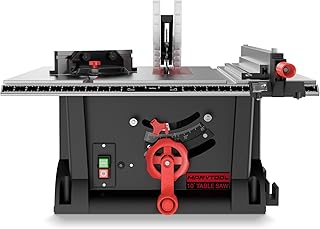
15Amp Portable 10-Inch Compact Benchtop Saw
At 4,600 RPM with a 36-tooth blade, this benchtop model leaves a clean enough edge for glue-up straight off the saw, and the full 0–45 degree bevel range covers mitered nightstand boxes. Bolt it to something heavy; on a flimsy table the vibration shows up in your cut lines.
10-Inch 15 Amp 5000RPM Saw with Stand and Cover
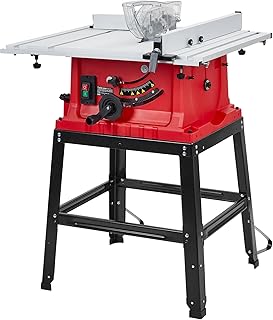
The 36 x 25-inch tabletop is the standout feature here, offering real outfeed support for long rails and stretchers that smaller decks simply can’t manage. Adjustable depth and a protective cover make it a sensible all-rounder if you’re building varied pieces rather than production runs.
Frequently Asked Questions
Is a 10-inch saw necessary, or will 8-1/4 inches do?
For plywood casework, drawer parts, and slats, 8-1/4 inches is plenty. Move to 10 inches once you start cutting solid stock thicker than about two inches or resawing tenon cheeks on chunky bed posts.
Do I need to replace the stock blade?
Yes, for furniture work. Stock 24- to 36-tooth blades are ripping blades; a 60- or 80-tooth crosscut blade or a quality 40-tooth combination blade dramatically reduces tearout on veneered plywood and hardwood end grain.
How flat does the table need to be?
Check with a straightedge before your first project. Anything beyond a few thousandths of dish or crown will fight you during bevels and long rips — shim the extension wings or return the saw rather than compensating by hand.
Can these saws cut hardwood like maple and white oak?
All of them can, with a sharp blade and a patient feed rate. The limiting factor is usually depth of cut and motor recovery under load, not raw amperage; let the saw regain speed between cuts on dense stock.
Final Thoughts
If you’re serious about furniture and have the floor space, the DEWALT DWE7491RS is the clear pick — its fence and rip capacity remove the two biggest obstacles to accurate casework. Tight on room? The DWE7485 delivers the same precision in a smaller footprint. And if you want maximum capacity per dollar for a mixed bag of bedroom projects, the DOVAMAN DTS10A rewards a careful initial setup with cuts good enough to build furniture you’ll sleep soundly on for decades.