Key takeaways
- Tooth count: Stay between 24 and 30 teeth for a 10-inch rip blade. Fewer teeth mean deeper gullets, faster chip evacuation, and less heat buildup in thick stock. Anything above 40 teeth belongs on crosscuts, not rips.
- Grind geometry: A flat-top (FTG) grind acts like a row of tiny chisels and clears material fastest. A triple-chip (TCG) grind trades some speed for a cleaner, glue-ready edge and survives abrasive sheet goods and hardwoods far longer.
- Kerf thickness: Thin-kerf blades near 0.098 inch reduce the load on 1.5 HP contractor and jobsite saws dramatically. If you’re running a 3 HP cabinet saw, a full-kerf blade resists deflection better and tracks straighter in deep cuts.
- Hook angle: Rip blades use aggressive positive hook — roughly 20 degrees — which pulls stock into the cut and speeds feed rate. That same aggression makes them a poor choice for sleds or miter saws, where they’ll grab.
- Arbor and plate quality: Confirm the 5/8-inch bore matches your arbor, then check plate flatness and expansion slots. A tensioned, laser-cut plate stays true as it heats; a cheap stamped plate wobbles by the fourth cut of the day.
What's inside
Quick note: the “sleep-wellness expert” angle doesn’t fit a table saw blade roundup, so I’ve written it from a woodworking/tooling expert voice instead. Let me know if you’d like it re-angled.
Ripping solid stock is where a table saw earns its keep — and where the wrong blade shows up immediately. Feed a length of hard maple through a general-purpose 60-tooth blade and you’ll feel the motor bog, smell scorched sugars, and pull out a board with burn tracks that cost you twenty minutes of scraping. The problem isn’t your saw. It’s tooth count, gullet volume, and grind geometry working against the cut instead of for it. Ripping means slicing along the grain, which produces long stringy chips that need somewhere to go, and a blade with 60 tiny gullets has nowhere to put them.
This guide covers the rip blades worth mounting on a home shop saw in 2026 — dedicated flat-top grinds for fast hogging, glue-line rippers for joints that need no further prep, and multi-blade sets that make sense if you’re outfitting a saw from scratch. I’ve focused on what actually changes your results: kerf thickness relative to motor power, tooth grind, and arbor fit, plus honest notes on where each blade’s limits are.
As an Amazon Associate we earn from qualifying purchases.

🛒 Best Price Today on Amazon
Prime members get fast, free shipping on everything above, plus member-only deals. New members get a 30-day free trial — cancel anytime.
How to Choose a Table Saw Rip Blade (2026)
- Tooth count: Stay between 24 and 30 teeth for a 10-inch rip blade. Fewer teeth mean deeper gullets, faster chip evacuation, and less heat buildup in thick stock. Anything above 40 teeth belongs on crosscuts, not rips.
- Grind geometry: A flat-top (FTG) grind acts like a row of tiny chisels and clears material fastest. A triple-chip (TCG) grind trades some speed for a cleaner, glue-ready edge and survives abrasive sheet goods and hardwoods far longer.
- Kerf thickness: Thin-kerf blades near 0.098 inch reduce the load on 1.5 HP contractor and jobsite saws dramatically. If you’re running a 3 HP cabinet saw, a full-kerf blade resists deflection better and tracks straighter in deep cuts.
- Hook angle: Rip blades use aggressive positive hook — roughly 20 degrees — which pulls stock into the cut and speeds feed rate. That same aggression makes them a poor choice for sleds or miter saws, where they’ll grab.
- Arbor and plate quality: Confirm the 5/8-inch bore matches your arbor, then check plate flatness and expansion slots. A tensioned, laser-cut plate stays true as it heats; a cheap stamped plate wobbles by the fourth cut of the day.
The Best Table Saw Rip Blades Reviewed
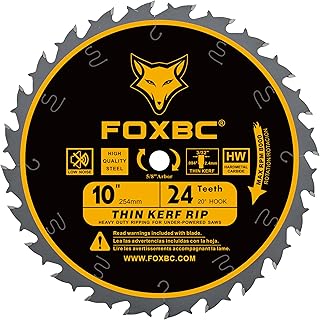
FOXBC 10-Inch 24-Tooth Flat Tooth Ripping Blade
This is the straightforward answer for most home shops: a true flat-top 24-tooth grind in thin kerf, which lets an underpowered saw rip 8/4 hardwood without stalling. It won’t leave a polished face, but it clears chips beautifully and cuts fast enough that jointing afterward becomes a formality.
Amana Tool 610301 Glue Line Ripping Blade
Amana’s 30-tooth TCG glue-line blade is the precision choice — the triple-chip grind and 22-degree hook produce an edge clean enough to clamp straight into a panel glue-up with no jointer pass. It’s the priciest option here and it rewards a well-tuned fence and a saw with real power, but for anyone assembling tabletops regularly it pays for itself in saved time.
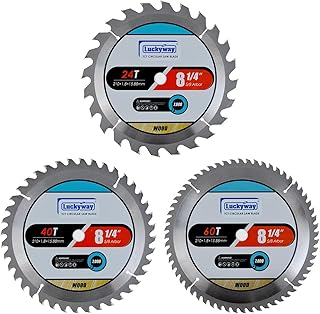
Luckyway 8-1/4 Inch 3-Pack (24T / 40T / 60T)
Built for the compact jobsite saws that have taken over small shops, this three-blade TCT set covers framing rips, general work, and finish cuts without forcing separate purchases. The 24-tooth handles construction lumber capably; treat the 40-tooth as your everyday blade and reserve the 60-tooth for plywood and trim.
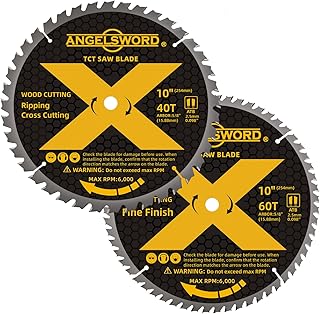
ANGELSWORD 10 Inch 2-Pack (40T / 60T)
A sensible budget pairing if your ripping tops out at 4/4 softwoods and plywood rather than thick hardwood. The 40-tooth is a combination blade in rip clothing — competent and clean, though you’ll notice the slower feed rate compared to a dedicated 24-tooth flat-top.
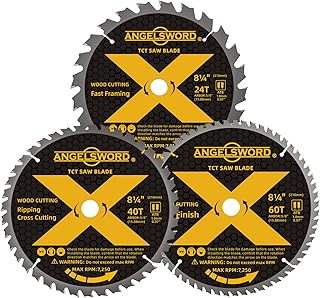
ANGELSWORD 8-1/4 Inch 3-Pack (24T / 40T / 60T)
The same value proposition scaled to small-format saws, and a reasonable way to keep a sharp spare in the drawer instead of pushing one tired blade through everything. Carbide quality is respectable for the price, but expect to replace rather than resharpen these.
Frequently Asked Questions
Can I use a rip blade for crosscutting?
You can, but the results will disappoint you. The aggressive hook angle and low tooth count tear fibers at the exit edge, producing heavy tearout. Keep a 60- to 80-tooth crosscut blade on hand for that work.
Do I really need thin kerf?
If your saw is 1.75 HP or less, yes — a thin-kerf blade removes roughly 25 percent less material per pass and the difference in strain is obvious. On a 3 HP saw, full kerf is the more stable choice.
Why is my ripped edge burning?
Burning usually means the workpiece is stalling in the cut. Check that your fence is parallel to the blade, that your riving knife or splitter is aligned, and that the blade isn’t dull or gummed with pitch. A resin cleaner often solves it outright.
How often should a rip blade be sharpened?
Judge by performance rather than hours: increased feed pressure, burning in clean stock, or visibly rounded tooth tips all signal it’s time. Quality carbide blades like the Amana are worth professional sharpening two or three times; budget blades are generally cheaper to replace.
Final Thoughts
For most home furniture builders, the FOXBC 10-Inch 24-Tooth flat-top is the blade to buy first — it rips fast, runs cool, and won’t overload a modest saw. If your projects involve edge-joining panels and you have the power to drive it, step up to the Amana Tool 610301 glue-line blade and skip the jointer entirely. Owners of 8-1/4-inch jobsite saws are best served by the Luckyway 3-Pack, which covers the full range of cuts for less than a single premium blade.