Key takeaways
- Kerf width: Thin kerf (around .098″) removes less material and demands less power, which makes it the right call for saws under 3 HP. Full kerf (.125″) runs stiffer and truer, but only if your motor can feed it without bogging.
- Tooth count and grind: A 50-tooth 4-and-1 combination grind — four ATB teeth plus a flat raker, repeating — is the classic compromise: clean crosscuts, flat-bottomed rip kerfs. Fewer teeth rip faster; 80 teeth crosscut beautifully but will scorch a rip.
- Hook angle: Roughly 15° is the sweet spot for a general-purpose table saw blade, pulling stock through with confidence. Lower hook angles are safer on sleds and slide saws but feel sluggish in a rip cut.
- Plate quality and vibration control: A precision-ground .071″ plate with laser-cut expansion slots stays flat as it heats up. That flatness, more than tooth count, is what gives you a glue-ready edge straight off the saw.
- Carbide grade and coating: Dense micrograin carbide holds an edge through far more board feet before it needs sharpening, and a nonstick coating keeps pitch from building up on the shoulders — the usual reason a “dull” blade starts burning cherry and maple.
What's inside
Anyone who has ever built a bed frame or a nightstand knows the moment the illusion breaks: you slide two panels together and the joint gapes, or you flip a crosscut over and find a fringe of torn fibers along the shoulder. Nine times out of ten the culprit isn’t the saw, the fence, or the operator. It’s the blade. A 10-inch combination blade is asked to do two contradictory jobs — clear a fast rip through thick hardwood and glide through end grain without splintering — and the cheap stamped disc that shipped in the box is genuinely bad at both. Buyers end up sanding away the evidence instead of cutting clean in the first place.
This guide is written for people building furniture that has to live in a bedroom: platform beds, headboards, dressers, nightstands — pieces where a visible joint line or a fuzzy edge is the difference between “handmade” and “homemade.” Below you’ll find our picks for the best 10-inch combination table saw blades for 2026, plus the specs that actually change your results (kerf, hook angle, plate thickness) and the ones that mostly sell blades. Whether you’re running a 1.75-HP contractor saw or a 3-HP cabinet saw, there’s a blade here matched to your motor and your standards.
As an Amazon Associate we earn from qualifying purchases.




🛒 Best Price Today on Amazon
Prime members get fast, free shipping on everything above, plus member-only deals. New members get a 30-day free trial — cancel anytime.
How to Choose a/an 10-Inch Combination Table Saw Blade (2026)
- Kerf width: Thin kerf (around .098″) removes less material and demands less power, which makes it the right call for saws under 3 HP. Full kerf (.125″) runs stiffer and truer, but only if your motor can feed it without bogging.
- Tooth count and grind: A 50-tooth 4-and-1 combination grind — four ATB teeth plus a flat raker, repeating — is the classic compromise: clean crosscuts, flat-bottomed rip kerfs. Fewer teeth rip faster; 80 teeth crosscut beautifully but will scorch a rip.
- Hook angle: Roughly 15° is the sweet spot for a general-purpose table saw blade, pulling stock through with confidence. Lower hook angles are safer on sleds and slide saws but feel sluggish in a rip cut.
- Plate quality and vibration control: A precision-ground .071″ plate with laser-cut expansion slots stays flat as it heats up. That flatness, more than tooth count, is what gives you a glue-ready edge straight off the saw.
- Carbide grade and coating: Dense micrograin carbide holds an edge through far more board feet before it needs sharpening, and a nonstick coating keeps pitch from building up on the shoulders — the usual reason a “dull” blade starts burning cherry and maple.
The Best 10-Inch Combination Table Saw Blade (2026)s Reviewed
Diablo D1050X 50T Combination Blade
The most sensible default for a home shop: a thin-kerf, 50-tooth ATB blade with a 15° hook and Perma-Shield coating that keeps resin from grabbing on softwoods and plywood. It’s the blade I recommend to anyone whose saw hesitates under load, because it cuts near-cabinet quality without asking much of the motor.
CMT Orange Tools 256.050.10
CMT’s 4+1 combination grind on a .071″ plate is a genuinely versatile industrial blade, ripping 8/4 hardwood and crosscutting face-grain veneer with equal composure. The slightly heavier .102″ kerf rewards a well-tuned saw with excellent stability and very little deflection at the end of a long rip.
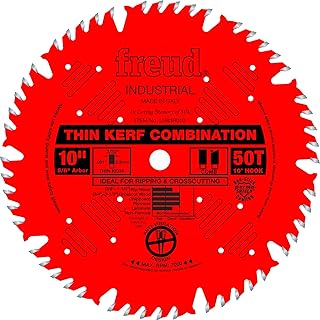
Freud LU83R010 Industrial Thin Kerf
This is the precision pick of the group — TiCo hi-density carbide and laser-cut anti-vibration slots that noticeably quiet the blade and leave a burnish-free surface. If you build furniture where the joint line is the finish, the Freud earns its keep.
US1048ATBFK 48T Combination Blade
A USA-made full-kerf 48-tooth blade with a plate stiff enough to track dead straight through wide panels. The slightly lower tooth count clears chips well in ripping, making it a strong choice for stock prep on a cabinet saw.
50-Tooth Thin Kerf Combination Blade
A budget-conscious 50T ATB thin kerf with a nonstick coating and a 6,000 RPM rating, and it handles hardwood and plywood far better than its price suggests. Ideal as a dedicated construction-lumber or breakdown blade so your premium blade stays sharp for show surfaces.
Frequently Asked Questions
Is a combination blade good enough, or do I need separate rip and crosscut blades?
For most furniture builds, one good 50-tooth combination blade covers 90% of the work. Dedicated blades are worth it once you’re ripping thick hardwood in volume or cutting a lot of melamine.
Thin kerf or full kerf for my saw?
Under 3 HP, choose thin kerf. At 3 HP and above, full kerf gives you a stiffer plate and marginally straighter cuts in tall stock.
Will an 80-tooth blade like the FOXBC work as an all-purpose blade?
No — treat it as a finish crosscut and plywood blade. Ripping solid wood with 80 teeth overheats the blade and burns the cut.
How do I know when to sharpen?
Watch for increased feed pressure, burning in maple or cherry, and fuzzy crosscut shoulders. Clean the pitch off first; if performance doesn’t return, it’s time for sharpening.
Final Thoughts
For most home furniture makers, the Diablo D1050X is the smartest first purchase — clean, forgiving, and easy on smaller motors. Step up to the Freud LU83R010 when surface quality is the priority, or the CMT 256.050.10 if you want one industrial-grade blade to handle everything a well-tuned saw can throw at it.