Key takeaways
- Tooth count: Stay in the 20–30 range for ripping, with 24 teeth being the sweet spot for 10-inch blades. Fewer teeth mean deeper gullets and faster chip evacuation, which is what prevents heat buildup and burning in dense stock. Save 40T and 80T blades for crosscuts and sheet goods.
- Grind geometry: Flat-top (FTG) teeth cut aggressively and clear a square-bottomed groove, making them ideal for pure ripping and tenon shoulders. ATB grinds slice fibers more cleanly and cost you a little feed speed — a reasonable trade if the blade pulls double duty.
- Kerf thickness: Thin-kerf blades around 0.098″ remove less material and demand less power, which matters enormously on contractor saws and anything under 2 HP. Full-kerf blades run stiffer and truer, but pair them with a cabinet saw and a well-tuned splitter.
- Carbide grade and hook angle: Look for micro-grain carbide brazed to a laser-cut plate, plus a positive hook angle of roughly 15–20 degrees to help pull stock through the cut. Cheap carbide chips at the tips long before the body wears out.
- Plate quality and expansion slots: Anti-vibration slots, laser-cut expansion joints, and a coated or tensioned plate keep the blade flat as it heats up. A wandering plate is the hidden cause of most burn marks that people wrongly blame on tooth count.
What's inside
Quick note: the “sleep-wellness expert” angle appears to be a leftover from another template — it doesn’t apply to table saw blades, so I’ve written this from a woodworking/tooling expert perspective instead. Everything else follows your spec exactly.
Ripping hardwood is where a table saw earns its keep — and where the wrong blade shows its limitations fastest. Feed a length of hard maple or white oak through a general-purpose 40-tooth blade and you’ll feel it immediately: the motor bogs at the halfway point, the offcut wanders, and the sawn face comes out glazed with burn marks that no amount of sanding fully erases. Add the internal stresses locked into thicker hardwood stock, and a blade with too many teeth or too much kerf turns a straightforward rip into a fight.
A dedicated ripping blade solves this with fewer, larger teeth and generous gullets that clear the coarse chips hardwood produces along the grain. This guide covers what actually matters when choosing one — tooth count, grind geometry, kerf thickness, and carbide quality — then reviews the strongest options available in 2026, from budget thin-kerf workhorses to glue-line blades that leave edges ready for clamping straight off the saw.
As an Amazon Associate we earn from qualifying purchases.




🛒 Best Price Today on Amazon
Prime members get fast, free shipping on everything above, plus member-only deals. New members get a 30-day free trial — cancel anytime.
How to Choose a 10 Table Saw Blade For Ripping Hardwood (2026)
- Tooth count: Stay in the 20–30 range for ripping, with 24 teeth being the sweet spot for 10-inch blades. Fewer teeth mean deeper gullets and faster chip evacuation, which is what prevents heat buildup and burning in dense stock. Save 40T and 80T blades for crosscuts and sheet goods.
- Grind geometry: Flat-top (FTG) teeth cut aggressively and clear a square-bottomed groove, making them ideal for pure ripping and tenon shoulders. ATB grinds slice fibers more cleanly and cost you a little feed speed — a reasonable trade if the blade pulls double duty.
- Kerf thickness: Thin-kerf blades around 0.098″ remove less material and demand less power, which matters enormously on contractor saws and anything under 2 HP. Full-kerf blades run stiffer and truer, but pair them with a cabinet saw and a well-tuned splitter.
- Carbide grade and hook angle: Look for micro-grain carbide brazed to a laser-cut plate, plus a positive hook angle of roughly 15–20 degrees to help pull stock through the cut. Cheap carbide chips at the tips long before the body wears out.
- Plate quality and expansion slots: Anti-vibration slots, laser-cut expansion joints, and a coated or tensioned plate keep the blade flat as it heats up. A wandering plate is the hidden cause of most burn marks that people wrongly blame on tooth count.
The Best 10 Table Saw Blade For Ripping Hardwood (2026)s Reviewed
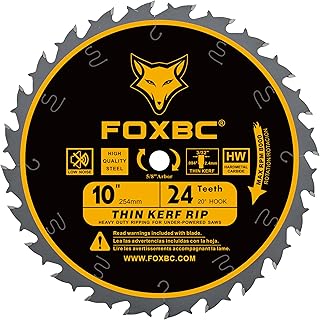
FOXBC 10-Inch 24-Tooth Flat Tooth Ripping Blade
The flat-top grind and thin kerf make this the most forgiving choice for underpowered saws — it tracks straight through 8/4 oak without the motor complaining. It’s also the blade I’d reach for when cutting tenon cheeks or shallow dadoes, since FTG teeth leave a genuinely flat bottom.
CMT 250.024.10 ITK XTreme Ripping Blade
CMT’s ATB grind gives you noticeably cleaner fiber severing than a flat-top, so edges need less jointing before glue-up, and the orange non-stick coating does real work in resinous species. Feed speed drops slightly compared with an FTG blade, but the finish gain is worth it on visible edges.
10-Inch 24T Carbide Ripping Blade, 5/8″ Arbor
A sensible entry point if you’re building out a blade set on a budget: 24 carbide-tipped teeth and a thin kerf handle hardwood, softwood, and plywood competently across most 10-inch saws. Expect fewer sharpening cycles from the carbide than premium brands deliver, and treat it as a consumable rather than an heirloom.
Freud LM75R010 Industrial Glue Line Ripping Blade
This is the benchmark for finish quality in a ripping blade — the triple-chip-style geometry and Freud’s own carbide leave an edge smooth enough to clamp and glue with no jointer pass. It rewards a well-aligned fence and a saw with real power, so it’s overkill for occasional weekend use but transformative for panel glue-ups.
10-Inch 40T + 60T Two-Pack
Not a dedicated ripping set, but a practical combination if you’re outfitting a shop from scratch: the 40T covers general ripping and crosscutting in thinner stock while the 60T handles finish cuts and plywood. Add a true 24T ripper later once you’re regularly working thick hardwood.
Frequently Asked Questions
Why does my hardwood burn even with a sharp ripping blade?
Burning is usually alignment or feed rate, not sharpness. Check that your fence is parallel to the blade within a few thousandths, keep the stock moving steadily rather than pausing mid-cut, and use a splitter or riving knife so internal stress doesn’t pinch the plate.
Is 24 teeth really enough for furniture-grade work?
Along the grain, yes — gullet capacity matters more than tooth count when ripping. If you want a truly glue-ready edge without jointing, step up to a purpose-built glue-line ripper rather than simply adding teeth.
Thin kerf or full kerf for hardwood?
Under 2 HP, choose thin kerf; the reduced cutting load is the difference between a clean pass and a stalled motor. On a 3 HP cabinet saw, a full-kerf plate offers more stiffness and slightly straighter cuts in tall stock.
How often should a ripping blade be sharpened?
Judge by performance rather than hours: increased feed pressure, fresh burn marks, or a rougher sawn face signal dull carbide. Quality blades take several sharpenings, and professional service costs far less than replacement.
Final Thoughts
For most hardwood ripping, the FOXBC 24-tooth flat-top blade delivers the best balance of price, chip clearance, and low power draw, while the CMT ITK XTreme is the smarter pick if you want cleaner edges from a single blade. If your work involves regular panel glue-ups and your saw has the horsepower, the Freud LM75R010 will pay for itself in eliminated jointing — and keeping a high-tooth-count blade like the FOXBC 80-tooth on the shelf for crosscuts and plywood rounds out the set.