Key takeaways
- Fence quality over motor size: Nearly every 15-amp saw has enough power for hardwood. What separates good from frustrating is whether the rip fence locks parallel to the blade every single time. A rack-and-pinion fence is worth paying for.
- Rip capacity vs. your projects: If you plan to break down plywood for cabinets or bookcases, look for 24 inches or more to the right of the blade. For small furniture, boxes, and trim work, a shorter capacity saves space and money.
- Stand and mobility: A rolling or folding stand transforms a garage saw from a permanent obstacle into something you can tuck against a wall. Benchtop-only models need a sturdy surface you’ve already got.
- Dust collection port: Fine sawdust is the hidden cost of woodworking. A shrouded blade with a shop-vac port keeps your lungs and your workspace considerably cleaner.
- Safety hardware: Insist on a riving knife, a functional blade guard, anti-kickback pawls, and a paddle-style off switch you can hit with your knee. These are non-negotiable while you’re building muscle memory.
What's inside
Buying your first table saw is oddly stressful. You’re standing in front of a wall of specs — amps, RPM, rip capacity, bevel range — trying to work out which numbers actually change what you can build, and which ones are just marketing decoration. Meanwhile the real questions are more practical: will this thing fit in a one-car garage, can I carry it alone, and will it cut a straight line without me fighting it? Beginners tend to overspend on power they’ll never use and underspend on the fence, which is the part that determines whether your cuts are square.
This guide is built around that reality. Below you’ll find six beginner-friendly table saws that span budget benchtop units to genuinely capable jobsite saws, along with the buying criteria that matter most in your first year of woodworking — fence accuracy, dust control, footprint, and stand quality. Each pick is assessed on how forgiving it is for someone still learning to read grain and set a blade height, not on how it performs in a production shop.
As an Amazon Associate we earn from qualifying purchases.



🛒 Best Price Today on Amazon
Prime members get fast, free shipping on everything above, plus member-only deals. New members get a 30-day free trial — cancel anytime.
How to Choose a Table Saw For Beginner Woodworking (2026)
- Fence quality over motor size: Nearly every 15-amp saw has enough power for hardwood. What separates good from frustrating is whether the rip fence locks parallel to the blade every single time. A rack-and-pinion fence is worth paying for.
- Rip capacity vs. your projects: If you plan to break down plywood for cabinets or bookcases, look for 24 inches or more to the right of the blade. For small furniture, boxes, and trim work, a shorter capacity saves space and money.
- Stand and mobility: A rolling or folding stand transforms a garage saw from a permanent obstacle into something you can tuck against a wall. Benchtop-only models need a sturdy surface you’ve already got.
- Dust collection port: Fine sawdust is the hidden cost of woodworking. A shrouded blade with a shop-vac port keeps your lungs and your workspace considerably cleaner.
- Safety hardware: Insist on a riving knife, a functional blade guard, anti-kickback pawls, and a paddle-style off switch you can hit with your knee. These are non-negotiable while you’re building muscle memory.
The Best Table Saw For Beginner Woodworking (2026)s Reviewed
DEWALT DWE7491RS 10-Inch with Rolling Stand
This is the saw most experienced woodworkers point beginners toward, and the reason is the rack-and-pinion fence — it glides, locks square, and stays that way, which removes the single biggest source of beginner frustration. The 32-1/2-inch rip capacity handles full sheet goods, and the folding rolling stand means you can genuinely store it out of the way.
SKIL TS6307-00 15 Amp Portable Jobsite Saw
SKIL’s rack-and-pinion fence punches well above the price bracket, and the integrated folding stand deploys in seconds without the usual wrestling match. A smart pick if you want DEWALT-class accuracy while keeping several hundred dollars for blades, clamps, and lumber.
DEWALT DWE7485 8-1/4-Inch Compact
The 8-1/4-inch blade trims weight and bulk dramatically, making this the best choice for apartment balconies, shared garages, and anyone who has to carry the saw to the work. Cut depth is shallower than a 10-inch, so it’s ideal for 3/4-inch stock and trim rather than thick hardwood slabs.
DOVAMAN DTS10A 10-Inch with Stand
A budget-conscious 10-inch option that covers the fundamentals: 3.35 inches of cut at 90 degrees, a 45-degree bevel, and a one-side table extension for wider panels. Expect to spend a little time dialing in the fence and swapping the stock blade, but the value is real.
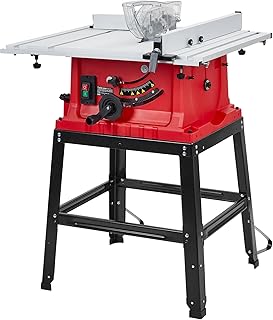
10-Inch 15 Amp Saw with 36 x 25-Inch Tabletop
The generous 36-by-25-inch table surface gives workpieces meaningful support, which matters more than beginners expect — unsupported stock is what causes wandering cuts. The included protective cover is a thoughtful touch for saws that live in a damp garage.
Frequently Asked Questions
Is a 10-inch saw better than an 8-1/4-inch for a beginner?
Only if you need the extra depth. A 10-inch blade cuts roughly 3-1/8 inches deep; 8-1/4-inch models manage about 2-1/2. For dimensional lumber and plywood, the smaller saw is lighter, cheaper, and perfectly adequate.
Do I need to replace the included blade?
Usually, yes. Stock blades are typically 24-tooth ripping blades. Adding a 40- or 50-tooth combination blade will noticeably improve edge quality on crosscuts and plywood.
How much space does a table saw actually need?
Plan for clear runoff equal to the longest board you’ll cut, both in front of and behind the blade — about eight feet of total working length for typical furniture work. Side clearance can be tighter.
Can these saws cut metal or plastic?
Some listings advertise it, but treat that as a secondary function. Cutting non-ferrous metal or acrylic requires a blade specifically rated for the material and a slower, steadier feed rate.
Final Thoughts
For most beginners building furniture at home, the DEWALT DWE7491RS is the saw you won’t outgrow — its fence and rip capacity remove excuses and let you focus on technique. The SKIL TS6307-00 delivers nearly the same accuracy for meaningfully less, and the compact DEWALT DWE7485 is the right answer when floor space, not budget, is the binding constraint.