Key takeaways
- Shade opacity over shade prettiness: A dense linen or fabric drum diffuses the bulb and keeps the filament out of your peripheral vision. Thin, translucent, or open-top shades throw hot spots that your eyes work to ignore for hours — a common source of that vague, wired-but-tired evening feeling.
- Height relative to seated eye level: Aim for the bottom of the shade to sit at or just below eye height when you’re on the sofa, roughly 24 to 32 inches of total lamp height on a standard end table. Taller lamps look grand but rain light directly into your line of sight.
- Warm color temperature, deliberately chosen: Reserve 2700K or lower for the living room and treat 3000K as the ceiling. Cooler bulbs are fine over a kitchen counter; in a wind-down space they flatten the room and suppress the melatonin signal your body is trying to build.
- Dimming or a second light level: A single on-off switch forces one brightness on every hour of the evening. Look for a rotary dimmer, a touch control with multiple stages, or a built-in nightlight so the room can step down as the night goes on.
- Reachability and cord discipline: If you have to lean, stretch, or crawl behind furniture to switch off, you’ll leave it on. Touch bases, in-line rotary switches, and USB ports that keep charging clutter off the coffee table all make a lamp likelier to be used well.
What's inside
Most living rooms are lit for the wrong hour. Buyers shop for a table lamp that looks handsome at 2 p.m. in a showroom photo, then live with it at 9:30 p.m. — when a too-bright, too-blue pool of light sitting at eye level quietly tells the body it’s still midday. From a sleep-wellness standpoint, the lamp beside your sofa is doing more work than the one beside your bed: it’s the last significant light source most people sit under for two or three hours before they try to fall asleep. Get it wrong and you’re fighting your own melatonin from the armchair.
This guide looks at living room table lamps through that evening-first lens. Alongside the usual questions of scale, shade material, and base finish, we weigh how each lamp behaves after dark — how much glare escapes the shade, whether the light falls warm or clinical, and whether you can dial it down without getting up. Below you’ll find our current picks for 2026, a short buying framework, and answers to the questions readers ask most.
As an Amazon Associate we earn from qualifying purchases.




🛒 Best Price Today on Amazon
Prime members get fast, free shipping on everything above, plus member-only deals. New members get a 30-day free trial — cancel anytime.
How to Choose a Table Lamp For Living Room (2026)
- Shade opacity over shade prettiness: A dense linen or fabric drum diffuses the bulb and keeps the filament out of your peripheral vision. Thin, translucent, or open-top shades throw hot spots that your eyes work to ignore for hours — a common source of that vague, wired-but-tired evening feeling.
- Height relative to seated eye level: Aim for the bottom of the shade to sit at or just below eye height when you’re on the sofa, roughly 24 to 32 inches of total lamp height on a standard end table. Taller lamps look grand but rain light directly into your line of sight.
- Warm color temperature, deliberately chosen: Reserve 2700K or lower for the living room and treat 3000K as the ceiling. Cooler bulbs are fine over a kitchen counter; in a wind-down space they flatten the room and suppress the melatonin signal your body is trying to build.
- Dimming or a second light level: A single on-off switch forces one brightness on every hour of the evening. Look for a rotary dimmer, a touch control with multiple stages, or a built-in nightlight so the room can step down as the night goes on.
- Reachability and cord discipline: If you have to lean, stretch, or crawl behind furniture to switch off, you’ll leave it on. Touch bases, in-line rotary switches, and USB ports that keep charging clutter off the coffee table all make a lamp likelier to be used well.
The Best Table Lamp For Living Room (2026)s Reviewed
JONATHAN Y Montreal 29″ Teardrop Gourd Glass Lamp
The ice-blue glass gourd reads as a decorative object first and a light source second, which is exactly right for a living room where the lamp is on display all day. The white linen drum is dense enough to soften the LED cleanly, and at 29 inches it lands in the sweet spot for most end tables beside a standard-depth sofa.
BOBOMOMO Modern Table Lamp Set of 2
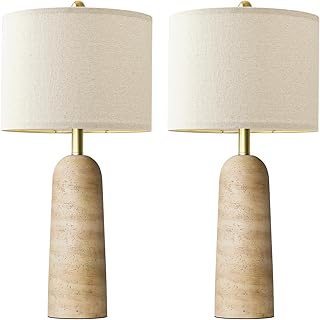
Warm beige resin with a stone-look texture gives you the visual weight of ceramic without the fragility, and buying as a pair solves the symmetry problem on a sofa flanked by two tables. The linen shades diffuse generously, so a warm 2700K bulb in each produces the even, low-glare wash that suits late-evening reading.
G-SAFAVA 23.75″ Retro Farmhouse Touch Lamp
This is the most sleep-friendly pick here on function alone: touch control, two separate light sources including a low nightlight, and USB-C and USB-A ports built into the base. The shorter 23.75-inch profile keeps the shade below seated eye level, and the nightlight mode lets you drop the room to a genuinely dim setting instead of switching from bright to black.
USumkky 25″ Table Lamps Set of 2
White-washed ceramic is a quiet, forgiving finish that works against warm wood, dark walls, and everything between, and the 25-inch height suits lower console and end tables well. A sensible choice when you want two matching lamps doing atmospheric work rather than making a statement.
JONATHAN Y Dallas 31.5″ Ceramic Column Lamp
At 31.5 inches this is the tallest option, best reserved for taller side tables or behind a low-slung sofa where the shade won’t sit in your eyeline. The rotary switch and silk-wrapped cord are the details that matter day to day — the former gives you tactile control, the latter keeps the lamp looking considered from every angle.
Frequently Asked Questions
How bright should a living room table lamp actually be?
For a lamp used as ambient or task-adjacent light beside seating, 450 to 800 lumens per lamp is usually plenty — roughly a 40 to 60 watt incandescent equivalent. Two modest lamps at opposite ends of a room read as more comfortable and less fatiguing than one very bright one, because the contrast between lit and unlit zones is gentler on the eyes.
Does the color temperature of a table lamp really affect sleep?
Intensity matters more than color, but both contribute. Cooler, bluer light in the two to three hours before bed delays melatonin release more than warm light at the same brightness, so a 2700K bulb dimmed low is a meaningfully better evening companion than a 4000K bulb at full output. The practical takeaway: buy warm, and buy dimmable.
Should I buy a single lamp or a matched pair?
Buy a pair when you have two symmetrical surfaces flanking a sofa or a pair of nightstand-height tables, since matching lamps create balanced, low-contrast light across the seating area. Choose a single statement lamp when it’s the only side table in play or when a floor lamp is already handling the opposite corner.
Can I put a smart bulb in these lamps?
In most cases yes, provided the lamp uses a standard E26 socket and isn’t an integrated-LED design. Note that lamps with built-in dimmers or touch controls can conflict with smart bulbs — if you want app or schedule control, pick a model with a simple on-off switch and let the bulb handle the dimming.
Final Thoughts
If you want one lamp that genuinely supports a good night’s sleep, the G-SAFAVA touch lamp earns it with a true low nightlight mode and controls you’ll actually reach for. For a pair that quietly improves the whole room, the BOBOMOMO resin set delivers warm, well-diffused light and enough presence to anchor a sofa, while the JONATHAN Y Montreal remains the pick for anyone who wants their lamp to look like a design decision as much as a light source.