Key takeaways
- 18V–24V: 8–11 inch swaths, 0.065–0.080 inch line, suitable for grass up to about 8 inches tall. Good for 5,000–8,000 sq ft of maintained lawn.
- 36V–40V: 12–15 inch swaths, 0.080–0.095 inch line, handles grass up to 12 inches and light weeds. Good for a quarter acre.
- 56V–60V: 14–16 inch swaths, 0.095–0.105 inch line, handles 18-inch weeds and saplings under half an inch. Good for a half acre.
- 80V and above: 16–18 inch swaths, 0.105–0.130 inch line, marketed at brush and ditch work. Good for overgrown lots, but weight climbs past 13 lbs.
Best String Trimmers Battery Powered: Top Picks for 2026
The best battery-powered string trimmers in 2026 cluster around two voltage classes: 18V–24V homeowner tools that weigh 5–7 lbs and cut a 10–13 inch swath, and 40V–80V machines that weigh 9–14 lbs and cut 14–17 inches with enough torque to clear brambles. If your lot is under a quarter acre of maintained grass, an 18V or 24V trimmer with a 4.0Ah battery will finish the job on one charge. If you are cutting fence lines, ditch banks, or knee-high weeds on a half acre or more, buy into a 40V or 56V platform and budget for a second battery. The single biggest mistake buyers make is matching voltage to yard size instead of matching cutting swath and amp-hour capacity to the actual grass they cut.
Below are the picks that hold up in 2026, organized by the situation that fits them, followed by the specifications that actually decide whether a trimmer works for you or fights you.
Quick Comparison Table
| Model / Type | Voltage | Cutting Swath | Weight (with battery) | Battery Run Time | Best For |
|---|---|---|---|---|---|
| EGO Power+ ST1511T | 56V | 15 in. | 11.3 lbs | ~45–60 min (2.5Ah) | Mid-size yards, mixed grass and weeds |
| Greenworks 40V 21342 | 40V | 12 in. | 9.4 lbs | ~45 min (2.0Ah) | Small yards, light trimming |
| Ryobi 40V RY40270 | 40V | 13 in. | 10.1 lbs | ~50 min (4.0Ah) | Tight fence lines, edging |
| Milwaukee M18 FUEL 2825-20 | 18V | 14 in. | 9.9 lbs | ~40–50 min (8.0Ah) | Contractor-grade, heavy weeds |
| DeWalt 20V MAX DCST922 | 20V | 14 in. | 8.8 lbs | ~30–40 min (5.0Ah) | Already own DeWalt 20V batteries |
| Makita 36V (18V×2) XRU15 | 36V (2×18V) | 15 in. | 10.4 lbs | ~45 min (2×5.0Ah) | Homeowners with Makita LXT system |
| Stihl FSA 57 | 36V (AP system) | 13 in. | 8.2 lbs | ~40 min (AP 300 S) | Light residential, quiet suburbs |
| Husqvarna 220iL | 40V | 15 in. | 10.8 lbs | ~45 min (4.2Ah) | Large lots, professional feel |
| Toro 60V 51810T | 60V | 14 in. | 11.0 lbs | ~50 min (2.5Ah) | Heavy grass, thick stems |
| Kobalt 80V KST 120X-06 | 80V | 16 in. | 12.8 lbs | ~60 min (2.0Ah) | Overgrown lots, brush |
What Actually Matters When You Compare Voltage, Swath, Run Time, and Weight
Voltage: the headline number that matters least by itself
Voltage determines the ceiling on cutting torque, but it is not the same as power delivered. A 56V trimmer with a 2.5Ah battery stores 140 watt-hours. A 40V trimmer with a 4.0Ah battery stores 160 watt-hours. In that comparison the “smaller” voltage tool runs longer and cuts more grass, because amp-hours moved in the opposite direction. The practical rule: multiply volts × amp-hours to get watt-hours, then divide by roughly 20–30 watts of average draw during normal trimming to estimate run time. Heavy weed cutting draws two to three times that, which is why the same battery that gives 60 minutes on lawn edges gives 20 minutes in a blackberry patch.
Our top picks


As an Amazon Associate we earn from qualifying purchases at no extra cost to you.
Voltage classes, as they translate to real work:
- 18V–24V: 8–11 inch swaths, 0.065–0.080 inch line, suitable for grass up to about 8 inches tall. Good for 5,000–8,000 sq ft of maintained lawn.
- 36V–40V: 12–15 inch swaths, 0.080–0.095 inch line, handles grass up to 12 inches and light weeds. Good for a quarter acre.
- 56V–60V: 14–16 inch swaths, 0.095–0.105 inch line, handles 18-inch weeds and saplings under half an inch. Good for a half acre.
- 80V and above: 16–18 inch swaths, 0.105–0.130 inch line, marketed at brush and ditch work. Good for overgrown lots, but weight climbs past 13 lbs.
Cutting swath: where the real time savings live
Swath width is the most underrated spec. Going from a 12-inch to a 15-inch swath reduces the number of passes by 20 percent, which on a quarter acre of fence line is 15–20 minutes saved per session. But a wider swath also demands more torque to keep the head spinning under load, so a 15-inch head on a weak 20V motor bogs down and leaves a ragged cut. Match swath to voltage, not the reverse.
Also check swath adjustability. Several 2026 models let you dial the guard to 13, 15, or 17 inches. A narrower setting concentrates power for thick stems; a wider setting covers ground fast on thin grass. That single feature does more for versatility than any voltage jump.
Run time: read it as watt-hours, not minutes
Manufacturer run-time claims assume light grass and a fully charged, room-temperature battery. Real-world numbers usually run 60–75 percent of the claim. If a listing says 60 minutes, plan on 40. For a quarter-acre lot with fence lines and some beds, budget 35–45 minutes of actual cutting, or 110–150 watt-hours. For a half acre with overgrowth, budget 60–90 minutes, or 200–300 watt-hours, which almost always means two batteries.
Two batteries beat one big battery in almost every case: you can run one while the other charges, and the trimmer stays lighter in the hand. Charging times are the hidden constraint — a 2.0Ah pack charges in 30–45 minutes on a fast charger, a 4.0Ah pack in 60–90 minutes, an 8.0Ah pack in 2–3 hours.
Weight: the spec that decides whether you finish
A trimmer held at chest height and swung side to side for 45 minutes puts load on the shoulders, forearms, and lower back. Every pound matters more than most buyers expect. A 12.8 lb 80V unit feels roughly 40 percent heavier in sustained use than an 8.2 lb 36V unit, because the weight sits at the far end of a lever arm. If you have shoulder or back issues, or you are trimming a terraced slope, stay at or under 10 lbs with the battery installed.
Related: check the balance point. A trimmer with the battery mounted at the rear grip feels lighter than one with the battery under the motor head, even at identical total weight. Loop handles and adjustable shafts also change fatigue more than a pound of spec sheet difference.
Picks by Situation
Small yards under 5,000 sq ft and simple edging
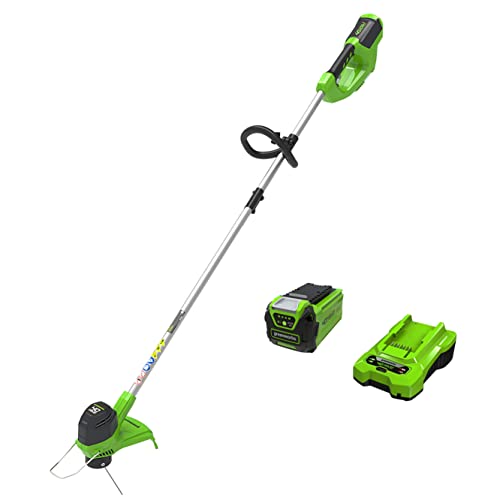
Greenworks 40V 21342 — 40V, 12-inch swath, 9.4 lbs with a 2.0Ah battery, roughly 45 minutes of light-duty run time. This is the right shape for a suburban front yard with a sidewalk edge and a few foundation shrubs. The 0.080-inch line is enough for grass and thin weeds. Expect to refill the bump head two or three times per session. Market range for a trimmer-plus-battery kit: usually $150–$220.
Stihl FSA 57 — 36V on the AP battery system, 13-inch swath, 8.2 lbs with the AP 300 S pack, about 40 minutes. The lightest credible option here and the quietest. It suits noise-restricted neighborhoods and older users who want minimum heft. The trade-off is a smaller battery ecosystem and a higher kit price for the same watt-hours, usually $250–$350.
Typical quarter-acre suburban lot with fence lines
EGO Power+ ST1511T — 56V, 15-inch swath, 11.3 lbs with a 2.5Ah battery, roughly 45–60 minutes on maintained grass. This is the default recommendation for a reason: it balances power, weight, and swath better than anything else in the 56V class. The bump feed handles 0.095-inch line without frequent jams, and the guard can be adjusted narrower for edging. Kit price usually $220–$300; bare tool $150–$200 if you already own EGO batteries.
Ryobi 40V RY40270 — 40V, 13-inch swath, 10.1 lbs with a 4.0Ah battery, about 50 minutes. The strongest argument for Ryobi is the ecosystem: one battery runs the mower, blower, and trimmer. The 4.0Ah pack gives genuinely usable run time at a moderate weight. Usually $180–$260 for the kit.
Husqvarna 220iL — 40V, 15-inch swath, 10.8 lbs with a 4.2Ah battery, roughly 45 minutes. The most “gas trimmer feel” of the 40V group, with a solid shaft and a well-damped handle. Good if you are replacing a gas unit and want familiar ergonomics. Usually $280–$380.
Half-acre lots and persistent weeds
Toro 60V 51810T — 60V, 14-inch swath, 11.0 lbs with a 2.5Ah battery, about 50 minutes. Toro’s 60V line runs cool and holds RPM under load better than most 40V tools. Good for thick fescue and johnsongrass. The 2.5Ah battery is thin for a half acre; budget for a second pack. Usually $250–$340 with one battery.
Milwaukee M18 FUEL 2825-20 — 18V, 14-inch swath, 9.9 lbs with an 8.0Ah battery, 40–50 minutes. This is the outlier: an 18V tool that outcuts most 40V trimmers because of motor and drive electronics. It is contractor-grade and priced that way. It is the right choice if you already own M18 batteries for drills and impacts. Bare tool usually $180–$250; an 8.0Ah battery adds $150–$220.
Makita 36V (18V×2) XRU15 — 36V from two 18V LXT packs in series, 15-inch swath, 10.4 lbs, roughly 45 minutes on two 5.0Ah batteries. Same logic as Milwaukee: leverage an existing battery platform. The two-battery design keeps the packs interchangeable with your drills. Bare tool usually $170–$230.
Overgrown lots, ditch banks, and brambles
Kobalt 80V KST 120X-06 — 80V, 16-inch swath, 12.8 lbs with a 2.0Ah battery, about 60 minutes at moderate load. The 16-inch head and 0.105-inch line clear tall grass and light brush that stalls smaller machines. The price is weight and arm fatigue: this is not a tool you swing for an hour without a break. Usually $250–$350 with battery.
For genuinely woody growth — saplings over half an inch, dense blackberry, or multi-year overgrowth — no handheld string trimmer from any brand is the right tool. A brush cutter with a metal blade on the same battery platform, or a walk-behind brush mower, will do the job in a fraction of the time. A 16-inch trimmer with 0.130-inch line will cut it, but slowly, and it will eat batteries.
Build Quality, Line Feed, and Durability: What Wears Out First
Battery string trimmers fail in a predictable order. Knowing the order tells you what to spend money on.
| Component | Typical Service Life | Failure Mode | What It Means for You |
|---|---|---|---|
| Trimmer line | 2–6 hours of cutting | Wear, weld, breakage | Buy 0.095–0.105 in. line in bulk; line cost dominates long-term spend |
| Bump head / spool | 1–3 seasons | Cracked spool, worn bump knob | Replaceable for $10–$20; buy a spare early |
| Drive shaft / gearhead | 3–6 years | Grease loss, bearing whine | Keep the gearbox greased; a grinding sound means stop and service |
| Motor and controller | 5–8 years | Overheat shutdown, then failure | Let it cool rather than forcing it; heat is the killer |
| Battery | 3–6 years / 500–1,000 cycles | Capacity fade, cell imbalance | Store at 40–60% charge indoors; never leave it in the sun |
| Trigger and housing | 4–7 years | Cracked plastic from drops | Hang it; do not lean it on the head |
The line system deserves more attention than it gets. Bump-feed heads are fastest but bind on thick line. Fixed-line and speed-load heads trade convenience for reliability. If you cut mostly thin grass, bump feed is right. If you cut thick stems, a manual-load head with pre-cut 0.105-inch segments jams less. On the highest-torque 56V and 60V machines, the head is the limiting component, not the motor, and swapping to a better aftermarket head is the single best upgrade.
Battery Platform Strategy: The Decision Buyers Regret Getting Wrong
A battery trimmer is really a battery purchase with a motor attached. The pack outlives the tool by years and locks you into a brand across mower, blower, hedge trimmer, and chainsaw. Choose the platform first, the trimmer second.
- Already own 18V or 20V power tools? DeWalt 20V MAX and Milwaukee M18 trimmers are competent and effectively cheaper because batteries are shared. This is the strongest reason to pick either, and the reason many of the 40V kits no longer make sense.
- Buying your first cordless yard tools? A 40V or 56V platform splits the difference between weight and capability. EGO and Ryobi both have deep enough lineups to cover a whole yard.
- Large property with a riding mower? Do not try to trim a half acre on handheld batteries. Buy a 56V or 80V trimmer for edges and a wheeled or towed trimmer for the bulk.
- Noise-restricted neighborhood or shared walls? Any 36V–40V brushless unit is quieter than gas by a wide margin; battery size barely affects noise, motor design does.
The trap is buying a cheap kit with a 2.0Ah battery on a 40V platform, then discovering the battery cannot finish the yard and a replacement 4.0Ah pack costs nearly as much as the kit did. If the kit price is unusually low, the battery is almost always small. Price the second battery into the purchase before you commit.
How to Choose: A Decision Matrix
| Your Situation | Voltage to Buy | Target Weight | Battery to Buy | Ballpark Budget |
|---|---|---|---|---|
| Apartment or townhouse patio edge, under 1,000 sq ft | 18V–24V | Under 6 lbs | 2.0–4.0Ah, one pack | $90–$150 |
| Small suburban yard, 2,000–5,000 sq ft | 40V | 8–10 lbs | 2.0–4.0Ah, one pack | $150–$260 |
| Quarter acre with fence lines and beds | 40V–56V | 9–11 lbs | 4.0Ah plus a spare | $220–$400 |
| Half acre with tall grass and weeds | 56V–60V | 10–13 lbs | Two 4.0–5.0Ah packs | $350–$550 |
| Overgrown lot, brambles, ditch banks | 80V or brush cutter | Any; expect fatigue | Two large packs | $300–$600+ |
| Shoulder or back pain, terraced ground | 36V–40V | Under 8.5 lbs | Small packs, swapped often | $250–$380 |
| Already own DeWalt 20V or Milwaukee M18 tools | Same platform | 9–10 lbs | Use existing 5.0–8.0Ah | $170–$260 bare tool |
| Renters who move every year or two | 40V with shared ecosystem | 9–10 lbs | One 4.0Ah pack | $180–$260 |
Practical Notes on Storage, Safety, and Use
Battery storage. Lithium packs degrade fastest at full charge in heat. A common cause of premature failure is a trimmer left in an unconditioned shed or garage in summer. Store the pack between 40 and 60 percent charge indoors, and charge it the day before use rather than leaving it topped up.
Weight below the waist is a load. A trimmer with a 4.0Ah battery at the rear grip balances better than a 2.0Ah pack mounted forward. When you pick a model up in a store, hold it at the front of the handle with the battery installed and see how much forward force you need to keep the head off the ground. That tells you more than the spec sheet weight.
Line diameter. Use the largest diameter the head accepts for cutting weeds — 0.095 inch minimum on 40V tools, 0.105 inch on 56V and up. Oversized line in a low-torque machine causes bogging and motor heat. Undersized line on a high-torque machine breaks constantly. Match the two.
Guard adjustment. If your trimmer has an adjustable guard, set it narrow for edging against walls and wider for open lawn. Many buyers never touch this and then blame the trimmer for a ragged cut.
Conversion kits. Many 2026 trimmers accept a quick-change head kit that converts to edger, pole saw, or brush blade. If you own only one outdoor power tool, this is the cheapest way to cover three jobs — but each attachment adds weight and each one performs at roughly 80 percent of a dedicated tool.
Frequently Asked Questions
Is a 40V trimmer enough for a half-acre lot?
Not in one session. A 40V trimmer with a 4.0Ah battery delivers about 160 watt-hours, which covers roughly 30–40 minutes of real cutting. A half acre with fence lines and beds takes 60–90 minutes. The practical answer is a 40V trimmer plus three 4.0Ah batteries, or a 56V–60V trimmer with two packs. Buying a second battery is almost always cheaper than buying a higher-voltage tool.
How long should a battery last before it needs replacing?
Expect 500–1,000 charge cycles, or three to six years of household use. Capacity fade becomes noticeable after about 300 cycles: a pack that once ran 45 minutes drops to 30. If a pack charges in half its former time and runs half as long, the cells are imbalanced and it is time to replace.
Can I use a bigger battery with the same trimmer?
Yes, within the same voltage platform. Amp-hour increases do not raise voltage, so a 4.0Ah pack is safe and the trimmer will run longer but weigh more. Never mix voltages between brands or platforms: a 40V tool will not accept a 56V pack, and adapters that force it are a safety hazard.
Should I buy a trimmer with a metal or plastic bump head?
Plastic is lighter and cheaper and is fine for line up to 0.095 inch. Metal or reinforced heads tolerate 0.105-inch line and heavy weeds without cracking. If you cut mostly thin grass, plastic is the lighter, cheaper choice. If you cut woody stems, pay the extra for the reinforced head.
Is a corded electric trimmer ever better?
Only on the smallest lots with a nearby outlet. A corded trimmer costs less and never runs out of charge, but a 100-foot cord plus extension limits you to roughly 3,000 sq ft of reachable edge and creates a real cut risk near fences. For anything beyond a small patio edge, battery wins.
The Short Version
For a small yard under 5,000 sq ft, a 40V trimmer at 9-ish pounds with a 4.0Ah battery is the correct shape: Greenworks 40V 21342 or Ryobi 40V RY40270. For a quarter-acre lot with real fence-line work, the EGO Power+ ST1511T at 56V and 15 inches is the most balanced pick, and the Husqvarna 220iL is the closest to gas-trimmer behavior. For a half acre or weeds that fight back, step to Toro 60V 51810T or Kobalt 80V and budget two large batteries. And if you already own DeWalt 20V, Milwaukee M18, or Makita 18V tools, buy the bare tool on that platform — shared batteries are worth more than a voltage class upgrade. Match watt-hours to your actual cutting time, match the swath to your grass height, and keep the weight under 11 pounds unless you genuinely need more power than that.