Key takeaways
- Match the wattage to the job: Most cordless models land between 150W and 200W, which is personal-space warmth, not room warmth. If you need to raise the temperature of an enclosed bedroom by several degrees, a battery unit is the wrong tool — look at insulation, a heated mattress pad, or a vented propane system instead.
- Read the runtime math, not the capacity number: A 12,000mAh pack sounds generous until you divide it by a 170W draw. Expect a window measured in tens of minutes at full heat, longer on fan-only or low settings. Anything promising all-night heating from an internal battery deserves skepticism.
- Decide between internal cells and tool batteries: Units built around Makita-style packs (BL1850B, BL1840B) let you swap in a fresh battery and keep going, which is why they dominate on jobsites. Sealed internal-battery designs are tidier and better suited to a car console or nightstand.
- Prioritize quiet and safety for sleep spaces: Look for a low-noise fan, anti-tilt shutoff, and overheat protection. A heater that clicks off when it falls over is not a luxury feature in a tent or a vehicle — it is the reason the device belongs there at all.
- Confirm ventilation and placement: Electric resistance heat produces no combustion byproducts, which is its real advantage over fuel-burning alternatives in confined spaces. Still, keep at least a foot of clearance from bedding, upholstery, and nylon.
What's inside
Anyone who has woken at 3 a.m. with cold feet and a racing heart knows that temperature is not a comfort detail — it is a sleep variable. Core body temperature drops as we fall asleep and rises again toward morning, and a room that runs too cold interrupts that curve, pulling you into lighter stages and shorter cycles. The trouble is that the places we most often sleep badly — a converted van, a jobsite trailer, a tent, a spare room with no vent, a reclined car seat during a long drive — are exactly the places where plugging in a 1,500-watt heater is not an option.
That is the gap battery powered heaters are trying to fill, and it is worth setting expectations honestly before you spend anything. Cordless units draw a fraction of the power of a wall-plug heater, which means they warm a small pocket of air near your body rather than an entire room. Used with that understanding, they are genuinely useful: a defroster on a frozen windshield, a hand-warmer in an unheated garage, a bit of directed warmth over a sleeping bag while your own body heat does the rest. This guide covers what actually matters when comparing them, then reviews the leading options for 2026.
As an Amazon Associate we earn from qualifying purchases.


🛒 Best Price Today on Amazon
Prime members get fast, free shipping on everything above, plus member-only deals. New members get a 30-day free trial — cancel anytime.
How to Choose a Battery Powered Space Heater (2026)
- Match the wattage to the job: Most cordless models land between 150W and 200W, which is personal-space warmth, not room warmth. If you need to raise the temperature of an enclosed bedroom by several degrees, a battery unit is the wrong tool — look at insulation, a heated mattress pad, or a vented propane system instead.
- Read the runtime math, not the capacity number: A 12,000mAh pack sounds generous until you divide it by a 170W draw. Expect a window measured in tens of minutes at full heat, longer on fan-only or low settings. Anything promising all-night heating from an internal battery deserves skepticism.
- Decide between internal cells and tool batteries: Units built around Makita-style packs (BL1850B, BL1840B) let you swap in a fresh battery and keep going, which is why they dominate on jobsites. Sealed internal-battery designs are tidier and better suited to a car console or nightstand.
- Prioritize quiet and safety for sleep spaces: Look for a low-noise fan, anti-tilt shutoff, and overheat protection. A heater that clicks off when it falls over is not a luxury feature in a tent or a vehicle — it is the reason the device belongs there at all.
- Confirm ventilation and placement: Electric resistance heat produces no combustion byproducts, which is its real advantage over fuel-burning alternatives in confined spaces. Still, keep at least a foot of clearance from bedding, upholstery, and nylon.
The Best Battery Powered Space Heaters (2026) Reviewed
Battery Powered Space Heater with 3000mAh Rechargeable Batteries (5-Cell)
The five-cell layout and dual USB ports make this the most sleep-friendly pick here: it runs quietly, adds anti-tilt shutoff, and can top up a phone while you rest. Runtime is short at full output, so treat it as a warm-up device for the first stretch of the night rather than a set-and-forget appliance.
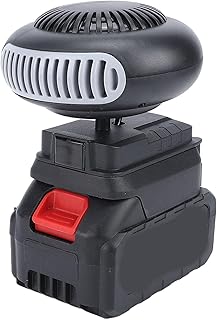
banapoy 200W Portable Car Defroster Heater
Because it runs on standard BL1850B and BL1840B tool packs, this is the option for people who already own a battery ecosystem and want swappable, effectively unlimited cycles. Two heat settings and a directed blower make it excellent for clearing a windshield before an early drive.
Cordless Space Heater 200W with 360° Rotation
The 55–85 °C range plus a natural-wind mode gives you more control than most competitors, and 360-degree rotation means you can aim warmth at your feet without moving the unit. A sensible choice for garage and jobsite use where you shift position often.
CUIFATI Portable Car Heater and Defogger
Its 160-degree tilt and rotating head let you fine-tune airflow in tight quarters, which matters more than raw wattage when you are trying to keep a fan off your face. Best understood as a defogging and micro-climate tool for vehicles and very small enclosures.
12000mAh Cordless Portable Heater, 170W Output
The largest onboard battery in this group, paired with dual-speed 170W heating, gives it the longest realistic session before a recharge. If you want one unit to cover car, tent, and desk duty without hunting for tool batteries, start here.
Frequently Asked Questions
Can a battery powered heater warm a bedroom overnight?
No. Physics sets the ceiling: a 170–200W device cannot offset heat loss from a whole room, and no internal battery in this category holds enough energy for eight hours at full draw. Use one for targeted warmth at bedtime, and rely on insulation, layered bedding, or a low-wattage heated pad for the night.
Is it safe to sleep with one running?
Electric heaters produce no carbon monoxide, which makes them far safer than fuel burners in enclosed spaces. Even so, choose a model with anti-tilt and overheat cutoffs, keep it clear of bedding, and prefer running it before sleep rather than through it.
What room temperature is actually best for sleep?
Most adults sleep best somewhere around 60–68 °F. Cool is generally better than warm — the goal is usually warm hands and feet in a cool room, which is why a directed heater aimed at your extremities can help more than raising the ambient temperature.
Why do some of these look like car accessories?
Because that is their engineering origin. Defroster and defogger designs became the template for the whole category, which is why 360-degree heads, tilt adjustment, and USB ports are so common.
Final Thoughts
For sleeping spaces, the 5-cell anti-tilt model is the most considered design of the group, thanks to its quiet operation and safety shutoff. If you need the longest single session, the 12000mAh 170W unit is the clear pick, while anyone with Makita packs on hand should go straight to the banapoy defroster for swap-and-continue runtime. Buy any of them for focused, short-duration warmth — and keep your expectations calibrated to the wattage.