Key takeaways
- Color temperature range: Look for a warm setting at or below 3000K for evening and overnight use. Warm amber-leaning light carries far less short-wavelength energy, so it’s gentler on melatonin production. Cooler 5000K–6000K modes are genuinely useful for chopping vegetables or reading labels — just treat them as daytime settings, not default ones.
- How low the dimmer goes: Multi-level dimming matters more than maximum brightness. Your dark-adapted eyes need surprisingly little light to navigate a kitchen, and a fixture whose lowest step is still glaring defeats the purpose. Prioritize lights with three or more discrete levels or true stepless dimming.
- Sensor logic and timeout: Motion sensors are the whole point overnight — no fumbling, no wall switch, no ceiling light. Check the detection angle, whether there’s an ambient light sensor that keeps the fixture asleep during the day, and how quickly it shuts off. A 15–30 second timeout is ideal; anything that lingers for minutes will drain cells and light up the room longer than you need.
- Beam direction and glare control: Mounted under a cabinet, the LED array sits roughly at eye level when you’re seated or leaning. Diffused lenses, adjustable heads, and recessed emitters prevent the hot-spot glare that causes squinting and afterimages. Aim light down at the countertop, never outward toward the room.
- Recharging and mounting: USB-C rechargeable cells save money and hassle, but only if removal is painless — magnetic strips are far better than adhesive-only mounts here. Replaceable AA cells still make sense in cold pantries or spots you’d rather never unmount. Either way, confirm the adhesive or magnet can hold the fixture’s weight long-term.
What's inside
Most people don’t buy under-cabinet lighting because their kitchen is dark. They buy it because of what happens at 2 a.m. — the stumble to the sink, the hand groping for a wall switch, and then the ceiling fixture detonating overhead at 4,000 lumens. From a sleep-physiology standpoint, that single moment is the costliest thing in the room. A blast of bright, blue-rich light at night suppresses melatonin and nudges your internal clock later, which is why a five-second trip for a glass of water can turn into forty minutes of staring at the ceiling.
This guide approaches battery-powered under-cabinet lights the way I’d approach any nighttime light source in a home: as a tool for seeing without waking up. Below you’ll find picks evaluated on the things that actually matter after dark — warm color temperature options, how low the dimmer really goes, sensor behavior, and whether the light lands on the counter instead of in your eyes. Everything here runs on batteries or an internal rechargeable cell, so you can place it exactly where the light needs to be rather than where an outlet happens to live.
As an Amazon Associate we earn from qualifying purchases.


🛒 Best Price Today on Amazon
Prime members get fast, free shipping on everything above, plus member-only deals. New members get a 30-day free trial — cancel anytime.
How to Choose a Battery Powered Under Cabinet Lighting (2026)
- Color temperature range: Look for a warm setting at or below 3000K for evening and overnight use. Warm amber-leaning light carries far less short-wavelength energy, so it’s gentler on melatonin production. Cooler 5000K–6000K modes are genuinely useful for chopping vegetables or reading labels — just treat them as daytime settings, not default ones.
- How low the dimmer goes: Multi-level dimming matters more than maximum brightness. Your dark-adapted eyes need surprisingly little light to navigate a kitchen, and a fixture whose lowest step is still glaring defeats the purpose. Prioritize lights with three or more discrete levels or true stepless dimming.
- Sensor logic and timeout: Motion sensors are the whole point overnight — no fumbling, no wall switch, no ceiling light. Check the detection angle, whether there’s an ambient light sensor that keeps the fixture asleep during the day, and how quickly it shuts off. A 15–30 second timeout is ideal; anything that lingers for minutes will drain cells and light up the room longer than you need.
- Beam direction and glare control: Mounted under a cabinet, the LED array sits roughly at eye level when you’re seated or leaning. Diffused lenses, adjustable heads, and recessed emitters prevent the hot-spot glare that causes squinting and afterimages. Aim light down at the countertop, never outward toward the room.
- Recharging and mounting: USB-C rechargeable cells save money and hassle, but only if removal is painless — magnetic strips are far better than adhesive-only mounts here. Replaceable AA cells still make sense in cold pantries or spots you’d rather never unmount. Either way, confirm the adhesive or magnet can hold the fixture’s weight long-term.
The Best Battery Powered Under Cabinet Lighting (2026) Reviewed
EZVALO Rechargeable Motion Sensor Lights, 6-Pack with Charging Station
The charging dock is the quiet innovation here — swapping six lights becomes a two-minute chore instead of a weekend project, which is the difference between a system you maintain and one you abandon. Three color temperatures plus remote dimming let you keep a warm, low preset for overnight and a brighter neutral mode for actual cooking.
RUIKORING 8.5″ Under Cabinet Lights, 6-Pack
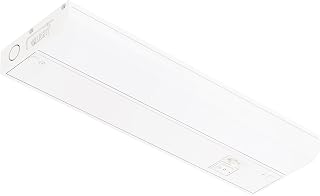
Six compact magnetic bars give you the freedom to distribute modest amounts of light across several zones rather than over-lighting one, which is exactly the right strategy for nighttime navigation. The three-color-temp selection and dimming are responsive, and the short 8.5-inch footprint tucks neatly under shallow cabinets and closet shelves.
MCGOR 14.7″ Rechargeable Motion Sensor Lights, 2-Pack
At nearly 15 inches, these throw an even wash across a long counter run without the scalloped bright-and-dark pattern that smaller pucks produce — visually calmer and easier on eyes adjusting from sleep. Five dimming levels give you real granularity, and the lowest step is genuinely dim rather than nominally so.
10″ Wireless Under Cabinet Lighting with Power Display, 3-Pack
The battery percentage readout removes the guesswork that makes rechargeable fixtures frustrating, so you recharge on schedule instead of discovering a dead light mid-night. Three color temps, solid dimming, and a magnetic mount round out a well-balanced mid-size option.
BLS T01L LED Closet Light with Adjustable Beam
The adjustable beam angle is the standout feature for anyone sensitive to glare — you can point the output down and away from sightlines instead of accepting whatever direction the housing dictates. The paired motion and ambient light sensors keep it dormant in daylight, and it accepts DC input if you’d rather hardwire it later.
Frequently Asked Questions
What color temperature is best for nighttime kitchen trips?
Stay at 3000K or warmer, and dim it as far down as you can while still seeing clearly. Warm, dim light minimizes melanopic stimulation, so your body keeps producing melatonin and your circadian clock stays where you left it.
Are motion sensors better than manual switches for sleep quality?
Generally yes. Motion sensors mean you never reach for an overhead switch, and they turn off automatically so light doesn’t linger in the room after you’ve gone back to bed. Choose models with a daylight sensor so they don’t fire needlessly all afternoon.
How long do rechargeable under-cabinet lights last per charge?
Real-world runtime depends almost entirely on brightness and how often the sensor triggers. Used as intended — low brightness, brief motion-activated bursts — most rechargeable models go one to three months between charges. Running them at maximum output continuously can drop that to a few hours.
Can these replace a kitchen night light?
They do the job better, in my view. A plug-in night light burns continuously and sits at outlet height, where it can shine toward the eyes. Under-cabinet lights aim downward, activate only when needed, and put illumination on the surfaces you’re actually trying to see.
Final Thoughts
If you want one system to handle an entire kitchen with minimal upkeep, the EZVALO 6-pack with charging station is the most sustainable choice — easy recharging is what keeps these lights working a year from now. For long counter runs where smooth, glare-free coverage matters most, the MCGOR 14.7-inch pair delivers the calmest light of the group, while the BLS T01L remains the best pick for anyone who needs to aim the beam precisely away from their line of sight.