The best seats for pontoon boats depend on how you use the boat: replacement loungers maximize relaxed seating, captain chairs improve control and support, and bench seats carry the most passengers in the least space.
When choosing replacement upholstery or complete marine seating, compare more than appearance. Measure the available deck, check the mounting pattern, and look for UV-resistant vinyl, quick-draining construction, corrosion-resistant hardware, and foam that will remain supportive after repeated wetting.
Our top picks
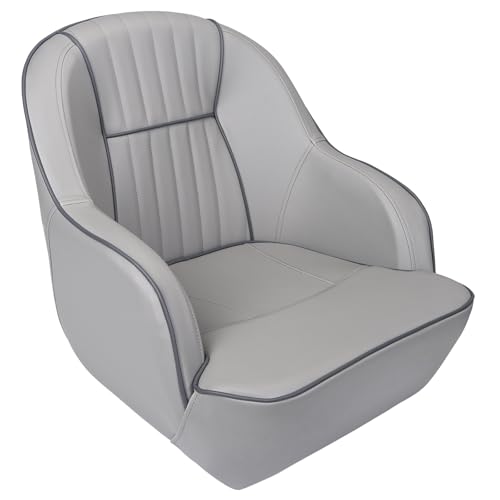 ERGOSEAT Gray Pontoon Captain Seat Marine Captains
- Ergonomically design provides maximum support
- Constructed with marine-grade Napa leather,30% thicker than others…
- Firm & Long-Lasting.High-density foam padding with double-needle stitching…
 ERGOSEAT White Pontoon Captain Seat Marine Captains
- Ergonomically design provides maximum support
- Constructed with marine-grade Napa leather,30% thicker than others…
- Firm & Long-Lasting.High-density foam padding with double-needle stitching…
 NORTHCAPTAIN Deluxe Marine High Back Folding Boat
- Ultimate Comfort Meets Smart Storage:Thickly padded seat and…
- Crafted from premium marine-grade vinyl, the seat features…
- The seat measures 23.6" in height, 16.2" in…
| Product | Key specs | |
|---|---|---|
| ERGOSEAT Gray Pontoon Captain Seat Marine Captains | Ergonomically design provides maximum support Constructed with marine-grade Napa leather,30% thicker than others… Firm & Long-Lasting.High-density foam padding with double-needle stitching… | Check price |
| ERGOSEAT White Pontoon Captain Seat Marine Captains | Ergonomically design provides maximum support Constructed with marine-grade Napa leather,30% thicker than others… Firm & Long-Lasting.High-density foam padding with double-needle stitching… | Check price |
| NORTHCAPTAIN Deluxe Marine High Back Folding Boat | Ultimate Comfort Meets Smart Storage:Thickly padded seat and… Crafted from premium marine-grade vinyl, the seat features… The seat measures 23.6" in height, 16.2" in… | Check price |
 ERGOSEAT Folding 2 Pack Boat Seats Padded ERGOSEAT Folding 2 Pack Boat Seats Padded | Sturdy and Reliable UV-Resistant and Durable.Made with UV-treated marine-grade vinyl, our… All-Day Comfort.The pontoon boat seat features thick padding… | Check price |
As an Amazon Associate we earn from qualifying purchases at no extra cost to you.
Quick picks by boating situation
| Situation | Best seat type | Why it fits | Important specification |
|---|---|---|---|
| Relaxing, cruising, and sunbathing | Replacement lounger | Offers angled back support and a longer leg position | Usually 65–75 inches long; confirm clearance from railings and consoles |
| Frequent driving or fishing | Captain chair | Provides better posture, visibility, and reach to the controls | Approximately 20–26 inches wide with a stable pedestal or swivel base |
| Families and larger groups | Bench seat | Seats several people along one straight run | Allow about 20–24 inches of width per adult passenger |
| Limited deck space | Narrow bench or compact captain chairs | Uses fewer inches of walkway and leaves room for gear | Look for a seat depth near 18–21 inches |
| Replacing damaged original furniture | Matched replacement module | Reduces drilling, fit problems, and mismatched upholstery | Measure the old base, hinge position, and mounting holes before ordering |
Replacement loungers: best for comfort and versatility
A pontoon lounger is the strongest choice when comfort matters more than maximum seating density. Many designs have a backrest at one end, a longer cushion, and sometimes a reversible or corner configuration. They work well for cruising, reading, and stretching out during a stop.
What to measure
Typical lounger modules are about 65–75 inches long, 24–32 inches deep, and 28–36 inches high at the back. Those dimensions vary considerably, so measure the actual deck opening rather than relying on the old cushion’s label. Leave at least 2 inches between the seat and a railing, side panel, or adjacent furniture so vinyl edges do not rub constantly. If the lounger sits beside a table, allow roughly 12–16 inches of usable leg clearance between the seat edge and the table pedestal.
A corner lounger may require 48–60 inches of width along each side of the corner. Confirm that it does not block a storage hatch, fuel access panel, ladder, or boarding path. A longer seat is not automatically better if passengers must climb over it to reach the swim platform.
Strengths and limitations
- Advantages: excellent back support, comfortable reclining position, useful for mixed adult and child seating, and a polished replacement for worn original cushions.
- Limitations: usually seats fewer adults than an equivalent-length bench, occupies more depth, and may restrict access to under-seat storage.
- Best construction: marine plywood or rot-resistant composite backing, stainless or coated fasteners, closed-cell or water-resistant foam, and underside drainage openings.
Captain chairs: best for control, posture, and individual support
Captain chairs are the best seats for pontoon boats when the driver needs a clear view and comfortable support for long periods at the helm. A swivel base can make docking and conversation easier, while a flip-up bolster gives the driver a higher position when standing or operating in rougher water.
Most helm chairs are approximately 20–26 inches wide, 20–25 inches deep, and 30–38 inches high above the deck, excluding the pedestal. Check the total height against the windshield and steering wheel. The front edge of the cushion should not press against the back of the knees when the driver is seated close enough to reach the controls.
Mounting and clearance
Do not assume a universal pedestal will fit the existing holes. Measure the bolt pattern, base diameter, pedestal height, and available rotation. A swivel needs enough side clearance to turn without striking the console or a neighboring seat. As a practical target, leave 3–4 inches around the widest part of the chair when it is rotated, and keep the steering wheel, throttle, and gauges within comfortable reach.
Captain chairs generally seat one adult each. Their advantage is not passenger capacity but better ergonomics. For a two-person helm, compare the combined width of two chairs with the console and walkway; two 24-inch chairs can require more than 52 inches once spacing and armrests are included.
Bench seats: best for passenger capacity
Bench seating makes efficient use of a pontoon’s straight side runs. It is usually the right choice for families, entertaining, or boats that need flexible seating rather than dedicated reclining positions. A back-to-back bench can provide seating on both sides while preserving a central passage.
Plan on approximately 20–24 inches of bench width per adult passenger. A 60-inch bench may therefore accommodate two adults comfortably or three smaller passengers, but the boat’s legal capacity plate and weight distribution always take priority. Avoid interpreting cushion length as a guaranteed passenger rating.
Typical bench cushions are 18–22 inches deep, with backrests that bring the total furniture depth to roughly 25–32 inches. Before selecting a deeper model, measure the remaining walkway. A clear passage of about 24 inches is easier to use than a narrow gap, especially when people are carrying coolers or moving toward the bow. Keep at least 18 inches around boarding points and ladders whenever the layout permits.
Marine materials compared
| Material or feature | Advantages | Trade-offs | What to look for |
|---|---|---|---|
| Marine-grade vinyl | Water-resistant, easy to wipe clean, and suited to frequent splashes | Can crack, fade, or become sticky if exposed to intense sun and poor-quality plasticizers | UV-resistant topcoat, mildew resistance, welded or well-sewn seams, and a documented marine application |
| Solution-dyed acrylic or marine fabric | Strong UV color retention and a cooler feel in direct sun | Can absorb more water and may require more careful cleaning | Removable covers, breathable construction, and fast-drying foam underneath |
| Closed-cell foam | Absorbs little water and dries faster than conventional open-cell foam | Can feel firmer and may cost more | Consistent density and enough thickness to prevent bottoming out |
| Marine plywood base | Rigid, familiar to installers, and strong when sealed correctly | Can rot if water reaches unsealed edges or screw holes | Sealed edges, drainage paths, and corrosion-resistant fasteners |
| Composite or molded plastic base | Resists rot and often weighs less than a wood-framed module | May flex if poorly supported and can be harder to modify | Reinforced mounting points and a base designed for marine loads |
UV resistance, drainage, and hardware matter most outdoors
Sun exposure usually damages upholstery before the internal frame fails. Choose vinyl or fabric specifically rated for outdoor marine use, not ordinary indoor upholstery. Light colors often remain cooler, while darker colors may show fading and heat-related wear sooner. A fitted cover can extend the life of any material, but it should be removed periodically so trapped moisture can evaporate.
Inspect the bottom of each cushion for drainage channels, mesh, grommets, or open gaps. Water that cannot escape remains against the foam and base, encouraging mildew and corrosion. Hinged loungers should open without pinching the upholstery, and storage compartments need ventilation rather than a completely sealed, damp cavity.
Use stainless steel or other marine-suitable corrosion-resistant hardware, particularly around hinges, swivels, brackets, and exposed bases. Galvanized hardware may be acceptable in some protected areas, but dissimilar metals can corrode when saltwater and moisture create an electrical path. Follow the manufacturer’s fastener recommendations instead of substituting ordinary indoor screws.
How to choose and install the right replacement
- Draw the deck layout. Record each straight run, corner, console, hatch, ladder, and walkway. Include the 2–4 inches of operating clearance needed around moving or swiveling furniture.
- Measure the old seat. Note length, depth, back height, base height, hinge locations, and every mounting-hole position. Photograph the underside before removing it.
- Check the load and attachment points. A cushion is only as secure as its base. Reinforce weak deck panels and avoid drilling into fuel, electrical, or plumbing routes.
- Test access before final fastening. Set the furniture in place and open storage lids, rotate chairs, reach the controls, and walk to the bow and stern.
- Seal new penetrations. Use an appropriate marine sealant around screw or bolt holes while avoiding blocked drainage channels.
Moving the furniture is also part of the installation. A large lounger may be 70 inches long but narrow enough to pass through a doorway on edge; its boxed packaging may be wider and heavier than the actual seat. Measure the boat gate, dock path, garage door, and home doorway before ordering. Two people are normally safer for carrying a long module, especially when the base contains a heavy frame or storage compartment.
Final buying checklist
- Does the furniture fit the measured deck opening, including corner and walkway clearance?
- Is the seating capacity realistic for the cushion width and the boat’s official capacity plate?
- Are the vinyl or fabric, foam, base, seams, and hardware intended for marine use?
- Can rainwater drain from the cushion and storage compartment?
- Will a captain chair clear the wheel, throttle, windshield, and adjacent furniture when rotated?
- Can you access hatches, batteries, fuel areas, boarding ladders, and emergency equipment after installation?
Choose replacement loungers for relaxation, captain chairs for helm ergonomics, and bench seats for efficient passenger seating. The best purchase is the one that matches the boat’s measured space, expected load, exposure to sun and water, and everyday movement pattern—not simply the thickest cushion or largest seat.