Key takeaways
- Seat height range: Aim for a top height of at least 21 inches if you’re 6’2″–6’6″. Your hips should sit marginally above your knees so the pelvis tilts forward naturally rather than tucking under — the same alignment principle that governs side-sleeping posture.
- Seat pan depth: Leave two to three fingers of clearance between the front edge and the back of your knee. Deeper pans (19″+) prevent the thigh-edge pressure that restricts venous return and leaves legs twitchy at night.
- Backrest and headrest travel: The backrest should reach the base of your skull with the headrest fully extended. A headrest that lands on your neck instead of your occiput actively worsens forward head posture.
- Lumbar adjustability: Fixed foam bumps are placed for average torsos. Look for 3D lumbar support you can raise, deepen, and reposition — tall spines need the apex several inches higher than most chairs assume.
- Load rating and base build: Treat a 400–600 lb rating as a durability spec, not a body-weight statement. Heavier steel bases, thicker gas cylinders, and rubber-coated casters resist the frame flex that turns into a wobbling, unsupportive chair by month six.
What's inside
As a sleep and recovery specialist, I spend most of my consultations tracing nighttime restlessness back to daytime posture — and with tall men, the trail almost always ends at the desk chair. Standard task seating is engineered around a 5’9″ median frame, which means anyone past 6’2″ spends eight hours quietly compensating: a seat pan that stops short of the knee and compresses the hamstrings, a backrest that tops out somewhere around the shoulder blades, and a headrest positioned for a chin that isn’t there. The body absorbs that mismatch by shortening the hip flexors, rounding the thoracic spine, and loading the cervical extensors. By the time you lie down, your body is still negotiating a neutral position it hasn’t felt since morning — which is exactly why so many tall clients describe “tossing for twenty minutes” before sleep onset.
This guide approaches office seating the way I’d approach a mattress fitting: dimensions first, marketing second. I’ve focused on cylinder stroke and maximum seat height, backrest and headrest travel, seat pan depth and width, weight capacity, and the recovery-oriented extras — deep recline locks, retractable footrests, adjustable lumbar depth — that let you decompress mid-shift instead of banking fatigue until bedtime. Below are the chairs that hold up for genuinely tall, broad frames in 2026.
As an Amazon Associate we earn from qualifying purchases.



🛒 Best Price Today on Amazon
Prime members get fast, free shipping on everything above, plus member-only deals. New members get a 30-day free trial — cancel anytime.
How to Choose an Office Chair For Tall Men (2026)
- Seat height range: Aim for a top height of at least 21 inches if you’re 6’2″–6’6″. Your hips should sit marginally above your knees so the pelvis tilts forward naturally rather than tucking under — the same alignment principle that governs side-sleeping posture.
- Seat pan depth: Leave two to three fingers of clearance between the front edge and the back of your knee. Deeper pans (19″+) prevent the thigh-edge pressure that restricts venous return and leaves legs twitchy at night.
- Backrest and headrest travel: The backrest should reach the base of your skull with the headrest fully extended. A headrest that lands on your neck instead of your occiput actively worsens forward head posture.
- Lumbar adjustability: Fixed foam bumps are placed for average torsos. Look for 3D lumbar support you can raise, deepen, and reposition — tall spines need the apex several inches higher than most chairs assume.
- Load rating and base build: Treat a 400–600 lb rating as a durability spec, not a body-weight statement. Heavier steel bases, thicker gas cylinders, and rubber-coated casters resist the frame flex that turns into a wobbling, unsupportive chair by month six.
The Best Office Chairs For Tall Men (2026) Reviewed
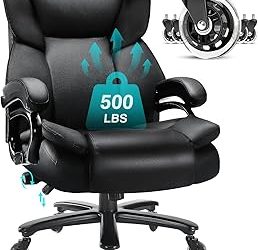
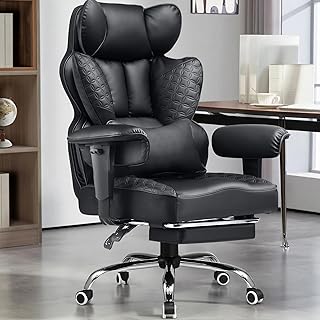
600LBS Heavy Duty Executive Chair with 5D Flip Arms
The most structurally serious option here, pairing a 600 lb-rated frame with pocket spring cushioning that distributes pressure far better than single-density foam. The 5D armrests are the standout for long-limbed users, since they slide forward and pivot inward to actually meet your elbows.
X100 Ergonomic Mesh Chair with Footrest
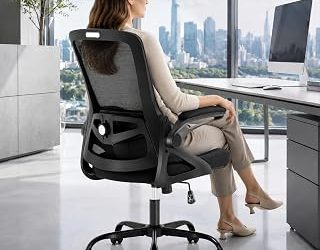
My pick for anyone who runs warm or works late — the breathable mesh back prevents the heat retention that quietly disrupts thermoregulation before bed. The 3D lumbar support and retractable footrest make it easy to shift into a genuine decompression position for ten minutes between calls.
High Back Mesh Chair with Headrest and Flip-Up Arms
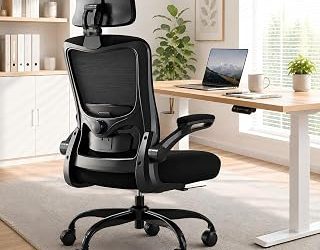
A clean, understated task chair with a 90–120° tilt lock and a wide cushion that suits broad frames without looking like gaming furniture. The flip-up arms are more useful than they sound for tall users who need to pull fully under a low desk.
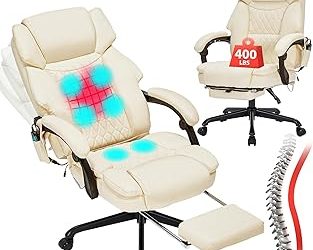
GTPLAYER Big and Tall Gaming Chair
The 3D saddle-shaped cushion is the reason to consider this one: it cradles the sit bones and discourages the slow forward slide that flattens the lumbar curve. Rated to 400 lbs with pocket spring lumbar support and a built-in footrest for recline breaks.
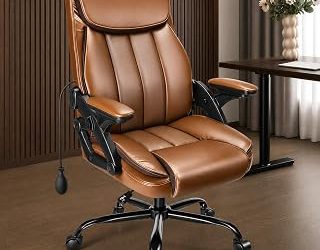
500lbs Big and Tall Executive Chair with Adjustable Lumbar
Built around an extra-wide seat and thickly padded armrests, this is the most traditional executive feel of the group. The adjustable lumbar unit is genuinely repositionable, which matters more than cushion thickness for anyone managing chronic low-back pain.
Frequently Asked Questions
What seat height do I need at 6’4″?
Roughly 20.5–22 inches at the top of the range. Measure from floor to the crease behind your knee in shoes, then confirm the chair’s maximum height meets or slightly exceeds it.
Is mesh or cushioned better for all-day sitting?
Mesh wins on airflow and thermal comfort; pocket spring cushions win on pressure distribution for heavier frames. If you sit more than six hours daily, a mesh back with a sprung seat is the best of both.
Does a footrest actually make a difference?
Yes — brief reclined intervals with legs elevated reduce lumbar disc pressure and improve circulation, which measurably lowers evening leg restlessness in clients I’ve tracked.
Can my chair really affect my sleep?
Indirectly but reliably. Sustained postural compression and tight hip flexors make it harder to settle into a relaxed sleep position, extending the time it takes to fall asleep.
Final Thoughts
If you want maximum structural headroom and the best armrest geometry, the 600LBS Heavy Duty Executive Chair with 5D Flip Arms is the strongest overall buy. Warm sleepers and long-shift workers should look at the X100 Ergonomic Mesh Chair with Footrest, while anyone prioritizing a straightforward, well-proportioned task chair will be well served by the High Back Mesh Chair with Headrest.