Key takeaways
- Backrest and headrest height: Look for a back panel around 28 inches or taller, and insist the headrest slides independently. A fixed headrest that lands on your trapezius is worse than none — it pushes your head forward into the exact flexed posture that leaves your neck stiff at bedtime.
- Seat depth and width: You should be able to fit two to three fingers between the seat edge and the back of your knee. Too deep and you’ll get popliteal pressure and heavy, restless legs by evening; too shallow and your femurs dangle unsupported. Wider seats, roughly 20 inches and up, also let you shift position without fighting the armrests.
- Cylinder travel: Check the seat height range, not just the maximum. Tall users generally need a top end near 21 inches so hips sit level with or slightly above the knees. A Class 4 gas lift is the durability benchmark at higher body weights.
- Recline range and tilt lock: A 90–120° range with a firm lock turns your chair into a legitimate rest station. Ten minutes reclined with your eyes closed mid-afternoon is a far better answer to the post-lunch dip than a third coffee, which is the single most common cause of delayed sleep onset I see in intake questionnaires.
- Load rating and base construction: Chairs rated to 400–600 pounds use thicker steel frames and heavy-gauge five-star bases that resist the flex tall users generate through leverage alone. Rubber-coated casters are the quiet, floor-friendly upgrade worth prioritizing.
What's inside
Most office chairs are engineered around a 5’9″ reference body. If you’re 6’2″ or taller, you’ve felt what that compromise costs: a backrest that stops at your shoulder blades, a headrest parked somewhere between your neck and nothing at all, and a seat pan so shallow it leaves your thighs unsupported by the last three inches. You compensate — you perch, you crane, you tuck a leg under. And because I spend my working life studying what wrecks people’s sleep, I can tell you the bill usually arrives around 2 a.m., as cervical tension, tight hip flexors that fight a clean side-sleeping position, and the low-grade nervous-system arousal that follows eight hours of postural bracing.
This guide approaches the tall-frame chair as a recovery tool, not just furniture. Below you’ll find the specs that actually matter above six feet — backrest height, cylinder travel, seat depth, recline range, and load rating — followed by reviews of the strongest big-and-tall options available in 2026, from breathable mesh task chairs to 600-pound-rated executive builds with footrests for genuine midday decompression.
As an Amazon Associate we earn from qualifying purchases.


🛒 Best Price Today on Amazon
Prime members get fast, free shipping on everything above, plus member-only deals. New members get a 30-day free trial — cancel anytime.
How to Choose an Office Chair For Tall People (2026)
- Backrest and headrest height: Look for a back panel around 28 inches or taller, and insist the headrest slides independently. A fixed headrest that lands on your trapezius is worse than none — it pushes your head forward into the exact flexed posture that leaves your neck stiff at bedtime.
- Seat depth and width: You should be able to fit two to three fingers between the seat edge and the back of your knee. Too deep and you’ll get popliteal pressure and heavy, restless legs by evening; too shallow and your femurs dangle unsupported. Wider seats, roughly 20 inches and up, also let you shift position without fighting the armrests.
- Cylinder travel: Check the seat height range, not just the maximum. Tall users generally need a top end near 21 inches so hips sit level with or slightly above the knees. A Class 4 gas lift is the durability benchmark at higher body weights.
- Recline range and tilt lock: A 90–120° range with a firm lock turns your chair into a legitimate rest station. Ten minutes reclined with your eyes closed mid-afternoon is a far better answer to the post-lunch dip than a third coffee, which is the single most common cause of delayed sleep onset I see in intake questionnaires.
- Load rating and base construction: Chairs rated to 400–600 pounds use thicker steel frames and heavy-gauge five-star bases that resist the flex tall users generate through leverage alone. Rubber-coated casters are the quiet, floor-friendly upgrade worth prioritizing.
The Best Office Chairs For Tall People (2026) Reviewed
High Back Mesh Task Chair with Headrest and Flip-Up Arms
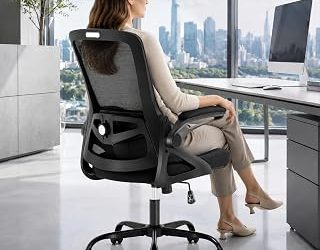
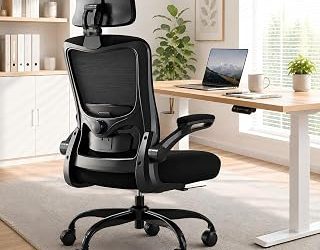
This is the sensible everyday pick: a genuinely tall mesh back with an adjustable headrest, a wide cushion, and a 90–120° tilt lock that lets you drop into a restorative recline without leaving your desk. The flip-up arms are an underrated feature for anyone who slides close to a keyboard tray or shares a compact home office.
600LBS Heavy Duty Executive Chair with 5D Flip Arms
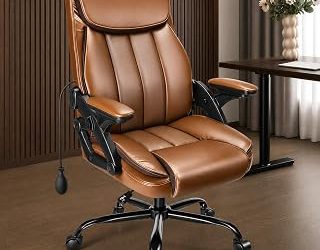
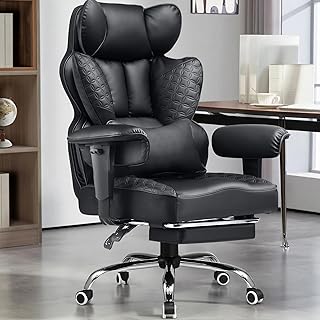
The most robust build here, with a 600-pound rating, dual rubber wheels, and a pocket-spring seat that behaves more like a quality mattress topper than conventional foam — it distributes load instead of bottoming out under a larger frame. The 5D armrests are what make it work for long limbs, since elbow support that only moves up and down rarely lands correctly above six feet.
X100 Ergonomic Mesh Chair with Footrest
My pick for anyone chasing genuine midday recovery: the retractable footrest plus deep recline gets your legs elevated and your spine unloaded, which is the closest thing to a proper reset break a desk allows. Adjustable 3D lumbar support and 5D flip-up arms give tall users the fine-tuning that fixed-lumbar chairs simply can’t.
GTPLAYER Big and Tall Gaming Chair (400lbs)
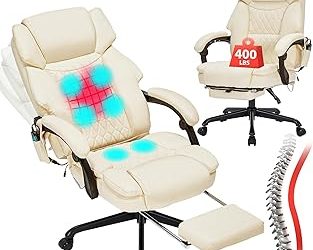
The 3D saddle-shaped cushion is the standout — it cradles the sit bones and reduces the forward pelvic slide that drives lower-back ache during long sessions. With a 400-pound rating, pocket-spring lumbar support, and a footrest, it’s the right call if you want one chair covering both a workday and a long evening at the screen.
500lbs Big and Tall Executive Chair with Quiet Rubber Wheels
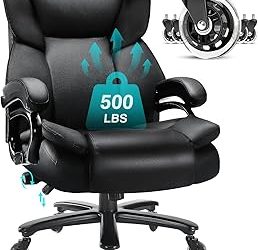
A quieter, more conservative-looking executive option with adjustable lumbar support and the same pocket-spring cushioning philosophy, wrapped in a high back that suits video calls. The rubber casters matter more than people expect in a bedroom-adjacent home office, where caster rumble is a real sleep-environment intrusion for anyone working late near a sleeping partner.
Frequently Asked Questions
What seat height do I need at 6’4″?
Aim for a chair that reaches roughly 20 to 22 inches at full extension. The functional test beats the number, though: feet flat, knees at or slightly below hip level, shoulders relaxed with elbows at about 90 degrees on the desk surface.
Is a footrest actually useful, or just a gimmick?
It’s useful if you use it deliberately. Reclining with legs elevated for ten to fifteen minutes eases venous pooling in the lower legs and downshifts the nervous system — a real fatigue countermeasure, provided you keep it short and don’t drift into a long afternoon nap that eats into your sleep pressure.
Mesh or a padded pocket-spring seat?
Mesh backs win on breathability, which matters because thermal discomfort at the desk tends to track with restlessness later. Pocket-spring seats win on pressure distribution for heavier frames — many of the best big-and-tall chairs now pair a mesh back with a sprung cushion, which is the ideal combination.
Can a desk chair really affect my sleep?
Indirectly but meaningfully. Poor seated posture drives shallow breathing and musculoskeletal pain, both of which fragment sleep, and daytime fatigue from a bad chair usually gets patched with late caffeine — the more damaging half of the equation.
Final Thoughts
If you want one chair that handles a tall frame without fuss, the High Back Mesh Task Chair with headrest and 90–120° tilt lock is the most balanced choice. Larger builds should go straight to the 600LBS Heavy Duty Executive Chair for its frame strength and 5D arms, while anyone serious about midday recovery will get the most from the X100 with its footrest and 3D lumbar adjustment.