Key takeaways
- Adjustable lumbar depth, not just height: A pad that slides up and down is common; one that also pushes forward is what fills the gap at your lower spine. Without forward adjustment, taller and slimmer users often sit against a support that never touches them.
- Recline range you’ll genuinely use: Look for a tilt lock spanning roughly 90–120°. Reclining to around 110° for even ten minutes an hour measurably drops disc pressure, which is the single cheapest intervention for evening stiffness.
- Seat depth and front-edge shape: Two to three fingers of clearance behind your knees, with a waterfall edge. A seat that presses the back of your thighs restricts circulation and encourages the slouch that flattens your lumbar curve.
- Weight rating with headroom: Buy a capacity comfortably above your own weight. Foam and gas lifts fatigue near their limit, and a sagging seat quietly undoes every other feature on this list.
- Armrests that get out of the way: Flip-up arms let you pull close to the desk instead of reaching, which keeps your shoulders down and your thoracic spine neutral — a small detail with outsized effect on neck tension at night.
What's inside
Most people think of back pain as a daytime problem — something that builds between the morning coffee and the 4 p.m. slump. In my work on sleep recovery, I see the other half of the story: the lumbar strain you accumulate in a badly shaped chair doesn’t clock out when you do. It follows you into bed, where compressed discs and shortened hip flexors turn every position change into a micro-awakening. Clients who complain of “waking up stiff” are often not sleeping wrong at all. They’re sitting wrong for nine hours and asking their mattress to undo it.
That’s the lens this guide uses. Rather than ranking chairs on spec sheets alone, I’ve looked at which designs actually reduce the postural debt you carry overnight — depth of lumbar contact, whether the recline lets your spine decompress mid-shift, seat pressure distribution for larger frames, and how much adjustment you get before the padding gives out. Below are six options worth your attention in 2026, followed by the buying criteria I’d apply if I were choosing one for my own study.
As an Amazon Associate we earn from qualifying purchases.


🛒 Best Price Today on Amazon
Prime members get fast, free shipping on everything above, plus member-only deals. New members get a 30-day free trial — cancel anytime.
How to Choose an Office Chair For Back Problems (2026)
- Adjustable lumbar depth, not just height: A pad that slides up and down is common; one that also pushes forward is what fills the gap at your lower spine. Without forward adjustment, taller and slimmer users often sit against a support that never touches them.
- Recline range you’ll genuinely use: Look for a tilt lock spanning roughly 90–120°. Reclining to around 110° for even ten minutes an hour measurably drops disc pressure, which is the single cheapest intervention for evening stiffness.
- Seat depth and front-edge shape: Two to three fingers of clearance behind your knees, with a waterfall edge. A seat that presses the back of your thighs restricts circulation and encourages the slouch that flattens your lumbar curve.
- Weight rating with headroom: Buy a capacity comfortably above your own weight. Foam and gas lifts fatigue near their limit, and a sagging seat quietly undoes every other feature on this list.
- Armrests that get out of the way: Flip-up arms let you pull close to the desk instead of reaching, which keeps your shoulders down and your thoracic spine neutral — a small detail with outsized effect on neck tension at night.
The Best Office Chairs For Back Problems (2026) Reviewed
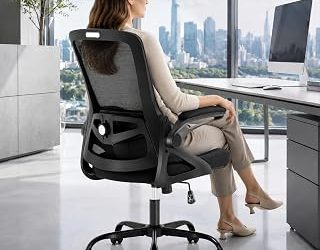
Ergonomic Office Chair for Long Hours with Adjustable Padded Lumbar Support
The standout here is a lumbar pad that’s genuinely padded rather than a thin plastic bulge, and it moves enough to suit most torso lengths. With a 330 lb capacity and a straightforward setup, it’s the sensible default for anyone whose pain sits low and central.
High Back Mesh Chair with Headrest and 90–120° Tilt Lock
The full tilt range and locking recline make this the best pick for people who need to unload their spine periodically through the day. The headrest earns its place too — supporting the skull reduces the low-grade neck bracing that so often shows up as difficulty settling at bedtime.
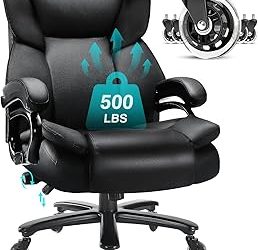
500 lb Big and Tall Executive Chair with Adjustable Lumbar Support
Extra-wide seating, thick armrest pads, and a heavy-duty base give this chair the structural honesty larger users rarely get at this price. If previous chairs have bottomed out or developed a lean within months, the generous capacity here is the fix.
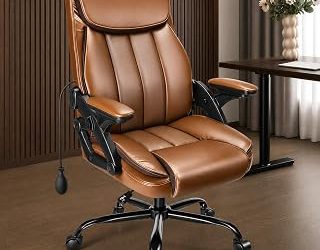
High Back Executive Chair with Built-In Lumbar Support and Flip Arms
A built-in adjustable lumbar system plus a metal base makes this the most polished-looking option that still takes ergonomics seriously. Quiet casters and flip-up arms suit shared spaces and small home offices where the chair lives close to the desk.
PU Leather Task Chair with Swivel Mesh Back
This one splits the difference: leather-look seat for a tidy aesthetic, breathable mesh where your back needs airflow. Adjustable lumbar support and flip-up arms cover the essentials without the bulk of a full executive chair.
Frequently Asked Questions
Can my office chair really affect how I sleep?
Yes, indirectly but reliably. Sustained lumbar flexion tightens hip flexors and irritates the surrounding tissue, and that discomfort raises the number of brief arousals you experience while changing position overnight.
Is mesh or padded better for back problems?
Neither wins outright. Mesh keeps you cooler over long sittings, while padded backs suit those who want firm, continuous contact — the deciding factor should be whether the lumbar support actually meets your spine.
How high should my lumbar support sit?
Roughly at the level of your belt line, filling the natural inward curve. Set it too high and you’ll be nudged into a rounded posture, which defeats the purpose entirely.
Should I sit with the recline unlocked?
Alternate. Lock upright for focused typing, then release and lean back for a few minutes each hour to let the discs rehydrate — variety matters more than any single “correct” position.
Final Thoughts
If I had to narrow it down: the Ergonomic Office Chair for Long Hours is the most broadly sensible choice for lower-back relief, the High Back Mesh Chair with 90–120° Tilt Lock is the one I’d recommend to anyone who needs to decompress through the day, and the 500 lb Big and Tall Executive Chair is the clear answer for larger frames who’ve outgrown lightweight builds. Any of the three will shorten the recovery your body has to do overnight.