Key takeaways
- Adjustable lumbar, not fixed foam: A bulge sewn into the backrest at the factory sits where the average spine curves — which is nobody’s spine. Look for lumbar support that moves vertically or inflates, so you can park it at your actual L3–L5 arch and stop bracing your lower back all afternoon.
- Seat width and depth over headline padding: Two to three fingers of clearance behind the knee prevents the seat edge from pressing on the popliteal vessels, which is a common source of the restless, achy legs people notice once they’re finally lying down. Wider seats also let broader or taller users sit square instead of perched.
- Real recline, ideally locking: Sitting bolt upright for nine hours keeps constant compressive load on the discs. A backrest that tilts through several stages — or reclines fully — lets you take three genuine 90-second decompression breaks a day, which does more for evening comfort than any lumbar pillow.
- Weight rating as a proxy for build quality: A 400–500 lb capacity chair uses a thicker steel base, a Class 4 gas lift, and denser foam. Even lighter users benefit, because that construction resists the slow sag that turns a supportive seat into a hammock by month six.
- Casters matched to your floor: Rubber or PU wheels roll silently and won’t chew hardwood. This matters more than it sounds if your desk shares a wall with a bedroom — low-frequency rolling noise is exactly the kind of sound that fragments a light sleeper’s night.
What's inside
As a sleep-wellness practitioner, I spend most of my day talking about mattresses, circadian rhythm, and evening wind-down routines — and yet the single biggest complaint I hear traces back to something that happens at 2 p.m., not 2 a.m. People sit for eight or nine hours in a chair that quietly wrecks their hip flexors, compresses their lumbar discs, and leaves their upper back locked in a forward hunch. Then they lie down at night, ask their spine to decompress in six hours, and wonder why they wake up stiff and unrested. Your desk chair is part of your sleep hygiene, whether you’ve thought of it that way or not.
This guide looks at office chairs under $500 through that lens: which models actually keep your pelvis neutral and your breathing unrestricted through a long workday, which ones let you recline enough to unload the spine on a break, and which ones are built solidly enough that they don’t sag into bad posture after four months. I’ve focused on lumbar adjustability, seat depth and width, recline range, and load rating — the specs that predict how your body feels at bedtime. Below are the standout options, followed by a buying framework and answers to the questions readers ask most.
As an Amazon Associate we earn from qualifying purchases.




🛒 Best Price Today on Amazon
Prime members get fast, free shipping on everything above, plus member-only deals. New members get a 30-day free trial — cancel anytime.
How to Choose a/an Office Chair Under 500 (2026)
- Adjustable lumbar, not fixed foam: A bulge sewn into the backrest at the factory sits where the average spine curves — which is nobody’s spine. Look for lumbar support that moves vertically or inflates, so you can park it at your actual L3–L5 arch and stop bracing your lower back all afternoon.
- Seat width and depth over headline padding: Two to three fingers of clearance behind the knee prevents the seat edge from pressing on the popliteal vessels, which is a common source of the restless, achy legs people notice once they’re finally lying down. Wider seats also let broader or taller users sit square instead of perched.
- Real recline, ideally locking: Sitting bolt upright for nine hours keeps constant compressive load on the discs. A backrest that tilts through several stages — or reclines fully — lets you take three genuine 90-second decompression breaks a day, which does more for evening comfort than any lumbar pillow.
- Weight rating as a proxy for build quality: A 400–500 lb capacity chair uses a thicker steel base, a Class 4 gas lift, and denser foam. Even lighter users benefit, because that construction resists the slow sag that turns a supportive seat into a hammock by month six.
- Casters matched to your floor: Rubber or PU wheels roll silently and won’t chew hardwood. This matters more than it sounds if your desk shares a wall with a bedroom — low-frequency rolling noise is exactly the kind of sound that fragments a light sleeper’s night.
The Best Office Chair Under 500 (2026)s Reviewed
500lbs Big and Tall High-Back Executive Chair
The pocket-spring cushion is the differentiator here: instead of foam that compresses uniformly and bottoms out, individually wrapped coils redistribute pressure under the sit bones, which noticeably reduces the numb, shifting restlessness of a long session. Paired with adjustable lumbar support and quiet rubber casters, it’s the most well-rounded heavy-duty pick under $500.
Ergonomic Office Chair for Long Hours
A focused, no-frills option built around one thing done well — padded lumbar support you can position for genuine lower-back relief rather than generic “ergonomic” contouring. At a 330 lb capacity it suits average-frame users who want fewer levers and more consistent all-day comfort.
YFO Home Office Desk Chair
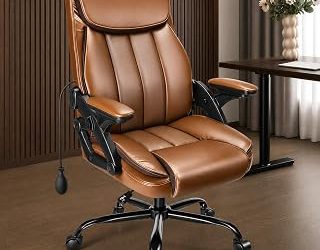
The brown leather and classic executive silhouette make this the easiest fit for a home office that doubles as a video-call backdrop or a shared living space. Height adjustment, lumbar support, and rubber casters cover the ergonomic essentials without the industrial look of a task chair.
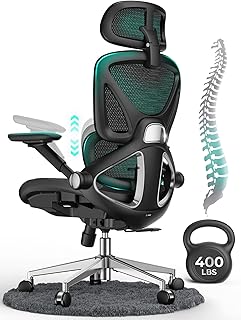
Ergonomic Mesh Office Chair with 3D Headrest
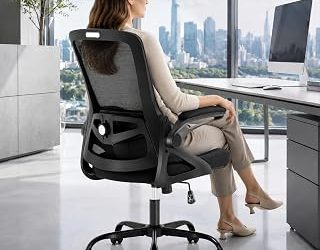
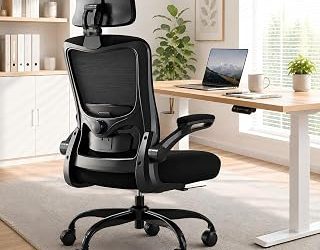
My pick for warm rooms and hot sleepers, since a breathable mesh back prevents the trapped heat that keeps core temperature elevated into the evening. The 4D flip-up arms, three-stage tilt, and adjustable headrest give you an unusual amount of postural fine-tuning at this price, and it’s rated to 400 lbs.
500lbs Extra-Wide Executive Chair
The extra-wide seat and thick armrest pads are the story — broader users get to sit squarely with their shoulders relaxed instead of narrowed and internally rotated, which is where most upper-back tension originates. A reinforced base and upgraded wheels make it feel stable rather than merely large.
Frequently Asked Questions
Can a desk chair really affect how well I sleep?
Indirectly but meaningfully. Prolonged poor seating produces hip flexor shortening and thoracic stiffness, and those restrictions don’t resolve the moment you stand up — they follow you into bed, where they drive position changes and micro-arousals. Better daytime posture usually shows up as fewer nighttime wake-ups within a couple of weeks.
Is mesh or cushioned upholstery better?
Mesh wins on airflow and is the smarter choice in a warm office or if you run hot. Cushioned seats — particularly pocket-spring designs — win on pressure distribution over very long sittings. If you sit more than six hours a day, prioritize the seat cushion; if your room is warm, prioritize the back.
Do I need a chair with a footrest or massage function?
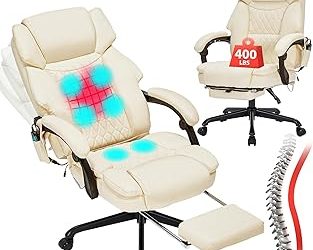
They’re comfort features, not clinical ones, but the footrest has real value: elevating your legs during a break aids venous return and eases the leg heaviness many desk workers feel at night. Vibration and heat, as found on the Massage Office Chair with Foot Rest, are pleasant for wind-down but shouldn’t substitute for movement.
How high should I set my chair?
Feet flat, knees at roughly 90 degrees or slightly open, hips level with or marginally above the knees, and elbows at desk height with shoulders down. If you have to raise the seat to reach the desk and your feet dangle, add a footrest rather than accepting the dangle.
Final Thoughts
If you want the best overall balance of pressure relief and durability, the 500lbs Big and Tall High Back Executive Chair with its pocket-spring cushion is where I’d start. Warm rooms and detail-oriented adjusters should go with the Ergonomic Mesh Office Chair, while broader-framed users who want room to sit square will get the most out of the 500lbs Extra Wide Executive Chair. Any of the three will do more for how you feel at 10 p.m. than you’d expect from a piece of office furniture.