Key takeaways
- Closable storage: Visible to-do piles act as cognitive cues that keep the nervous system in task mode. Drawers, doors, or a file cabinet let you shut the workday away in ten seconds — the single most useful feature for anyone working in a bedroom.
- Footprint versus room function: Measure the clearance behind your chair, not just the desktop. In small bedrooms, a desk that intrudes on the walking path to the bed makes the room feel like an office with a mattress in it.
- Portability or reversibility: Folding and reversible designs let you relocate or reorient a workstation seasonally. If you can carry the desk out of the bedroom on Friday, do.
- Surface material and light behavior: Matte wood and laminate scatter lamp light softly; glossy black tops bounce glare straight into your eyes during evening work, which does light-exposure timing no favors.
- Structural honesty: Look for solid wood, steel frames, or a certification such as BIFMA. A desk that wobbles trains you to brace your shoulders, and that low-grade muscular tension is something people carry into bed.
What's inside
Most desk guides talk about ergonomics and cable management. Almost none mention the thing I hear about every week in sleep consultations: the desk that lives eight feet from someone’s pillow. When a workspace bleeds into a bedroom, the brain stops filing that room under “rest” and starts filing it under “unfinished tasks.” Buyers feel this as vague evening restlessness, longer sleep onset, and the 11 p.m. urge to “just answer one email.” The desk itself is rarely blamed, but it is often the culprit.
This guide evaluates writing desks through a sleep-wellness lens as well as a furniture one. I looked at whether a desk can be visually closed down at the end of the day, whether it hides paperwork instead of broadcasting it, whether it can physically leave the room, and whether its surface and lighting habits encourage a hard stop rather than a slow drift into midnight work. Six current models are covered below, with buying criteria, reviews of the top five, and answers to the questions readers ask most.
As an Amazon Associate we earn from qualifying purchases.



🛒 Best Price Today on Amazon
Prime members get fast, free shipping on everything above, plus member-only deals. New members get a 30-day free trial — cancel anytime.
How to Choose a Writing Desk (2026)
- Closable storage: Visible to-do piles act as cognitive cues that keep the nervous system in task mode. Drawers, doors, or a file cabinet let you shut the workday away in ten seconds — the single most useful feature for anyone working in a bedroom.
- Footprint versus room function: Measure the clearance behind your chair, not just the desktop. In small bedrooms, a desk that intrudes on the walking path to the bed makes the room feel like an office with a mattress in it.
- Portability or reversibility: Folding and reversible designs let you relocate or reorient a workstation seasonally. If you can carry the desk out of the bedroom on Friday, do.
- Surface material and light behavior: Matte wood and laminate scatter lamp light softly; glossy black tops bounce glare straight into your eyes during evening work, which does light-exposure timing no favors.
- Structural honesty: Look for solid wood, steel frames, or a certification such as BIFMA. A desk that wobbles trains you to brace your shoulders, and that low-grade muscular tension is something people carry into bed.
The Best Writing Desks (2026) Reviewed
SEDETA Farmhouse 70.9″ Executive Desk
At nearly six feet with file drawers, a storage cabinet, and a built-in power outlet, this is the pick for anyone consolidating a scattered home office into one closable station. The integrated outlet is the quiet win for sleep hygiene: it gives phones and laptops a charging home that is not your nightstand.
Need 47″ Folding Desk
No assembly, BIFMA certification, and a frame that collapses flat make this the most sleep-friendly desk here in the literal sense — it can leave the bedroom entirely. Ideal for dorms, guest rooms, and anyone who wants work to be a temporary state of the room rather than a permanent one.
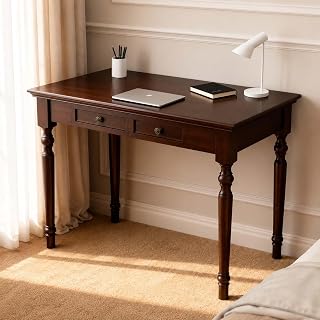
Solid Wood Vintage Writing Table, 45″ Walnut
A genuinely warm, low-visual-noise desk with drawers and a matte walnut finish that reads as bedroom furniture rather than office equipment. The 45-inch top is enough for a laptop and a notebook without inviting the sprawl of paperwork that keeps a room psychologically “open.”
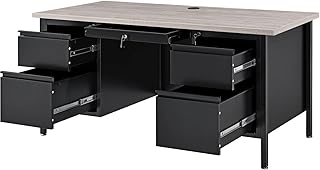
Global Industrial 60″ Steel Teacher’s Desk
Four locking box drawers and a double-pedestal steel build give this desk institutional durability and, more usefully, lockable closure — helpful for sensitive documents and for people who need work to be physically inaccessible after hours. It is heavy and utilitarian, so treat it as a dedicated-office choice, not a bedroom one.
Lufeiya 47″ Reversible Desk with File Cabinet
The reversible layout is the standout feature for awkward small rooms, letting you place the filing cabinet on whichever side keeps your walking path to the bed clear. The black finish is slightly reflective under direct lamp light, so pair it with a diffused, warm-toned task lamp.
Frequently Asked Questions
Is it really a problem to put a desk in the bedroom?
It is not automatically a problem, but it does raise the stakes. Sleep responds to consistent environmental cues, so the goal is a desk you can visually and functionally close at day’s end — closed drawers, chair tucked in, task lamp off.
How deep should a writing desk be?
Twenty to thirty inches suits most writing and laptop work. Deeper surfaces encourage clutter accumulation, which is the enemy of a room that needs to reset each night.
Does solid wood matter, or is laminate fine?
Quality laminate over engineered wood performs well and costs less. Solid wood earns its premium in longevity and in the matte, glare-free surface that makes evening work easier on the eyes.
Should my desk face the bed or the wall?
Face the wall or a window if possible. Working with your bed in your sightline blurs the boundary between rest and effort in both directions.
Final Thoughts
For a full-service home office that closes down cleanly, the SEDETA Farmhouse 70.9″ Executive Desk offers the best combination of storage and integrated power. In a bedroom or dorm, the Need 47″ Folding Desk is the smartest choice because it can simply be removed, while the Solid Wood 45″ Walnut Writing Table is the pick for anyone who wants a permanent desk that still lets the room read as a place for sleep.