Key takeaways
- Deployment method: Gravity-rise frames lift the saw into position in one motion with almost no bending, while folding leg stands take a few more seconds but pack flatter. If you are loading into a vehicle daily, prioritize the former; if the stand lives in a corner of a tight garage, the latter usually wins on storage footprint.
- Wheel diameter: Anything under six inches will stall on driveway expansion joints, gravel, and door thresholds. Larger wheels roll over debris instead of digging into it, which matters more than load rating for most homeowners.
- Usable material support: Look at the extended span, not the folded length. Roughly eight feet of supported material handles standard trim and most sheet-good rips; extension arms with adjustable rollers or flip stops let you repeat lengths without re-measuring.
- Mounting system: Universal rails and quick-release brackets mean you can swap saws later or lift the saw off for benchtop work. Proprietary-only mounting locks you into one brand and complicates resale.
- Onboard power and storage: Integrated outlets eliminate one extension cord run, and trays keep your square, pencil, and clamps off the floor. Small conveniences, but they are the difference between a stand you use and one that stays folded.
What's inside
Anyone who has tried to crosscut an eight-foot piece of baseboard on a pair of sagging sawhorses knows the feeling: the offcut drops, the piece rocks, and a joint that should have been invisible now needs caulk. A miter saw is only as accurate as the surface holding it. Without continuous, level support on both sides of the blade, your fence angle is fighting gravity, and repeat cuts drift by a sixteenth or more. The problem gets worse in a home shop, where the saw usually has to come out, get used, and disappear again before dinner.
That is exactly what a rolling miter saw stand solves. Wheels turn a 60-pound assembly into something one person can move alone, and a folding or gravity-assisted frame lets it live against a wall between projects. This guide covers the stands worth buying in 2026, what separates a genuinely rigid frame from a wobbly one, and which model makes sense depending on whether you are trimming out a whole house or building a single bookcase in a one-car garage.
As an Amazon Associate we earn from qualifying purchases.



🛒 Best Price Today on Amazon
Prime members get fast, free shipping on everything above, plus member-only deals. New members get a 30-day free trial — cancel anytime.
How to Choose a Miter Saw Stand With Wheels (2026)
- Deployment method: Gravity-rise frames lift the saw into position in one motion with almost no bending, while folding leg stands take a few more seconds but pack flatter. If you are loading into a vehicle daily, prioritize the former; if the stand lives in a corner of a tight garage, the latter usually wins on storage footprint.
- Wheel diameter: Anything under six inches will stall on driveway expansion joints, gravel, and door thresholds. Larger wheels roll over debris instead of digging into it, which matters more than load rating for most homeowners.
- Usable material support: Look at the extended span, not the folded length. Roughly eight feet of supported material handles standard trim and most sheet-good rips; extension arms with adjustable rollers or flip stops let you repeat lengths without re-measuring.
- Mounting system: Universal rails and quick-release brackets mean you can swap saws later or lift the saw off for benchtop work. Proprietary-only mounting locks you into one brand and complicates resale.
- Onboard power and storage: Integrated outlets eliminate one extension cord run, and trays keep your square, pencil, and clamps off the floor. Small conveniences, but they are the difference between a stand you use and one that stays folded.
The Best Miter Saw Stands With Wheels (2026) Reviewed
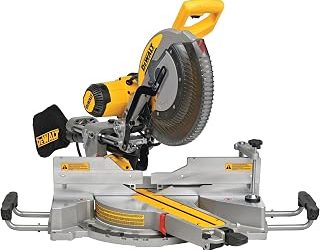
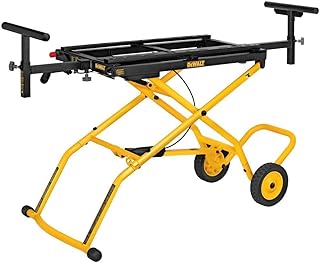
DEWALT DWX726 Rolling Miter Saw Stand
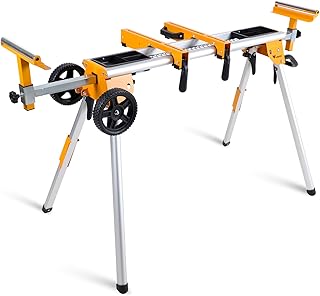
The steel frame and 8-foot material support make this the most versatile pick for anyone doing real trim work, and the adjustable-height legs let you dial in a comfortable cut line rather than accepting whatever the frame gives you. Universal mounting rails accept virtually any saw, which is why this stand tends to outlive the tool bolted to it.
BORA Portacube PM-8000
A different concept entirely: the rotating top turns the stand into a compact workbench, so your saw stows underneath and flips up when needed. For a shop where floor space is the scarcest resource, the dual-purpose design earns its footprint better than any single-task stand.
Bosch T4B Gravity-Rise Stand
The gravity-rise mechanism remains the smoothest deployment on the market, raising and lowering a mounted saw with a single handle pull and minimal back strain. Large pneumatic-style wheels handle rough jobsite ground, making this the choice if the stand travels more than it sits.
POWERTEC MT4000V Portable Stand
Quick-release brackets, a 330-pound capacity, and 8-inch wheels deliver most of the premium feature set at a mid-tier price, and the triple three-prong outlets are a genuinely useful addition. Fit and finish are a step below the DEWALT, but functionally it covers the same ground.
WEN MSA330 Collapsible Rolling Stand
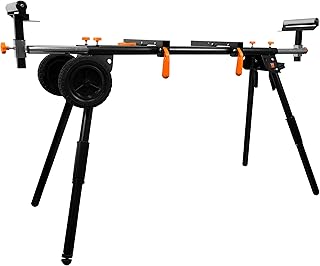
The value option, and an honest one: it collapses compactly, rolls easily, and includes three onboard outlets. Expect a bit more flex under heavy oak stock, but for occasional weekend furniture and trim projects it is more than adequate.
Frequently Asked Questions
Will any miter saw fit these stands?
Most models use universal mounting rails or adjustable brackets that accommodate the large majority of 10- and 12-inch saws, sliding or fixed. Always confirm your saw’s base footprint and bolt-hole spacing before ordering, since a few compact and oversized saws need adapter plates.
How much weight can a rolling stand actually hold?
Typical ratings run from 300 to 500 pounds, which comfortably covers the saw plus long stock. In practice, tipping resistance and leg splay matter more than the raw number, so keep heavy material centered and use the extension supports rather than cantilevering it.
Do I still need a separate outfeed table?
Usually not for trim and dimensional lumber. Once you are handling wide sheet goods or slabs, a stand’s narrow rails cannot replace a proper outfeed surface, so plan on a supplementary support for that work.
Is a gravity-rise stand worth the premium?
If you set up and break down frequently, yes; the time and back savings compound quickly. For a stand that stays parked in a garage and only occasionally rolls out, a folding-leg model at a lower price is the smarter buy.
Final Thoughts
For most readers, the DEWALT DWX726 is the safest recommendation: rigid, adjustable, and saw-agnostic enough to outlast several tools. Choose the Bosch T4B if your stand needs to travel and deploy quickly, or the BORA Portacube if you want a rolling stand that doubles as a workbench in a space-constrained shop. Budget-focused buyers will be well served by the WEN MSA330.