Key takeaways
- Blade length first: Measure your existing blade or check the saw’s manual — a 70-1/2″ blade will not stretch onto a 93-1/2″ machine. Common lengths are 70-1/2″ and 72″ for 10″ saws, 93-1/2″ for 14″ saws, 111″ for 17″–18″ saws, and 131-1/2″ for larger industrial frames.
- Go as wide as your saw allows: Width resists deflection, and deflection is what causes barreled cuts. A 1/2″ blade is the practical ceiling on most benchtop saws; 3/4″ is ideal on any machine with the tensioning power to handle it.
- Low tooth count, big gullets: Aim for 2–4 TPI. Resawing produces a long, continuous chip, and if the gullet fills before the tooth exits the cut, the blade starts burnishing instead of cutting. Fine-pitch blades belong in thin stock, not 8-inch hardwood.
- Carbon steel versus carbide: Silicone-steel and SK5 carbon blades are inexpensive and cut beautifully when fresh, making them right for occasional resawing. Carbide-tipped blades cost several times more but survive figured hardwood, exotics, and reclaimed lumber for dozens of hours.
- Check your tension range: Low-tension designs are engineered to track true at pressures a lightweight frame can actually reach. If your saw struggles to tension a 3/4″ blade, a purpose-built low-tension blade will outperform a stiffer one you can’t properly load.
What's inside
Resawing is where band saws either prove their worth or reveal their limits. Slicing a 6-inch board of hard maple down the middle sounds simple until the cut wanders, the blade drifts off the fence line, and what should have been two book-matched panels becomes a barrel-shaped mess you have to plane away. Nine times out of ten, the saw isn’t the problem. The blade is. Too many teeth, too little tension capacity, or a gullet too shallow to clear a long ribbon of dust, and even a well-tuned 14-inch saw will fight you the whole way through.
This guide focuses specifically on blades built for deep vertical cuts in solid wood — wide bodies, low tooth counts, aggressive gullets, and steel or carbide that stays sharp long enough to justify the setup time. Below you’ll find the standouts for 2026 across every common wheel size, from compact 10-inch benchtop saws through 18-inch cast-iron machines, plus a short buying framework so you can match blade length, width, and tooth pitch to the saw already sitting in your shop.
As an Amazon Associate we earn from qualifying purchases.



🛒 Best Price Today on Amazon
Prime members get fast, free shipping on everything above, plus member-only deals. New members get a 30-day free trial — cancel anytime.
How to Choose a Band Saw Blade For Resawing (2026)
- Blade length first: Measure your existing blade or check the saw’s manual — a 70-1/2″ blade will not stretch onto a 93-1/2″ machine. Common lengths are 70-1/2″ and 72″ for 10″ saws, 93-1/2″ for 14″ saws, 111″ for 17″–18″ saws, and 131-1/2″ for larger industrial frames.
- Go as wide as your saw allows: Width resists deflection, and deflection is what causes barreled cuts. A 1/2″ blade is the practical ceiling on most benchtop saws; 3/4″ is ideal on any machine with the tensioning power to handle it.
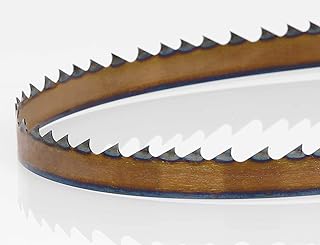
- Low tooth count, big gullets: Aim for 2–4 TPI. Resawing produces a long, continuous chip, and if the gullet fills before the tooth exits the cut, the blade starts burnishing instead of cutting. Fine-pitch blades belong in thin stock, not 8-inch hardwood.
- Carbon steel versus carbide: Silicone-steel and SK5 carbon blades are inexpensive and cut beautifully when fresh, making them right for occasional resawing. Carbide-tipped blades cost several times more but survive figured hardwood, exotics, and reclaimed lumber for dozens of hours.
- Check your tension range: Low-tension designs are engineered to track true at pressures a lightweight frame can actually reach. If your saw struggles to tension a 3/4″ blade, a purpose-built low-tension blade will outperform a stiffer one you can’t properly load.
The Best Band Saw Blade For Resawings Reviewed
Timber Wolf 3423VPC 93.5″ x 3/4″ Low Tension Resaw Blade
The benchmark blade for 14-inch saws, and deservedly so — the silicone steel body and variable-pitch tooth geometry cut quietly and track straight at tension levels a stock cast-iron saw can genuinely achieve. If you resaw a few times a month and want clean, glue-ready faces without buying carbide, start here.
Dark Stone 111″ Carbide-Tipped Resaw Blade (3/4″ x 2 TPI)
Built for 17-inch and 18-inch saws, this hook-tooth carbide blade shrugs off white oak, hard maple, and abrasive reclaimed stock that would dull carbon steel in an afternoon. Feed pressure stays consistent cut after cut, which is exactly what you want when you’re slicing veneer at consistent thickness.
Dark Stone 131-1/2″ Carbide-Tipped Resaw Blade (3/4″ x 2 TPI)
The same carbide tooth package on a longer, 0.032″-gauge body sized for larger production frames. At this length you’re typically resawing wide slabs, and the thin gauge keeps kerf loss and material waste down across long rip cuts.
AYAO 70-1/2″ x 1/2″ 4 TPI Hardened Teeth Blade
A sensible, affordable upgrade for Craftsman 921400 and Rikon 10-305/10-306 owners who are tired of the blade that shipped with the saw. The 1/2″ width is about as much as a 10-inch machine can tension properly, and the hardened teeth hold an edge far longer than budget alternatives.
93-1/2″ SK5 Carbon Steel Assortment (4-Pack)
Two 1/2″ 6 TPI blades plus 1/4″ and 1/8″ options make this the smart buy for a 14-inch saw that does a bit of everything. The 6 TPI pitch is happiest in stock under about 4 inches, so treat it as a versatile starter set rather than a dedicated deep-resaw solution.
Frequently Asked Questions
What TPI is best for resawing?
Two to three TPI for stock over 4 inches tall, and up to 4 TPI for shallower cuts or smaller saws. The old rule of keeping at least three teeth in the workpiece still applies, but in deep cuts chip clearance matters more than tooth count.
Do I need a carbide blade?
Only if you resaw regularly or work with dense, figured, or abrasive material. A carbon steel blade cuts just as cleanly when new — carbide simply stays that way ten to fifteen times longer, which pays off over time but not for occasional use.
Will a 3/4″ blade fit my 10-inch band saw?
Almost certainly not. Small saws lack both the throat clearance and the tensioning capacity for 3/4″ stock. Stick with 1/2″, such as the AYAO blades sized for Craftsman, Rikon, and Wen 10-inch machines.
Why does my blade drift even with a new blade?
Insufficient tension, worn guide bearings, or a fence set parallel to the miter slot rather than to the blade’s natural drift angle. Test-cut a scrap, mark the drift, and angle your resaw fence to match it.
Final Thoughts
For most home furniture makers running a 14-inch saw, the Timber Wolf 3423VPC delivers the best balance of cut quality, price, and forgiveness on a lightly tensioned machine. Step up to the Dark Stone 111″ carbide-tipped blade if you resaw hardwood weekly and want to stop changing blades mid-project, and choose the AYAO 70-1/2″ x 1/2″ if a compact benchtop saw is what you’re working with.