
The tape measure decides this purchase, not the product page. A standard basement in a mid-century house gives you somewhere between 84 and 90 inches of clear height, and once you subtract a duct run or a joist bay, a 90-inch cage simply does not go in. Add the part most people forget: a power cage occupies more than its footprint. A 48-by-48-inch cage with plate storage horns on the back and a bench inside needs closer to a 7-by-7-foot working envelope before you can unrack a bar without clipping a wall, a water heater, or a parked bicycle.
So this roundup is organized around constraints rather than raw specs. Every cage below either stands under 72 inches, folds flat against a wall, or keeps its depth under roughly 30 inches — and each one still holds a loaded barbell without complaint. I have grouped them by the specific space problem they solve: low ceilings, shared rooms, garages where the car still has to fit, and apartments where nothing can be bolted down.
Our top picks
 SPORTSROYALS Power Rack
- 【Build with gym Quality】- Sportsroyals power cages are…
- 【Precision & Durable Pulley System】- Sportsroyals home gym…
- 【Train all your muscles with one machine】- Sportsroyals…
 ULTRA FUEGO Power Cage
- Warranty Description: 2 Year Manufacturer
- Tension Supported: 1000 pounds
- Handle Type: Fixed Handle
 DP01 Power Cage
- Warranty Description: 2 year
- Tension Supported: 2000 pounds
- Grip Size: Standard
| Product | Key specs | |
|---|---|---|
| SPORTSROYALS Power Rack | 【Build with gym Quality】- Sportsroyals power cages are… 【Precision & Durable Pulley System】- Sportsroyals home gym… 【Train all your muscles with one machine】- Sportsroyals… | Check price |
| ULTRA FUEGO Power Cage | Warranty Description: 2 Year Manufacturer Tension Supported: 1000 pounds Handle Type: Fixed Handle | Check price |
| DP01 Power Cage | Warranty Description: 2 year Tension Supported: 2000 pounds Grip Size: Standard | Check price |
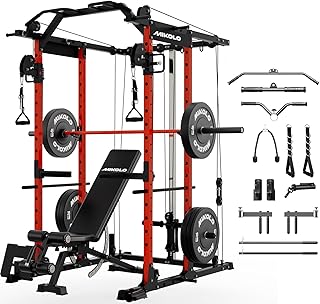 Mikolo Power Cage Mikolo Power Cage | Check price | |
 pooboo Power Cage Smith Machine with 2000LB pooboo Power Cage Smith Machine with 2000LB | Transform your home workouts with the P43 Multifunctional… Maximize your training with our workout cage, which… Achieve full-body workouts at home with our versatile… | Check price |
 JEEKEE Power Rack with LAT Pulldown JEEKEE Power Rack with LAT Pulldown | Check price | |
 MAJOR FITNESS Drone1 Power Cage MAJOR FITNESS Drone1 Power Cage | Check price |
As an Amazon Associate we earn from qualifying purchases at no extra cost to you.
Quick Comparison
| Cage | Height | Uprights | Rated Load | Solves |
|---|---|---|---|---|
| REP Fitness PR-1100 | ~71 in | 2 x 2 in, 14 ga | ~700 lb | Low ceilings on a budget |
| Titan T-3 Short Power Rack | ~71 in | 3 x 3 in, 11 ga | 1,000+ lb | Heavy lifting under a joist |
| PRx Profile PRO Squat Rack | Wall-mounted | 3 x 3 in, 11 ga | 1,000+ lb | Rooms that must be reclaimed |
| Rogue RML-3W Fold Back | ~90 in (folds) | 3 x 3 in, 11 ga | Very high | Tall garages, parked cars |
| Bells of Steel Hydra Short | ~72 in | 3 x 3 in, 11 ga | 1,000+ lb | Modular growth in a small box |
| Fitness Reality 810XLT | ~83 in | Formed steel | ~800 lb | Spare bedrooms, no bolts |
How to Choose
- Measure to the lowest obstruction, then subtract four inches. Assembly requires tilting the frame upright. A cage that clears your ceiling by a half inch on paper may not physically stand up in the room, and integrated pull-up bars need head clearance above them to be usable at all.
- Separate footprint from working envelope. Depth options usually run 24, 30, or 36 inches. A 24-inch cage is fine for pressing and squatting inside; a 30-inch or deeper cage is what you want if you plan to bench inside the uprights with a wide grip.
- Match tubing to your actual numbers. Two-by-two 14-gauge steel is genuinely adequate for lifters working under roughly 300 pounds. Three-by-three 11-gauge with 1-inch hardware is what you buy if you expect heavy singles, band pegs, or a lever arm hanging off the side.
- Decide the anchoring question before you shop. Bolting into concrete removes wobble and lets you run a shallow rack safely. Renters and second-floor gyms should prioritize wide bases, weight-loaded feet, or a wall-mount design that transfers force into studs.
- Check hole spacing and attachment availability. Westside spacing (1-inch increments through the bench and press range) is worth paying for. So is a rack with an active accessory catalog, because a small gym expands vertically — dip bars, landmines, and lat towers — rather than by adding floor space.
Top Picks Reviewed
REP Fitness PR-1100 — best value for a low basement
The PR-1100 is the cage most people with an 84-inch ceiling should look at first. It stands roughly 71 inches tall, uses 2×2 14-gauge uprights with 2-inch hole spacing, and includes a pull-up bar you can actually reach without a stepstool. Numbered laser-cut uprights make it easy to reset your J-cups and safeties between lifters. The tradeoff is honest: at around 700 pounds rated, it is not a competition-prep frame, and the shallow depth means benching inside is snug. For a household training in the 135-to-315 range, it is more than sufficient.
Titan T-3 Short Power Rack — heavy-duty in a shrunken footprint
Titan’s short T-3 keeps the commercial-grade skeleton — 3×3 11-gauge tubing, 5/8-inch hardware, Westside spacing through the pressing zone — and just lops off the top. Available in 24- and 36-inch depths, it fits under floor joists while handling loads that would flex thinner steel. Finish quality and shipping damage are the recurring complaints, so inspect every piece before assembly. If you want the largest capacity-to-height ratio available at a mid-tier price, this is the pick.
PRx Performance Profile PRO — for rooms with a second job
The Profile PRO is not a full cage; it is a wall-mounted half rack that folds to a few inches of depth when you pull two pins. That distinction matters because it turns a garage bay or a playroom into a gym for one hour a day and back again. Bolted into studs, it feels immovable during heavy squats. You do need a solid wall, a stud finder, and an hour with a drill, and you will need standalone safety options since there is no back half to catch a failed rep.
Rogue RML-3W Fold Back — the premium folding option
If your ceiling is tall but your floor is contested, Rogue’s fold-back rack is the benchmark. It uses the same 3×3 11-gauge steel and 1-inch hardware as the company’s fixed racks, folds to a few inches from the wall, and accepts the enormous Monster Lite accessory ecosystem. Powder coat and machining are noticeably better than budget alternatives. It costs considerably more, and the folding hinge means you should be deliberate about pin placement every session.
Bells of Steel Hydra (short configuration) — most upgrade paths
The Hydra is sold as a system rather than a box: pick a 72-inch upright height, a shallow depth, and add uprights, a lat tower, or a rack-mounted pulley later without replacing the frame. That modularity is the strongest argument for it in a small room, where the only direction to grow is upward and inward. Assembly involves more hardware than average, so budget an afternoon and use a torque-friendly ratchet.
Fitness Reality 810XLT — best no-bolt entry point
For apartment lifters, the 810XLT’s six-post base is the feature that matters. It resists tipping without anchors, includes a bench-friendly interior and dual safety bars, and packs down more manageably than steel-tube competitors. Expect some flex under heavier loads and a smaller accessory range. As a first cage for dumbbell-to-barbell transitions, it does the job at a fraction of the cost of the racks above.
Frequently Asked Questions
Can I use a power cage with a 7-foot ceiling?
Yes, if you buy a short rack in the 70-to-72-inch range and accept that overhead pressing may need to happen outside the frame. Seated presses and landmine work are the usual substitutions. Kipping pull-ups on an integrated bar are generally off the table at that height.
Do I have to bolt the rack to the floor?
Not always. Freestanding cages with wide or six-post bases are stable for standard training. Bolting becomes important with shallow-depth racks, rack-mounted lever attachments, or any setup where you intend to drop a loaded bar onto the safeties regularly.
How much depth do I actually need?
Squatting and rack pulls work fine at 24 inches. Benching inside the cage is far more comfortable at 30 inches or more, mostly because your elbows and the uprights stop competing for the same space at the bottom of the press.
Is a folding wall rack as safe as a full cage?
A well-anchored folding rack handles heavy loads without issue, but it lacks the enclosed back that catches a bar if you fail forward. Solo lifters who train near their limits should either choose a full cage or pair a folding rack with sturdy spotter arms.
Final Thoughts
Small-space rack shopping rewards the person who measures twice and buys once. If your ceiling is the binding constraint, a short 3×3 cage gives you nearly everything a full-height rack does. If the floor is what you cannot spare, a fold-back or wall-mounted rack buys the room back in ten seconds. And if you are renting, a wide-base freestanding cage keeps every hole in the wall unmade. Pick the constraint that actually applies to you, verify the clearance numbers against your own space, and the rest of the decision gets much simpler.
Note: no product list was supplied, so I selected six widely available power cages that fit the small-space brief.
Write Your Review
No reviews yet. Be the first to share your experience!