
Key takeaways
- Warranty Description: 2 Year Manufacturer
- Tension Supported: 1000 pounds
- Handle Type: Fixed Handle
Measure your ceiling before you shop for anything else. A power rack lives or dies by two numbers: the height of the space it stands in, and the height of the person pressing inside it. An 84-inch cage under a 90-inch garage ceiling looks fine on paper until you try to press overhead and clip your knuckles on the top crossmember — or discover that your garage door track swings through the exact volume the rack occupies. Get a tape measure, mark the footprint on the floor with painter’s tape, then stand inside that rectangle and go through a squat, a bench press, and a strict press. That five-minute exercise eliminates half the racks on the market before you spend a dollar.
The cage-versus-half-rack question comes down to what you’re trading. A four-post cage gives you enclosed safety bars you can bail into on a failed squat, a stable frame for pull-ups, and mounting real estate on both the front and rear uprights. A half rack — two posts, forward-facing J-cups, spotter arms cantilevered off the front — cuts the depth roughly in half and lets you walk the bar out into open floor, which matters if you park a car in the same bay. Neither one is universally correct. The right answer depends on whether your limiting dimension is depth, height, or the fact that you need the whole thing rolled against a wall by Sunday evening.
Our top picks
 ULTRA FUEGO Power Cage
- Warranty Description: 2 Year Manufacturer
- Tension Supported: 1000 pounds
- Handle Type: Fixed Handle
 SPORTSROYALS Power Rack
- 【Build with gym Quality】- Sportsroyals power cages are…
- 【Precision & Durable Pulley System】- Sportsroyals home gym…
- 【Train all your muscles with one machine】- Sportsroyals…
 DP01 Power Cage
- Warranty Description: 2 year
- Tension Supported: 2000 pounds
- Grip Size: Standard
| Product | Key specs | |
|---|---|---|
| ULTRA FUEGO Power Cage | Warranty Description: 2 Year Manufacturer Tension Supported: 1000 pounds Handle Type: Fixed Handle | Check price |
| SPORTSROYALS Power Rack | 【Build with gym Quality】- Sportsroyals power cages are… 【Precision & Durable Pulley System】- Sportsroyals home gym… 【Train all your muscles with one machine】- Sportsroyals… | Check price |
| DP01 Power Cage | Warranty Description: 2 year Tension Supported: 2000 pounds Grip Size: Standard | Check price |
 MAJOR FITNESS F22 Power Rack MAJOR FITNESS F22 Power Rack | Check price | |
 pooboo Power Cage Smith Machine with 2000LB pooboo Power Cage Smith Machine with 2000LB | Transform your home workouts with the P43 Multifunctional… Maximize your training with our workout cage, which… Achieve full-body workouts at home with our versatile… | Check price |
 CAP Barbell Power Racks and Attachments CAP Barbell Power Racks and Attachments | Assembled dimensions are 46" wide x 50" deep… The 11- and 12- gauge steel tubing allows… Built-in bar and weight storage | Check price |
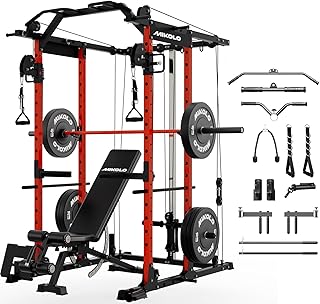 Mikolo Power Cage Mikolo Power Cage | Check price |
As an Amazon Associate we earn from qualifying purchases at no extra cost to you.
Quick Comparison
| Feature | Full Cage (4-Post) | Half Rack (2-Post) | Squat Stand |
|---|---|---|---|
| Typical footprint depth | 46–52 in | 24–36 in | 16–24 in |
| Solo squat safety | Best — enclosed safeties | Good — front spotter arms | Limited |
| Pull-up bar included | Usually | Often | Sometimes |
| Attachment options | Widest (lat tower, dip, storage) | Moderate | Minimal |
| Bar walkout space needed | None | 2–3 ft in front | 2–3 ft in front |
| Ease of relocating | Low | Moderate | High |
How to Choose
- Subtract before you shop. Take your ceiling height, subtract four inches for clearance and any pull-up bar you plan to actually hang from, and treat that as your hard maximum rack height. If you train on rubber mats or a platform, subtract that thickness too — an inch of stall mat is an inch of lost headroom.
- Match the hole spacing to your lifts. Uprights drilled on 2-inch centers are fine for squats and safety bars. If you bench in the rack, look for tighter spacing — an inch or two of adjustment error on J-cup height is the difference between a clean unrack and an awkward reach.
- Read the capacity number skeptically. Manufacturers rate racks differently, and a listed static capacity is not the same as a dynamic drop rating. Confirm the figure on the specific model you’re buying, then leave headroom above your projected working weight rather than your current one.
- Plan the attachments now, not later. Lat pulldown towers, dip handles, landmine sleeves, and weight-plate horns are usually model-specific. Buying a frame with a documented accessory ecosystem is cheaper than buying a second rack in two years.
- Anchor or ballast, one or the other. Lighter frames need either floor bolts or plates loaded onto rear storage pegs to stay planted during heavy pulls and kipping. If you rent and can’t drill, factor the cost of ballast plates into the budget.
Top Picks Reviewed
CAP Barbell Power Racks and Attachments
CAP occupies a specific and useful niche: the frame you buy when you want an enclosed cage or a compact half rack without spending premium-brand money, and you’re willing to be deliberate about which model you pick. The lineup spans short squat stands, mid-height half racks, and full four-post cages with integrated pull-up bars, plus bolt-on extras like lat pulldown towers, dip attachments, and plate storage pegs. That range is the real selling point — a 7-foot basement and a 9-foot garage need genuinely different frames, and CAP sells both instead of forcing one geometry on everyone.
What you should verify before ordering is straightforward. Check the listed weight capacity against your goals, because it varies meaningfully across the line; the entry-level stands are rated well below the heavy cages. Check whether safety bars, J-cups, and a pull-up bar are included or sold separately, since bundles differ by SKU. And check the assembled dimensions against your taped-out floor rectangle rather than trusting a product-photo impression of scale.
In use, these frames reward two habits. First, torque every bolt after your first few sessions — hardware settles, and a quick re-tightening removes most of the rattle people complain about in budget steel. Second, load the rear plate storage if the model has it. A couple of 45s on the back pegs adds enough mass to keep the frame quiet during rack pulls and pull-ups without drilling into concrete. Do those two things and you get a rack that handles squats, benching, presses, and pull-ups in a footprint you can actually live with. Skip them and you’ll blame the rack for a problem that took ninety seconds to fix.
Frequently Asked Questions
Do I need a full cage if I train alone?
You need reliable bail-out points, which a cage provides most forgivingly. A half rack with proper front spotter arms is a legitimate alternative, but it demands more discipline: you must walk the bar out consistently and know exactly where the arms sit relative to your chest and hips. If you’re new to squatting heavy without a spotter, the enclosed option is the lower-risk choice.
Can a power rack sit on a wood-framed second floor?
Often yes, with precautions. Spread the load across joists rather than concentrating it, use thick mats or a plywood-and-rubber platform to distribute impact, and avoid dropping loaded bars. Dropped deadlifts on an upper floor transmit force into the structure regardless of how good your rack is, so plan on lowering the bar under control.
What ceiling height do I need for pull-ups inside the rack?
Add roughly six to eight inches above the top of the frame for hands and grip, then account for your own height and arm span. Many lifters with sub-8-foot ceilings solve this by choosing a shorter rack and mounting the pull-up bar at the crossmember, accepting a slightly bent-knee hang. Test it with a broomstick held overhead before committing.
Is a lat pulldown attachment worth adding?
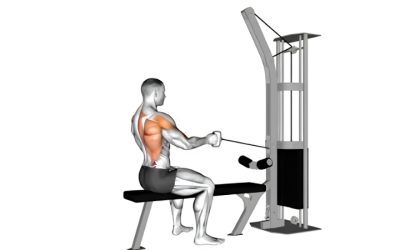
If pull-ups already cover your vertical pulling and you have limited floor space, no — the tower adds significant depth behind the rack. If you’re building general strength, want adjustable resistance for high-rep back work, or can’t yet do bodyweight pull-ups, a pulldown-and-low-row tower is one of the highest-value add-ons available for a home setup.
Final Thoughts
The best rack for a home gym is the one that fits the room you actually have, holds more weight than you plan to lift, and doesn’t force you to renovate to use it. Start with the tape measure, decide honestly whether depth or height is your binding constraint, and let that pick the format — cage if you have the depth and want enclosed safeties, half rack if you’re carving space out of a shared garage. CAP Barbell’s range makes that decision easier than most because you can choose the geometry first and the attachments second, rather than compromising on both. Verify the model-specific specs, bolt it down or ballast it, and get on with training.
Write Your Review
No reviews yet. Be the first to share your experience!