Key takeaways
- Color temperature: Stay at or below 2700K for any fixture used in the evening. 2500K options are warmer still and closer to firelight, which is the least melatonin-disruptive light you can put overhead.
- Dimming quality, not just dimmability: Almost every LED claims to dim. What matters is whether it holds a steady, warm glow at 10 percent output instead of buzzing, stepping, or cutting out. Check that the bulb lists compatibility with your specific dimmer type.
- Base and shape: E12 candelabra is the standard chandelier base. B11 and B10 are slim torpedo shapes, CA10 is the bent flame tip. Shape is purely aesthetic, so match what your fixture was designed around.
- Flicker and light quality: Low-frequency flicker is invisible to most people but is associated with eye strain and headaches during long exposure. Filament-style LEDs from established sellers generally perform better here than cheap frosted plastic bulbs.
- Lumens per bulb, multiplied: A six-arm chandelier with 460-lumen bulbs delivers nearly 2,800 lumens. That is a lot of light overhead. Buy lower-output bulbs than you think you need and let the dimmer do the rest.
What's inside
Most people shopping for chandelier bulbs are solving a decorating problem. As someone who spends their working life on sleep quality, I’d argue you’re actually solving a circadian one. A dining room or entryway chandelier is often the brightest fixture in the house, and it tends to be switched on during the exact window — roughly two to three hours before bed — when your body is trying to release melatonin. Get the color temperature and dimming behavior wrong, and a beautiful fixture quietly pushes your bedtime later, night after night.
The good news: the specs that make a bulb kind to your sleep are the same ones that make a chandelier look expensive. Warm filament light, smooth low-end dimming, and no visible flicker all read as “candlelit” to the eye and as “evening” to the brain. This guide breaks down what to look for in 2026, then reviews the strongest candelabra bulbs available right now — clear-glass filament LEDs for efficiency, plus one incandescent option for purists who want the warmest possible glow.
As an Amazon Associate we earn from qualifying purchases.


🛒 Best Price Today on Amazon
Prime members get fast, free shipping on everything above, plus member-only deals. New members get a 30-day free trial — cancel anytime.
How to Choose a Bulb For Chandelier (2026)
- Color temperature: Stay at or below 2700K for any fixture used in the evening. 2500K options are warmer still and closer to firelight, which is the least melatonin-disruptive light you can put overhead.
- Dimming quality, not just dimmability: Almost every LED claims to dim. What matters is whether it holds a steady, warm glow at 10 percent output instead of buzzing, stepping, or cutting out. Check that the bulb lists compatibility with your specific dimmer type.
- Base and shape: E12 candelabra is the standard chandelier base. B11 and B10 are slim torpedo shapes, CA10 is the bent flame tip. Shape is purely aesthetic, so match what your fixture was designed around.
- Flicker and light quality: Low-frequency flicker is invisible to most people but is associated with eye strain and headaches during long exposure. Filament-style LEDs from established sellers generally perform better here than cheap frosted plastic bulbs.
- Lumens per bulb, multiplied: A six-arm chandelier with 460-lumen bulbs delivers nearly 2,800 lumens. That is a lot of light overhead. Buy lower-output bulbs than you think you need and let the dimmer do the rest.
The Best Chandelier Bulbs of 2026, Reviewed
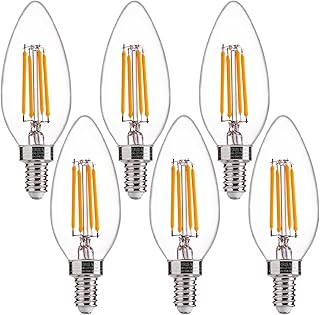
60W Equivalent Clear B11 LED Filament Candelabra Bulbs, 6-Pack
The most versatile pick here: genuine 60W-equivalent brightness in a clear B11 filament body, with 2700K warmth that never tips orange. Best suited to larger fixtures or open-plan rooms where you need real illumination for dinner, then a deep dim afterward.
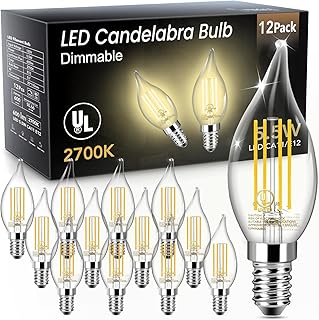
E12 Flame Tip Candle Bulbs, 4W 460 Lumen, 12-Pack
The flame-tip silhouette is the traditional choice for period fixtures, and at 460 lumens per bulb this is a sensible output for a multi-arm chandelier. The twelve-pack pricing makes it easy to replace every bulb at once, which is worth doing — mixing old and new bulbs is the fastest way to get uneven color across a fixture.
COLWATT 12-Pack Candelabra Bulbs, 2500K, CA10
My preferred option for evening-heavy rooms. At 2500K and 380 lumens, these sit meaningfully warmer and dimmer than the standard 2700K field, which makes them the most sleep-friendly LED on this list. The CA10 clear glass also suits ceiling fans and pendants, and they’re rated for damp outdoor use.
12-Pack Dimmable B11 Vintage Filament Bulbs, 450 Lumens
A well-balanced middle option: 4W, 450 lumens, 2700K, clear glass, and a straight B11 profile that disappears into modern fixtures. Reliable dimming performance is the standout, holding a stable warm output well into the low end of the dial.
E12 B10 Edison Filament Bulbs, 470 Lumens, 5-Pack
The exposed Edison-style filament is the most decorative choice here, ideal for fixtures where the bulb itself is meant to be seen. The five-pack suits smaller chandeliers or anyone testing the look before committing to a full set.
Frequently Asked Questions
Does chandelier lighting really affect sleep?
Bright, cool overhead light in the evening suppresses melatonin and delays your internal clock. Because chandeliers sit high and shine into the eye from above, they influence circadian signaling more than a table lamp of the same wattage.
Are 2500K bulbs too dim for a dining room?
Not with a full set. Six 380-lumen bulbs produce plenty of usable light for dining. The warmth reads as intimate rather than dark.
Should I choose LED or incandescent?
LED wins on cost, heat, and lifespan. Incandescent still wins on dimming smoothness and warmth, which is why the MEQIQTEK E12 60W Incandescent Candle Bulbs remain a legitimate choice for a rarely used formal fixture.
Why do my LEDs buzz when dimmed?
Almost always a dimmer mismatch. Older leading-edge dimmers were built for incandescent loads; a trailing-edge or LED-rated dimmer resolves the noise in most cases.
Final Thoughts
For most homes, the COLWATT 2500K 12-Pack is the smartest buy — warm enough to protect your evening wind-down without looking gloomy. Choose the 60W Equivalent Clear B11 Filament 6-Pack if your fixture is the main light source in a large room, or the MEQIQTEK Incandescent 12-Pack if you want the most forgiving dim of all in a formal space you light only occasionally.